
How to Avoid Misleading Food Labels: A Guide to Clear and Accurate Label Design
Food labels play an important role in helping consumers understand what they are buying. Product names, ingredient lists, nutrition information, allergen declarations, claims, images, and other packaging elements all contribute to the way a food product is perceived.
For food brands, creating an effective label is therefore about more than making packaging attractive. The information needs to be accurate, easy to understand, and presented clearly.
A food label can potentially create confusion when wording, images, layout, or other design elements give consumers an impression that does not accurately reflect the product. In some markets, specific labeling and advertising claims are also subject to regulatory requirements.
The good news is that many potential problems can be reduced through careful content review, thoughtful label design, and appropriate material and printing choices.
This guide explains common food labeling issues, how businesses can improve label clarity, and what to consider when producing custom food labels.
What Makes a Food Label Misleading?
A food label may become misleading or confusing when the information presented does not accurately communicate the characteristics of the product.
Importantly, misleading communication is not always caused by an obviously false statement. The overall presentation can also influence consumer expectations.
For example, consumers may form an impression based on the combination of:
- Product claims
- Ingredient images
- Product names
- Colors and graphics
- Nutrition information
- Ingredient lists
- Allergen information
- Typography and layout
- The relative prominence of different elements
In the United States, the FDA regulates food labeling and distinguishes between different types of claims, including nutrient content claims and health claims. Businesses should review the requirements applicable to their specific products and claims before finalizing label content.
The following table summarizes some common issues brands should review before printing.
Common Food Labeling Issues to Watch For
| Potential Issue | What Consumers May Understand | What Brands Should Check |
|---|---|---|
| Ambiguous claims | The product provides a particular nutritional or health benefit | Verify that claims are accurate and applicable to the product |
| Product imagery | A pictured ingredient is a major component of the product | Make images consistent with the actual product |
| Unclear ingredient information | Important ingredients may be overlooked | Use readable typography, spacing, and organization |
| Hard-to-find allergen information | Allergen information may be difficult to identify | Follow applicable allergen-labeling requirements |
| Poor readability | Important information may be missed | Review font size, contrast, spacing, and layout |
| Confusing visual hierarchy | Promotional information may appear more important than essential information | Organize information into logical sections |
| Outdated information | The label may not reflect the current product | Review artwork when ingredients, claims, or specifications change |
A useful principle is simple:
A food label should communicate what the product is, what it contains, and what consumers can reasonably expect from it as clearly as possible.
7 Common Food Labeling Issues to Avoid
1. Ambiguous or Unsupported Claims
Words such as “natural,” “healthy,” “low fat,” “high protein,” and “no added sugar” can influence how consumers perceive a product.
However, some claims have specific regulatory requirements depending on the market and product category. In the United States, for example, FDA provides specific guidance on nutrient content claims and health claims.
Before putting a claim on a food label, brands should ask:
- Is the statement factually accurate?
- Does the product meet any applicable requirements for the claim?
- Could consumers reasonably interpret the wording differently from what the business intends?
- Does the rest of the package support the same message?
- Has the claim been reviewed for the target market?
The goal is not simply to make a product sound attractive. The goal is to communicate its characteristics accurately.
2. Misleading Product Images
Images can be just as influential as words.
A package featuring large images of strawberries, blueberries, almonds, chocolate, or other ingredients can create strong expectations about the product.
That does not mean food packaging should avoid attractive imagery. Instead, visual elements should be consistent with the actual product and its positioning.
Brands should review whether:
- The images accurately represent the product.
- Ingredient imagery is consistent with the product’s composition.
- The overall design could create an unrealistic expectation.
- Supporting text provides sufficient context where necessary.
The key consideration is the overall impression created by the package rather than any single visual element.
3. Unclear Ingredient Information
Ingredient information is one of the most practical parts of a food label.
Even when the information is technically correct, poor design can make it difficult for consumers to read or understand.
Common problems include:
- Very small text
- Insufficient contrast
- Excessive text density
- Poor spacing
- Inconsistent alignment
- Decorative backgrounds behind text
- Information placed in difficult-to-read areas
A well-designed ingredient section should prioritize clarity over decoration.
4. Incomplete or Hard-to-Find Allergen Information
Allergen information deserves particular attention because some consumers rely on food labels to identify ingredients that may pose a health risk.
For packaged foods in the United States, federal requirements address the declaration of major food allergens. FDA currently identifies nine major food allergens: milk, egg, fish, Crustacean shellfish, tree nuts, wheat, peanuts, soybeans, and sesame.
Businesses should review the applicable requirements for their products and market.
From a design perspective, required allergen information should also remain readable and easy to locate.
This is a good example of why content accuracy and label design need to work together.
5. Confusing Nutrition Information
Nutrition information can become difficult to use when the label contains too many competing visual elements.
For example, a package may contain:
- A large product image
- Multiple promotional claims
- Brand messaging
- Certifications
- Marketing copy
- Nutrition information
- Ingredient information
If all of these elements receive similar visual emphasis, consumers may have difficulty finding the information they need.
A clear information hierarchy can help.
A typical hierarchy might look like:
Brand → Product Name → Key Product Information → Claims → Ingredients & Nutrition → Additional Information
The exact structure depends on the product and applicable requirements, but the principle remains the same: important information should be easy to find.
6. Important Information That Is Difficult to Read
A label can contain accurate information and still provide a poor user experience if the information is difficult to read.
Readability can be affected by:
| Design Factor | Potential Problem | Better Approach |
|---|---|---|
| Font size | Text is too small | Use an appropriate, readable size |
| Contrast | Text blends into the background | Provide sufficient contrast |
| Typeface | Decorative fonts reduce readability | Use clear typefaces for essential information |
| Spacing | Sections appear crowded | Use appropriate line and section spacing |
| Background | Images interfere with text | Keep important text areas visually clean |
| Finish | Reflections make text harder to see | Select a suitable finish for the application |
| Layout | Information is scattered | Group related information logically |
This is why readability should be considered during the design stage rather than after the artwork has already been finalized.
7. Inconsistent Information Across Packaging
Another potential source of confusion is inconsistency.
Food products can change over time. Ingredients, formulas, serving information, packaging formats, and marketing claims may all be updated.
When a product changes, its label artwork should be reviewed accordingly.
Before printing a new batch, businesses should check whether the current artwork still matches:
- Product formulation
- Ingredient information
- Nutrition information
- Allergen information
- Product claims
- Net quantity
- Product specifications
- Barcode information
- Storage instructions
Keeping artwork synchronized with the actual product can help reduce both consumer confusion and costly reprints.
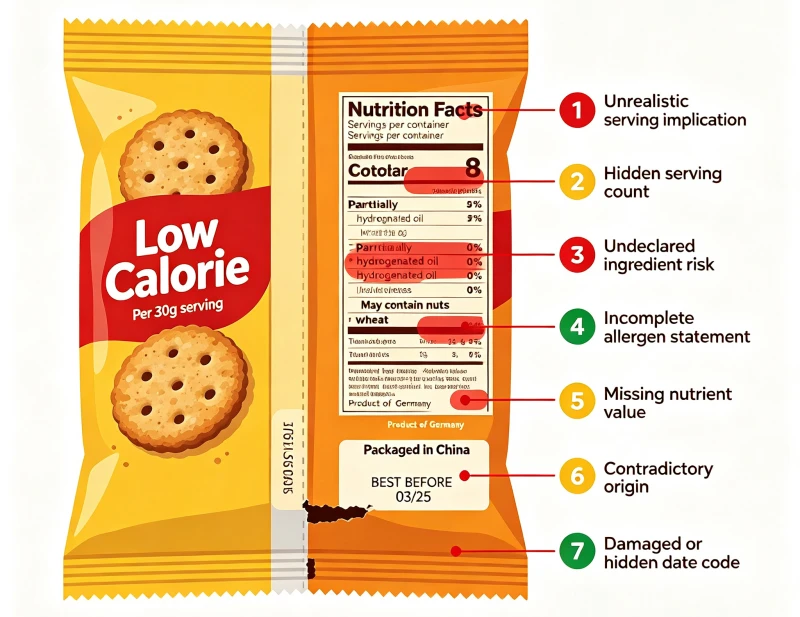
Common Food Labeling Issues to Avoid
Food Label Content vs. Label Design: What’s the Difference?
One of the most important distinctions for food brands is the difference between what a label says and how that information is presented.
Accurate content is the foundation, but good design helps consumers find and understand that content.
| Label Element | Content Consideration | Design & Printing Consideration |
|---|---|---|
| Product claims | Claims should accurately represent the product | Make claims visible without overwhelming essential information |
| Ingredients | Information should be accurate and complete | Use readable type, spacing, and contrast |
| Allergens | Required allergen information should be reviewed | Make information easy to locate and read |
| Nutrition information | Nutrition details should be verified | Maintain a clean and structured layout |
| Product images | Images should represent the product appropriately | Use printing quality suitable for detailed graphics |
| Barcode | Barcode information should be correct | Maintain sufficient print sharpness and contrast |
| Storage instructions | Instructions should reflect actual product requirements | Choose materials suitable for the storage environment |
| Brand elements | Visual identity should remain consistent | Select appropriate colors, finishes, and printing techniques |
This leads to an important principle:
Clear food labeling requires both accurate content and effective physical presentation.
A label manufacturer does not replace the brand’s responsibility for product information or regulatory review. However, the manufacturer can play an important role in translating approved artwork into a physical label that is readable, durable, and appropriate for the intended application.
How to Design Clearer and More Accurate Food Labels
Once the content has been reviewed, the next step is to make sure the information works effectively as a physical label.
1. Create a Clear Information Hierarchy
Consumers should be able to understand the basic identity of a product quickly.
Use differences in:
- Font size
- Weight
- Position
- Spacing
- Alignment
- Sections
- Supporting graphics
to distinguish primary information from supporting details.
Avoid filling every available area simply because there is space.
A clean layout can often communicate more information than an overcrowded design.
2. Prioritize Readability
When evaluating label artwork, review it at the actual printed size.
Text that looks comfortable on a large computer monitor may become difficult to read once reduced to the final label dimensions.
Pay attention to:
- Font size
- Letter spacing
- Line spacing
- Contrast
- Text placement
- Background complexity
A physical proof can be particularly useful for evaluating readability before mass production.
3. Keep Claims and Visuals Consistent
The words and images on a package should work together.
If a product emphasizes a particular ingredient, nutritional characteristic, or product attribute, the visual presentation should not create a substantially different expectation.
Review the front, back, and side panels as one complete communication system rather than treating each section independently.
4. Make Important Information Easy to Find
Consumers should not have to search through decorative elements to find essential information.
Use clear sections and logical grouping for:
- Ingredients
- Nutrition information
- Allergen information
- Storage instructions
- Preparation instructions
- Product details
- Contact information
The exact content required will depend on the product and target market.
5. Consider the Physical Environment
Food labels exist in real-world conditions.
A label may be exposed to:
- Refrigeration
- Freezing
- Condensation
- Moisture
- Oil
- Frequent handling
- Abrasion
- Bright retail lighting
The design should therefore be evaluated together with the physical label specification.
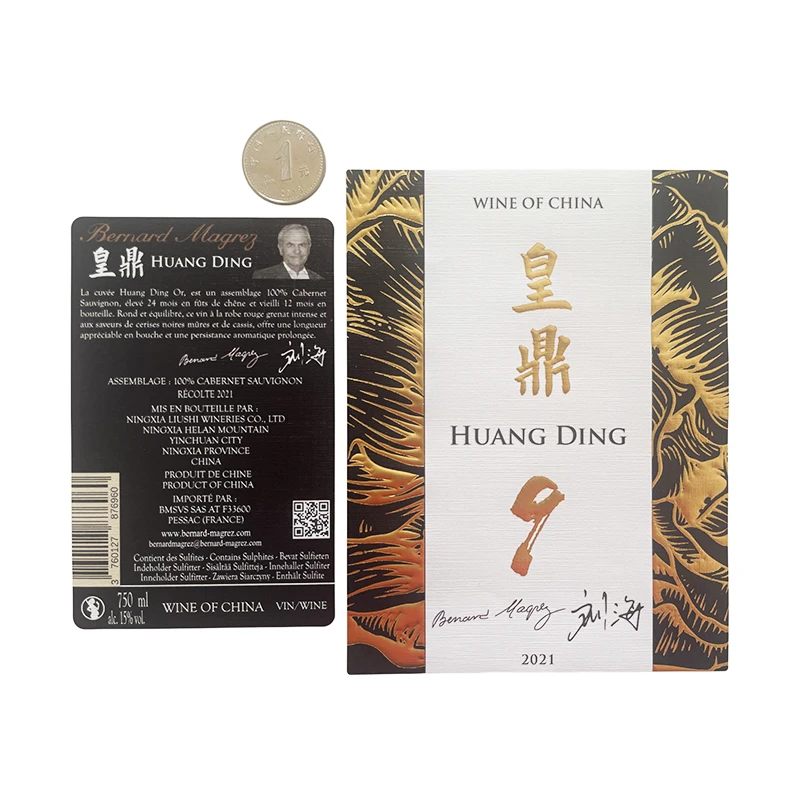
Examples of clear and accurate industry-specific labels
Choosing the Right Food Label for Your Product
A visually attractive label is not necessarily the right label for every application.
The label material, adhesive, printing process, finish, and construction should match the product and its environment.
| Common Challenge | Possible Label Solution | Specification to Consider |
|---|---|---|
| Refrigerated products | Moisture-resistant label construction | Suitable material and adhesive |
| Frozen products | Cold-environment label construction | Freezer-compatible material and adhesive |
| Oil or grease exposure | More resistant label construction | Material and adhesive compatibility |
| Frequent handling | Durable label construction | Appropriate material or protective finish |
| Premium positioning | Decorative finishing | Embossing, hot stamping, specialty finishes |
| Small packaging | Space-efficient custom label | Custom dimensions and shape |
| Detailed graphics | High-quality printing | Fine text and image reproduction |
| Multiple SKUs | Flexible production | Customized artwork and SKU management |
| Large production volumes | Scalable manufacturing | Suitable production and finishing capacity |
There is no single “best” food label material for every application. The right specification depends on the packaging surface, product environment, application method, desired appearance, and expected service life.
What Should Brands Consider When Printing Food Labels?
After the artwork is approved, production quality becomes another important part of the process.
Label Material
Different packaging surfaces and environments may require different label materials.
Common considerations include:
- Packaging substrate
- Moisture exposure
- Temperature
- Product handling
- Label size
- Required appearance
- Expected product life
Adhesive
The adhesive needs to work with the packaging surface and intended conditions.
A label intended for glass, plastic, coated cartons, flexible packaging, or another substrate may require different adhesive characteristics.
Printing Quality
Food labels can contain very small text, detailed graphics, barcodes, icons, and other fine elements.
Consistent printing helps preserve:
- Text clarity
- Barcode readability
- Image detail
- Color consistency
- Fine lines
- Brand identity
Finishing
Finishing techniques can add visual differentiation to food packaging.
Depending on the design, options may include:
- Matte finish
- Gloss finish
- Soft-touch effects
- Embossing
- Hot stamping
- Specialty decorative effects
Finishing should support the overall design rather than make essential information harder to read.
Durability
The finished label should be appropriate for the environment in which the product will be stored, transported, displayed, and used.
For example, refrigerated and frozen products may require different considerations from dry packaged foods.
Food Label Checklist Before Printing
Before approving a label for mass production, a structured review can help reduce mistakes and unnecessary reprints.
| Category | Questions to Ask Before Printing |
|---|---|
| Product information | Is the product information accurate and up to date? |
| Ingredients | Has the ingredient list been reviewed? |
| Allergens | Has applicable allergen information been checked? |
| Claims | Have product and nutritional claims been reviewed? |
| Artwork | Is all important text readable at actual print size? |
| Images | Do images accurately represent the product? |
| Dimensions | Does the label fit the packaging correctly? |
| Material | Is the material appropriate for the application? |
| Adhesive | Is the adhesive compatible with the packaging surface? |
| Storage | Can the label withstand the intended environment? |
| Barcode | Has the barcode artwork been checked? |
| Finishing | Are the requested finishes suitable for the design? |
| Proofing | Has a final proof or physical sample been reviewed? |
For products sold in regulated markets, businesses should also conduct any required regulatory review before production.
Why Work With a Custom Food Label Manufacturer?
For food brands, producing the right label involves more than printing an existing design.
A capable label manufacturing partner can help translate approved artwork into a finished product with the appropriate:
- Material
- Adhesive
- Size
- Shape
- Printing process
- Finishing
- Durability
- Production volume
This becomes particularly important when a project involves multiple SKUs, unusual packaging surfaces, special finishes, demanding storage conditions, or large production quantities.
The manufacturer should also be able to provide appropriate technical support during sampling and production.
Custom Food Labels for Food & Beverage Brands
At Perfect Label, we provide custom label solutions for food and beverage brands, packaging companies, and manufacturers.
As an original label manufacturer based in Qingdao, China, we have more than 16 years of experience in the label printing industry. Our capabilities cover custom printed labels, specialty-material labels, decorative labels, functional labels, security labels, smart labels, and industry-specific label solutions.
For food and beverage applications, our approach combines label design support, material selection, printing, finishing, sampling, and mass production.
Our manufacturing capabilities include a 12-color satellite rotary printing press, automated production lines, die-cutting, hot stamping, embossing, and other post-press processes. Our in-house technical team supports customers with customized label requirements, while our production facilities are equipped to handle both flexible custom projects and high-volume orders.
We also provide rapid sample-making services so customers can evaluate the physical label before moving into mass production.
What Perfect Label Can Support
| Customer Requirement | Perfect Label Capability |
|---|---|
| Custom label sizes | Customized dimensions and shapes |
| Detailed label artwork | High-quality multi-color printing |
| Premium packaging | Embossing, hot stamping and decorative finishes |
| Special application environments | Customized material and construction options |
| Multiple product SKUs | Flexible customized production |
| Prototype evaluation | Rapid sample-making |
| Large-volume orders | Scalable production capacity |
| One-stop label sourcing | Design support, printing and finishing |
Our experience spans food & beverage, beauty & personal care, healthcare, electronics, industrial manufacturing, and other applications.
For each project, the appropriate label solution depends on the product, packaging, environment, design, and production requirements.
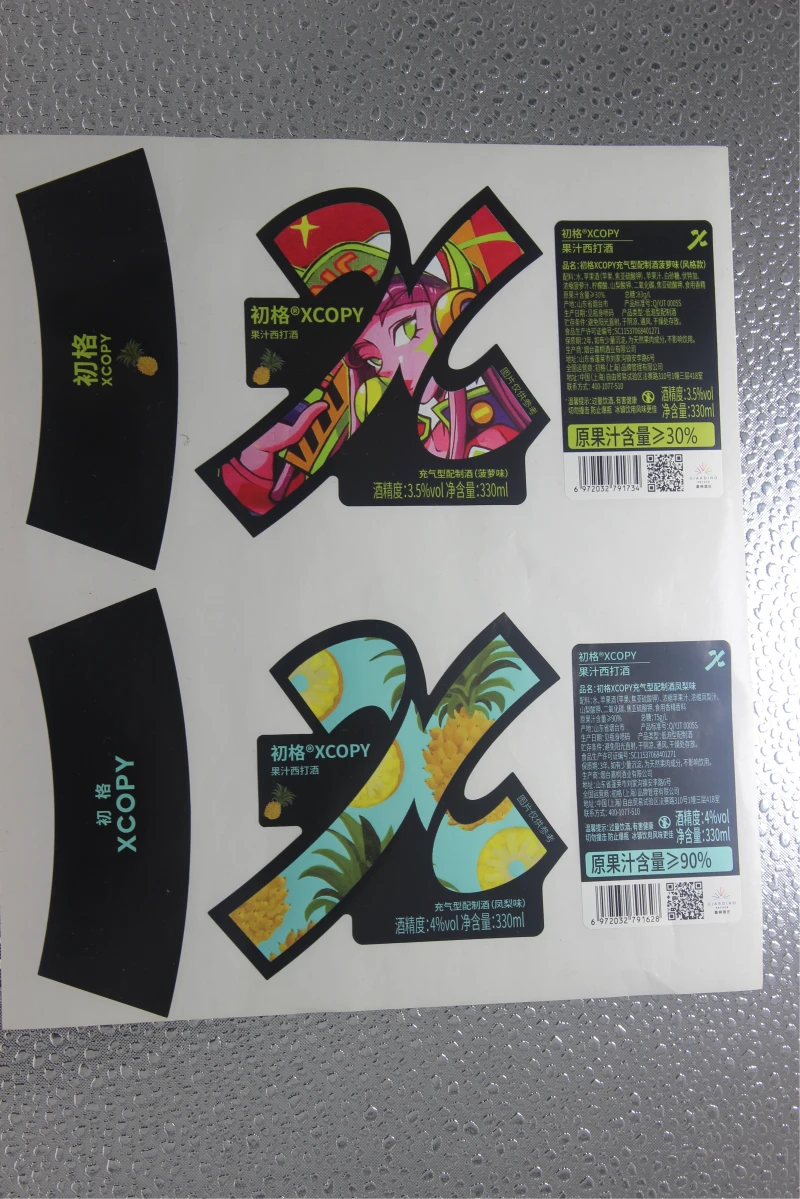
Samples of food labels we have produced.
Final Thoughts
Avoiding misleading food labels starts with accurate information, but effective food labeling goes further than simply checking the words on the package.
A successful food label brings together:
Accurate Content + Clear Design + Readability + Appropriate Materials + Reliable Printing
Brands should review product claims, ingredient information, allergen information, nutrition details, imagery, and other content before approving artwork. At the same time, they should consider typography, information hierarchy, label dimensions, material, adhesive, finishing, and durability.
The physical label is ultimately the medium through which all of that information reaches the consumer.
By considering content, design, and production together, food businesses can create labels that are clearer, more consistent, and better suited to their products and packaging environments.
If you are developing a new food or beverage product or looking for a reliable supplier for an existing label program, Perfect Label can provide customized label solutions from sampling through mass production.
Contact us to discuss your custom food label requirements and request a quotation.
Frequently Asked Questions
Can food labels be misleading?
Yes. A food label can potentially create a misleading impression through inaccurate claims, unclear information, product imagery, omissions, or the overall way different elements are presented. Specific requirements vary by market and product category.
What makes a food label misleading?
Common issues include unsupported or unclear claims, inaccurate or confusing imagery, difficult-to-read information, unclear ingredient or allergen information, and inconsistencies between the label and the actual product.
How can businesses avoid misleading food labels?
Businesses should verify product information, review applicable claims and labeling requirements, use appropriate imagery, prioritize readability, and conduct a thorough artwork review before printing.
Why is food label design important?
Food label design affects how easily consumers can locate and understand product information. Typography, contrast, spacing, layout, images, and information hierarchy all contribute to readability.
What should businesses consider when choosing custom food labels?
Important considerations include the packaging material, label size and shape, adhesive, storage environment, moisture and temperature exposure, durability, printing requirements, and desired finishing.
Can food labels be customized for refrigerated or frozen products?
Yes. Food labels can be specified according to different application and storage environments. Refrigerated and frozen products may require materials and adhesives suitable for low temperatures, moisture, condensation, or other environmental conditions.
Can a label manufacturer help with food label compliance?
A label manufacturer can provide technical support regarding label size, materials, printing, finishing, and production. However, the food business remains responsible for ensuring that its product information and claims meet applicable regulatory requirements. Where necessary, businesses should consult a qualified regulatory professional.