blog

How much do custom stickers cost?

If you are planning to order custom stickers for product packaging, branding, security, wine bottles, retail products, or industrial applications, one of the first questions is simple: how much do custom stickers cost?

The answer depends on several factors, including sticker material, size, order quantity, printing method, adhesive, finishing, and application. A basic security label may cost only a few cents per piece, while decorative or multi-layer stickers require more materials and production processes.

For B2B buyers, the custom stickers cost is also strongly influenced by order volume. Buying directly from a manufacturer can significantly reduce the unit price compared with small-quantity retail orders.

Based on actual custom sticker factory pricing, standard custom label and sticker products can range from approximately $0.015 to $0.298 per piece, depending on the product type and specifications.

Custom Sticker / Label TypeFactory Price Range
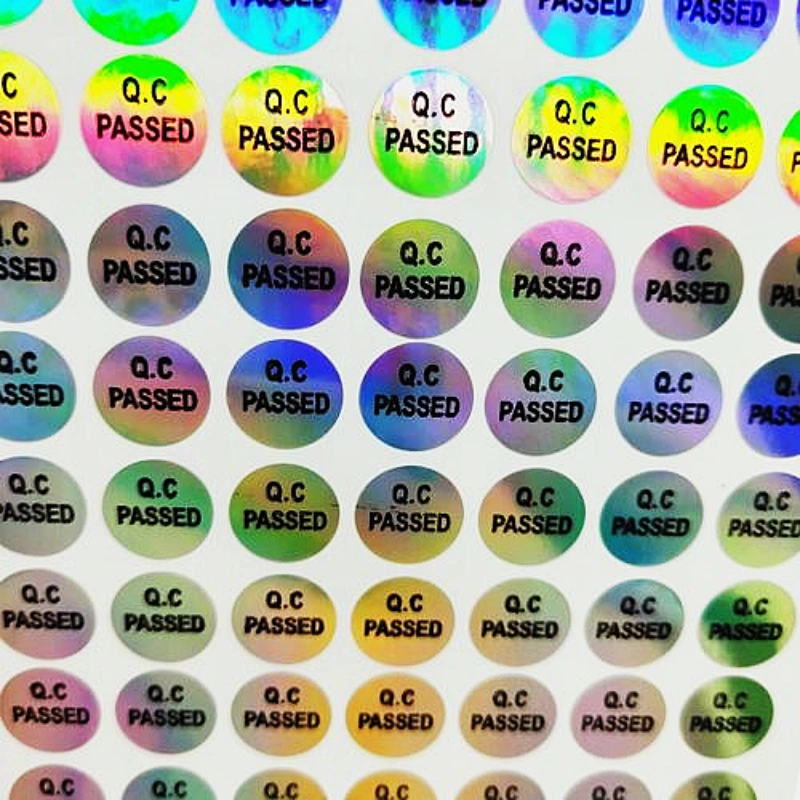
Security Labels$0.015–$0.030/pc
Dome Labels$0.030–$0.074/pc
RFID Tags$0.060–$0.119/pc
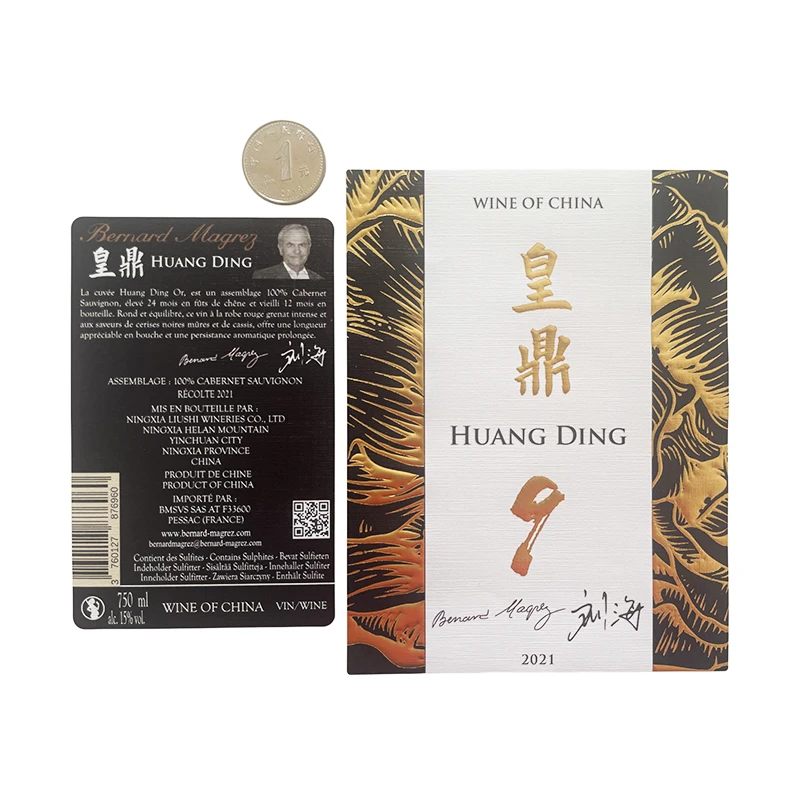
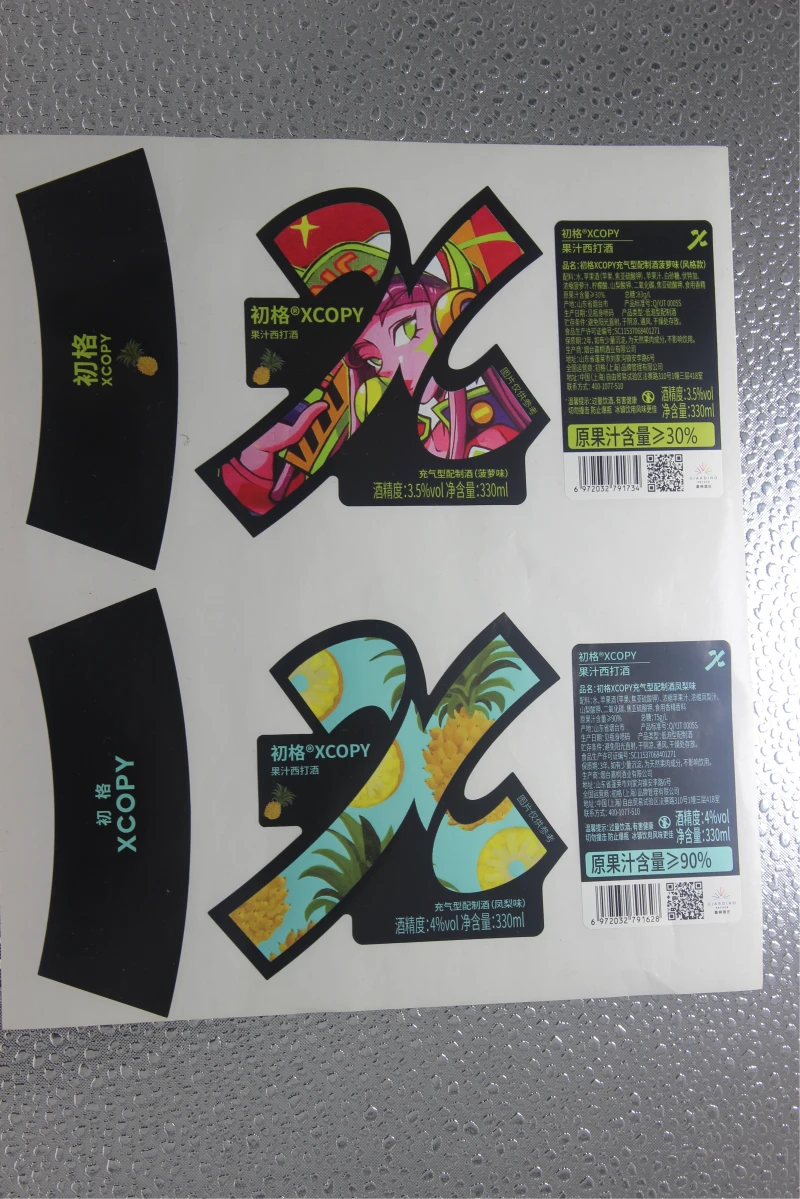
Wine & Beverage Labels$0.089–$0.179/pc
Multi-Layer Booklet Labels$0.119–$0.223/pc
Decorative Labels$0.179–$0.298/pc

These prices are factory reference ranges, not universal fixed prices. The final quotation depends on the actual specifications, quantity, materials, printing requirements, finishing, and packaging.

How Much Do Custom Stickers Cost?

For many B2B applications, custom stickers can cost anywhere from a few cents to several tenths of a dollar per piece.

However, comparing sticker prices only by the unit price can be misleading.

For example, a $0.02 security label and a $0.25 decorative label may look very different in price, but they are designed for completely different purposes.

A security label may require a relatively simple construction, while a premium decorative label may include multiple layers, specialty materials, metallic effects, embossing, foil stamping, or other finishing processes.

For this reason, the most useful way to evaluate custom sticker cost is to compare the following:

  • Product type
  • Material
  • Sticker size
  • Order quantity
  • Printing method
  • Adhesive
  • Surface finishing
  • Application environment
  • Packaging requirements

The right question is not simply “What is the cheapest sticker price?” but rather “What sticker construction provides the required performance at the lowest practical cost?”

Custom Stickers Cost: Factory Price Examples

The following table provides a useful starting point for B2B buyers.

ProductPrice Range per PieceTypical Application
Security Labels$0.015–$0.030Anti-counterfeiting, tamper evidence
Dome Labels$0.030–$0.074Branding, equipment, promotional products
RFID Tags$0.060–$0.119Inventory, logistics, asset tracking
Wine & Beverage Labels$0.089–$0.179Wine, beer, spirits, beverages
Multi-Layer Booklet Labels$0.119–$0.223Instructions, compliance, product information
Decorative Labels$0.179–$0.298Premium packaging and branding

These figures demonstrate why sticker costs cannot be represented by a single number.

A buyer ordering 50,000 security labels has a completely different cost structure from a brand ordering 5,000 premium decorative labels.

What Factors Affect Custom Stickers Cost?

Several variables determine the final custom sticker price.

Understanding these factors can help buyers control costs without compromising product performance.

Sticker Size

Size is one of the most straightforward cost factors.

A small 30 × 30 mm sticker uses less material than a 100 × 100 mm sticker. Larger labels also consume more printing and coating resources.

For high-volume orders, even a small difference in material consumption can noticeably affect the total project cost.

When designing a custom sticker, consider whether the artwork and required information can fit into a smaller standardized size.

Material

Material selection has a direct influence on custom stickers pricing.

Common materials include:

  • Paper
  • PP
  • PE
  • PET
  • PVC
  • Synthetic paper
  • Transparent film
  • Metallic materials
  • Holographic materials

Paper is often suitable for basic indoor applications, while synthetic materials are better for applications that require moisture, abrasion, or environmental resistance.

Premium materials can increase the sticker’s price, but they may also provide better durability and appearance.

Order Quantity

Quantity is one of the most important factors for B2B buyers.

A small order may have a relatively high unit price because production setup, material preparation, die cutting, printing setup, and packaging costs are distributed across fewer pieces.

As the quantity increases, these fixed costs are spread over more units.

For example, a buyer should request pricing at several quantities:

  • 1,000 pcs
  • 5,000 pcs
  • 10,000 pcs
  • 50,000 pcs
  • 100,000 pcs

This makes it easier to identify the most economical purchasing level.

Printing Method

The printing method also affects the final custom sticker cost.

Depending on the product, manufacturers may use:

  • Digital printing
  • Flexographic printing
  • Offset printing
  • Screen printing

Digital printing works well for shorter runs and variable designs, while high-volume production may benefit from more efficient industrial printing processes.

Sticker Shape

Standard rectangular or square stickers are generally straightforward to manufacture.

Custom die-cut stickers can have almost any shape, including:

  • Logos
  • Circles
  • Ovals
  • Product silhouettes
  • Special promotional shapes

Complex shapes may require customized tooling or additional production processes, which can increase the overall price.

Adhesive

Adhesive is another important but often overlooked component of sticker pricing.

Different applications may require adhesives for:

  • Glass
  • Plastic
  • Metal
  • Cardboard
  • Rough surfaces
  • Removable applications
  • Permanent applications
  • Outdoor environments

Choosing the right adhesive matters more than choosing the cheapest one.

A low-cost sticker that falls off the product is not really a cost-saving solution.

Custom Sticker Price by Product Type

Different sticker products serve different commercial purposes.

Security Labels

Security labels are among the most cost-effective specialized label solutions.

The factory reference price is approximately:

$0.015–$0.030 per piece

They can be used for:

  • Tamper evidence
  • Anti-counterfeiting
  • Warranty protection
  • Product authentication
  • Asset protection
  • Brand security

Because security labels can be produced at relatively low unit costs, they are suitable for large-volume product protection programs.

Dome Labels

Custom dome labels typically use a raised resin or epoxy layer to create a three-dimensional appearance.

Factory reference pricing:

$0.030–$0.074 per piece

They are commonly used for:

  • Equipment branding
  • Electronic products
  • Promotional products
  • Automotive components
  • Machinery
  • Corporate logos

The 3D surface provides additional visual impact compared with conventional flat stickers.

RFID Tags

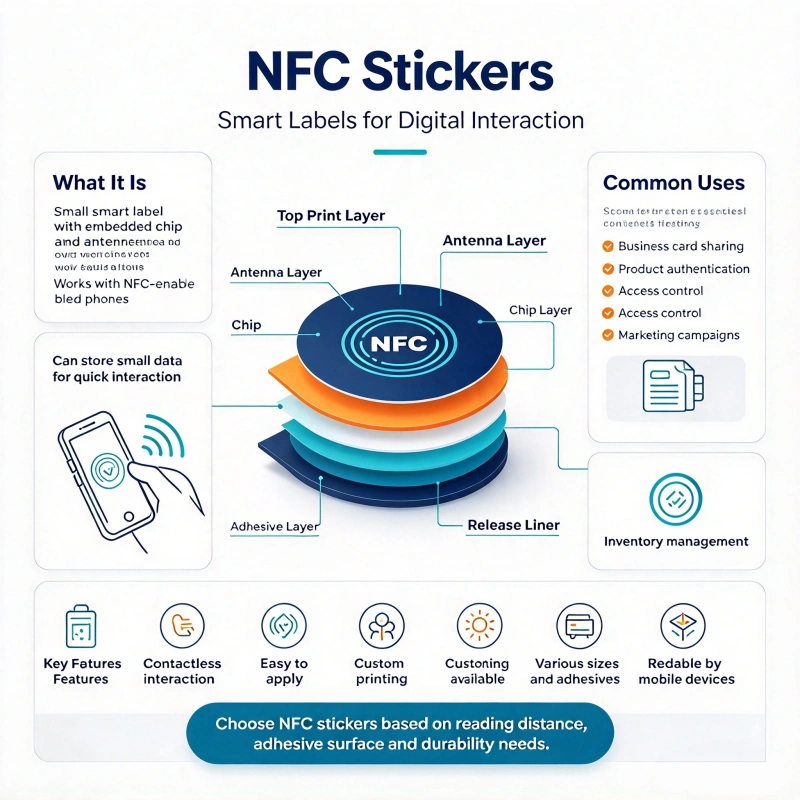
RFID tags combine a printed label or substrate with an RFID inlay.

Factory reference pricing:

$0.060–$0.119 per piece

Applications include:

  • Inventory management
  • Warehouse tracking
  • Asset identification
  • Retail
  • Logistics
  • Supply-chain management

RFID tags generally cost more than basic printed stickers because they contain an RFID chip and antenna.

However, they can provide automated identification and tracking capabilities that conventional stickers cannot.

Wine & Beverage Labels

Wine and beverage labels typically require a stronger focus on appearance, adhesion, moisture resistance, and brand presentation.

Factory reference pricing:

$0.089–$0.179 per piece

They can be customized with:

  • Premium papers
  • Waterproof materials
  • Foil stamping
  • Embossing
  • Metallic effects
  • Matte finishes
  • Glossy finishes
  • Special adhesives

For wine and beverage brands, the label is not simply an identification tool. It is also an important part of the product’s visual identity.

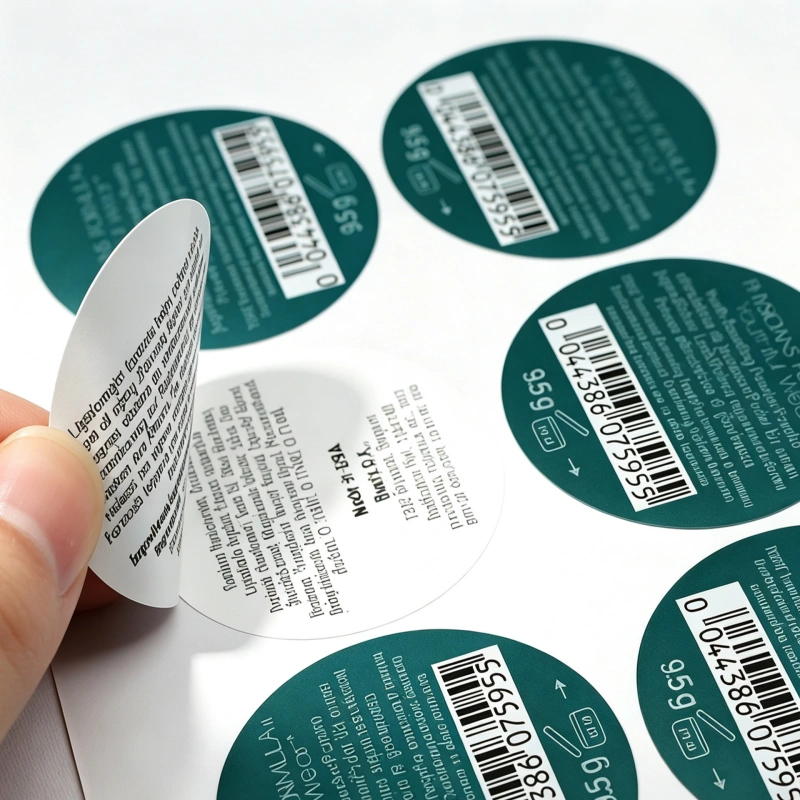
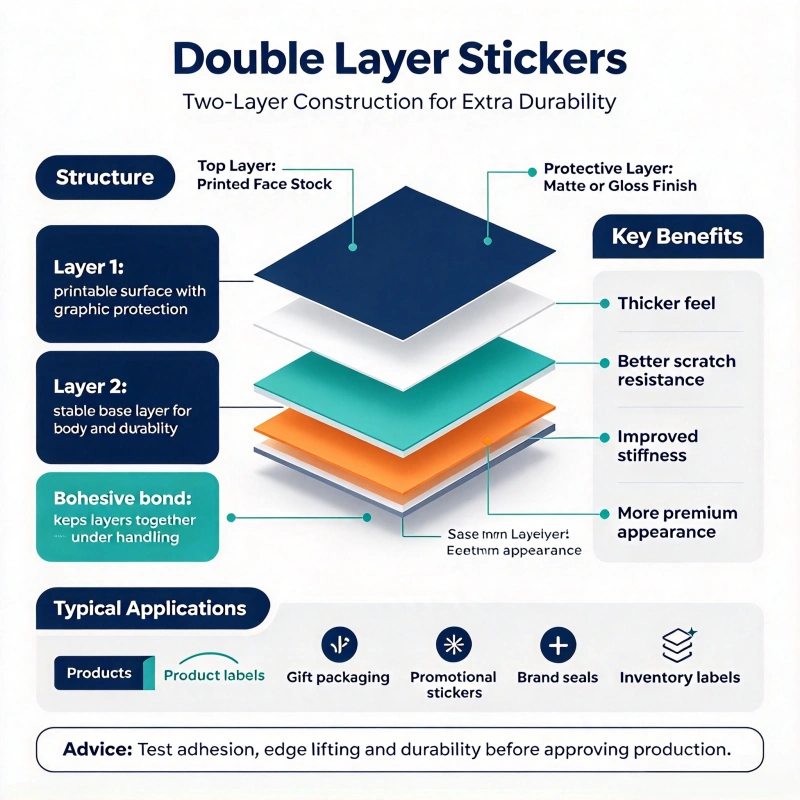
Multi-Layer Booklet Labels

Multi-layer booklet labels provide substantially more printable space than conventional single-layer stickers.

Factory reference pricing:

$0.119–$0.223 per piece

They are suitable for products that need additional information, including:

  • Instructions
  • Warnings
  • Ingredients
  • Technical information
  • Multilingual content
  • Regulatory information
  • Product usage instructions

Instead of increasing the physical packaging size, manufacturers can use multiple layers to place more information into a compact label.

Decorative Labels

Decorative labels generally sit toward the higher end of the factory price range.

Reference pricing:

$0.179–$0.298 per piece

Applications include:

  • Premium packaging
  • Cosmetics
  • Luxury products
  • Gift packaging
  • Food and beverages
  • Brand promotion

Decorative labels may include multiple finishing techniques, specialty papers, metallic effects, embossing, foil stamping, or other visual treatments.

The higher stickers price is therefore associated with a more complex construction and stronger visual impact.

How Much Do 100 Custom Stickers Cost?

Small quantities generally have a higher unit cost.

For example, ordering only 100 pieces may involve:

  • Setup costs
  • Material preparation
  • Cutting setup
  • Printing setup
  • Packaging
  • Handling

For this reason, the price per sticker can be considerably higher than a large-volume order.

For businesses that need only a small quantity for testing, samples or prototypes may be more appropriate than production orders.

However, if you are purchasing for commercial production, requesting a larger quantity usually provides a much better unit price.

How Much Do 1,000 Custom Stickers Cost?

At 1,000 pieces, buyers can usually obtain more competitive manufacturing prices than at very small quantities.

The exact custom sticker cost depends heavily on the product.

For example:

  • Basic security labels can remain very inexpensive.
  • RFID tags cost more because of their electronic components.
  • Decorative labels cost more because of specialty materials and finishing.
  • Multi-layer booklet labels cost more because of their construction.

Instead of asking only for a 1,000-piece quotation, B2B buyers should ask suppliers to quote several quantity levels.

How Much Do 10,000 Custom Stickers Cost?

For commercial buyers, 10,000 pieces is a more meaningful production quantity.

At this volume, manufacturers can generally optimize:

  • Material purchasing
  • Printing
  • Die cutting
  • Production scheduling
  • Packaging

This can reduce the average sticker cost per piece.

For example, a buyer may request:

1,000 / 5,000 / 10,000 / 50,000 pcs

This allows the purchasing team to see how the unit price changes with volume.

If the product will be reordered regularly, it can also be useful to calculate the expected annual quantity rather than evaluating only the first order.

Are Custom Stickers Cheaper in Bulk?

In most manufacturing situations, yes.

Bulk orders usually reduce the average production cost because fixed costs are distributed across a larger number of pieces.

For example, an illustrative pricing structure could look like:

QuantityExample Unit Price
100 pcs$0.40
1,000 pcs$0.15
10,000 pcs$0.07
50,000 pcs$0.04

The actual figures vary by product, but the principle is important.

A buyer should not compare:

100-piece retail price vs. 50,000-piece factory price

as though they were equivalent.

They are two completely different purchasing models.

Custom Stickers Cost vs. Retail Sticker Prices

When researching stickers price, buyers may encounter prices from online marketplaces, local printing companies, and retail websites.

These prices can be significantly different from factory quotations.

A retail sticker price may include:

  • Design services
  • Platform fees
  • Retail margins
  • Small-order handling
  • Packaging
  • Shipping

A factory quotation is more directly related to:

  • Raw materials
  • Production
  • Printing
  • Finishing
  • Packaging
  • Order quantity

For B2B buyers ordering thousands or tens of thousands of pieces, purchasing directly from a manufacturer can therefore provide a more competitive cost structure.

How to Reduce Custom Stickers Cost

Reducing the custom stickers cost does not always mean selecting the cheapest material.

A better approach is to optimize the entire specification.

Choose the Right Material

Do not use a premium waterproof material for a simple indoor application if it provides no meaningful benefit.

Optimize the Size

Reducing unnecessary label dimensions can lower material consumption.

Order in Larger Quantities

Higher volumes generally provide better unit economics.

Simplify Finishing

Foil stamping, embossing, special coatings, and other processes can increase the price.

Use them when they contribute real value to the product.

Use Standard Shapes

Standard shapes can sometimes reduce tooling and production costs.

Select the Correct Adhesive

The right adhesive can reduce application failures, replacements, and waste.

Work Directly With a Manufacturer

Direct factory sourcing can reduce intermediary margins and make it easier to customize materials, sizes, printing, and finishing.


When choosing a supplier, you should choose a label factory directly. We offer complete design and production solutions, and our prices are highly competitive.

How to Get an Accurate Custom Sticker Price

If you want an accurate quotation, do not simply send a message saying:

“How much are custom stickers?”

A manufacturer needs enough information to calculate the actual production cost.

Provide:

  1. Sticker type
  2. Sticker size
  3. Quantity
  4. Material
  5. Shape
  6. Printing requirements
  7. Adhesive type
  8. Surface finish
  9. Application environment
  10. Packaging requirements
  11. Delivery destination

For example:

50 × 50 mm custom waterproof PP stickers, full-color printing, matte lamination, permanent adhesive, 10,000 pcs.

This specification allows the manufacturer to provide a much more meaningful custom sticker price.

Custom Stickers From a Direct Manufacturer

For brands, manufacturers, distributors, and purchasing companies, choosing a direct sticker manufacturer can simplify the entire sourcing process.

Perfect Label provides customized label and sticker manufacturing for different industries and applications.

Customization can include:

  • Materials
  • Sizes
  • Shapes
  • Adhesives
  • Printing
  • Surface finishes
  • Foil stamping
  • Embossing
  • RFID integration
  • Security features
  • Multi-layer construction
  • 3D dome effects

The factory can provide different solutions depending on whether the buyer needs a low-cost security label, a functional RFID tag, a premium wine label, a multi-layer booklet label, or a decorative packaging sticker.

The objective is not simply to achieve the lowest stickers cost.

It is to find the best combination of price, appearance, durability, functionality, and production volume.

Custom Stickers Cost: Which Product Is Right for Your Budget?

Your target price can help determine the appropriate sticker solution.

Budget / NeedRecommended Solution
Lowest-cost product protectionSecurity Labels
3D brandingDome Labels
Inventory automationRFID Tags
Premium beverage packagingWine & Beverage Labels
Large amounts of product informationMulti-Layer Booklet Labels
Premium visual packagingDecorative Labels

This approach makes it easier for buyers to match their budget with their actual application.

A low-cost sticker is not necessarily the best value, and an expensive sticker is not automatically better.

The best solution meets the application’s technical and branding requirements without adding unnecessary production costs.

FAQ

How much do custom stickers cost?

Custom sticker prices vary by product type, size, material, quantity, printing, adhesive, and finishing. Factory reference prices for common customized labels can range from about $0.015 to $0.298 per piece, depending on the product category and specifications.

What is the cheapest type of custom sticker?

Security labels can be among the lowest-cost specialized options, with a factory reference range of approximately $0.015–$0.030 per piece.

How much do RFID tags cost?

Based on factory reference pricing, RFID tags can cost approximately $0.060–$0.119 per piece, depending on the RFID chip, tag construction, size, printing, and order quantity.

Are custom stickers cheaper when ordered in bulk?

Usually, yes. Larger quantities allow manufacturers to spread setup, material, printing, and packaging costs over more units, reducing the average stickers cost per piece.

Does sticker size affect the price?

Yes. Larger stickers generally consume more material and may require more printing and finishing resources, increasing the overall production cost.

Are waterproof custom stickers more expensive?

They can be. Waterproof stickers may require synthetic materials such as PP, PET, or vinyl, together with waterproof adhesives and protective finishes.

Do special finishes increase custom sticker prices?

Yes. Foil stamping, embossing, lamination, UV effects, metallic finishes, and other specialty processes can increase the final custom stickers price.

How can I get the best custom sticker price?

Provide the manufacturer with the exact size, material, quantity, printing, adhesive, finishing, and application requirements. Request several quantity tiers to compare the unit price at different production volumes.

Is buying directly from a sticker manufacturer cheaper?

For larger B2B orders, direct factory sourcing can often provide a more competitive price structure by reducing intermediary costs. However, the final comparison should also consider quality, customization capability, production consistency, and delivery.

Final Thoughts: What Is a Reasonable Custom Stickers Cost?

There is no universal custom stickers cost because stickers are highly customizable products.

For reference, actual factory price ranges can start at approximately $0.015–$0.030 per piece for security labels and reach around $0.179–$0.298 per piece for decorative labels. RFID tags, dome labels, wine and beverage labels, and multi-layer booklet labels fall between these ranges depending on their construction.

The most important factors are:

Material + Size + Quantity + Printing + Adhesive + Finishing + Application

For B2B buyers, the best strategy is to define the required performance first and then optimize the specification around the target budget.

If you are sourcing custom stickers wholesale, do not compare suppliers based only on the lowest quoted unit price. Compare the complete solution, including material quality, adhesive performance, printing accuracy, finishing, customization capability, MOQ, production capacity, and delivery.

That is how you turn a low sticker price into a genuinely cost-effective labeling solution.

RFID Tags for Inventory: Complete Guide

Managing inventory becomes increasingly difficult as the number of products, warehouses, SKUs, and supply-chain movements grows. Traditional barcode systems remain useful, but they normally require the scanner to see the barcode and are often used for item-by-item identification. RFID Tags for Inventory offer another approach: products can be identified through radio-frequency communication, allowing businesses to automate more inventory data capture and improve visibility across warehouses, manufacturing facilities, distribution centers, and retail operations.

For companies evaluating RFID, the important question is not simply “What is RFID?” It is “Will RFID solve our inventory problem, and which RFID tag should we choose?”

This guide explains how RFID inventory tags work, their advantages and limitations, RFID versus barcode, UHF RFID selection, materials, read range, customization, implementation, and the key factors procurement teams should consider before ordering.

What Are RFID Tags for Inventory?

RFID Tags for Inventory are electronic identification tags attached to products, cartons, pallets, containers, or assets so that their identity can be captured using RFID readers.

A typical passive RFID tag consists of:

  • RFID chip
  • Antenna
  • Inlay
  • Substrate
  • Adhesive
  • Protective layer, depending on the application

In a typical passive RFID system, the reader sends a radio signal that provides operating energy to the tag. The tag responds by backscattering information to the reader. GS1 describes this reader-and-tag architecture as the foundation of passive UHF RFID deployments.

The information associated with a tag may include a unique identifier such as an EPC, which can then be linked to product information in an inventory, warehouse management, ERP, or other business system.

This means an RFID tag does not necessarily need to store the entire product database. Instead, its unique identification can act as the bridge between the physical product and digital inventory record.


How Do RFID Tags Work for Inventory Management?

A basic RFID inventory workflow looks like this:

RFID Tag → RFID Reader → Data Capture → Inventory Software → Inventory Database

Here is how the process works.

Step 1: Attach the RFID Tag

The tag is attached to the:

  • Product
  • Box
  • Carton
  • Pallet
  • Container
  • Equipment
  • Asset

Step 2: Assign an Identification Number

Each item can receive a unique identification value.

Depending on the system, this may be associated with information such as:

  • SKU
  • Product ID
  • Serial number
  • Batch
  • Lot
  • Asset number

GS1’s EPC standards provide standardized approaches for encoding identifiers used for physical objects and supply-chain processes.

Step 3: RFID Reader Sends a Signal

A fixed or handheld RFID reader communicates with tags within its reading zone.

Step 4: Tags Respond

Passive tags use energy from the reader’s signal and return their identification information.

Step 5: Software Processes the Data

The captured information can be transferred into an inventory or warehouse system.

This can help businesses monitor:

  • What products are in stock
  • What products entered a warehouse
  • What products left a facility
  • Which items require replenishment
  • Where tagged assets were last detected

RFID therefore connects physical inventory with digital records rather than simply replacing a printed label.


What Inventory Problems Can RFID Tags Solve?

The strongest reason to implement RFID is not the technology itself. It is the operational problem the technology solves.

Manual Inventory Counting

Traditional inventory counting can require employees to scan products individually or manually count stock.

RFID can automate more of the data-capture process and allow multiple nearby tags to be identified during a reading event. GS1 notes that RAIN RFID can capture tags without the direct line of sight required by optical barcode scanning.

Barcode Line-of-Sight Limitations

A barcode scanner generally needs to visually access the barcode.

RFID does not use optical scanning in the same way.

This means a reader can potentially identify tags when they are:

  • Inside cartons
  • On stacked products
  • Moving through a doorway
  • Within a pallet
  • In storage locations

The actual performance still depends on tag design, reader configuration, product materials, tag orientation, and the environment.

Inventory Accuracy

Manual data entry and scanning processes can introduce errors.

Automated RFID data capture can help reduce some manual handling and improve inventory visibility. GS1 US identifies real-time inventory visibility, improved cycle-count accuracy, and operational efficiency among the potential benefits of RFID inventory management.

Slow Warehouse Processes

RFID can be integrated into processes such as:

  • Receiving
  • Put-away
  • Inventory counting
  • Picking
  • Packing
  • Shipping

Fixed readers can also be positioned at locations such as loading docks or conveyor areas to automatically capture tagged items as they pass through the reading zone.


What Types of RFID Tags Are Used for Inventory?

Not every RFID tag is suitable for every inventory application.

The main categories include passive, active, and semi-passive RFID.

Passive RFID Tags

Passive tags do not contain a battery.

They receive operating energy from the RFID reader and respond to the reader’s signal.

Advantages include:

  • Lower tag cost
  • Small form factors
  • Long service life
  • Suitable for high-volume tagging
  • Widely used in inventory applications

For many warehouse and supply-chain applications, passive RFID is the starting point.

Active RFID Tags

Active RFID tags contain a battery and can support applications requiring longer-range or more persistent tracking.

They may be considered for:

  • High-value equipment
  • Large assets
  • Returnable transport equipment
  • Specialized asset tracking

However, active tags generally involve a different cost and system architecture than passive inventory labels.

Semi-Passive RFID Tags

Semi-passive, or battery-assisted, solutions occupy a middle ground and can be appropriate for specialized applications that require additional functionality.

For high-volume product inventory, passive RFID is often the more practical option.


Why UHF RFID Is Popular for Inventory

When search for RFID Tags for Inventory, UHF RFID is often one of the first technologies they encounter.

UHF passive RFID, also called RAIN RFID, is widely implemented in supply-chain and inventory applications. GS1 identifies UHF passive RFID as one of the most broadly implemented RFID technologies for industry applications.

GS1’s EPC Gen2 air-interface standard covers UHF RFID operation, with implementations in the 860–930 MHz range described by GS1; regional frequency allocations can vary.

UHF RFID is attractive for inventory because it can support:

  • Longer reading distances
  • Fast tag identification
  • Multiple-tag reading
  • Automated inventory capture
  • Warehouse and distribution applications

However, UHF does not automatically mean better.

The right RFID technology depends on:

  • Product material
  • Reading distance
  • Application environment
  • Required tag size
  • Reader type
  • Data requirements
  • Regional requirements

RFID Tags for Inventory vs. Barcodes

One of the most important questions for procurement teams is whether RFID is actually worth adopting when barcode technology already works.

The answer depends on the application.

FeatureRFIDBarcode
Direct optical line of sightGenerally not requiredUsually required
Multiple-item identificationPossibleUsually individual scanning
Automated readingYesUsually requires scanning action
Printing costHigherLower
Infrastructure costHigherLower
Product-level identificationExcellentExcellent
Harsh-environment optionsAvailableAvailable
Existing ecosystemStrongVery mature
Best fitAutomation and high-volume trackingSimple, cost-sensitive identification

RFID and barcodes do not have to compete.

In many supply chains, they can complement each other. GS1 specifically notes that barcode and RFID can coexist, allowing businesses to maintain familiar barcode processes while adding automated RFID data capture where it creates value.

When Should You Consider RFID?

RFID becomes particularly interesting when your operation involves:

  • Large inventory volumes
  • Frequent stock counting
  • Labor-intensive scanning
  • High inventory accuracy requirements
  • Multiple warehouse movements
  • Automated receiving or shipping
  • Item-level traceability
  • Real-time or near-real-time visibility requirements

If you only need to identify a few products occasionally, a barcode may remain the more economical choice.


Where Are RFID Tags for Inventory Used?

RFID inventory tracking is applicable across multiple industries.

Warehouse Inventory

Warehouses can use RFID tags for:

  • Receiving
  • Storage
  • Picking
  • Cycle counting
  • Shipping

RFID readers can be installed at strategic points or used with handheld devices.

Manufacturing Inventory

Manufacturers can tag:

  • Raw materials
  • Components
  • Work-in-progress
  • Finished goods
  • Returnable containers

This creates greater visibility as products move through production.

Retail Inventory

Retailers can apply RFID tags to:

  • Apparel
  • Footwear
  • Electronics
  • Sporting goods
  • General merchandise

RFID can help improve item-level inventory visibility between warehouses and stores.

Automotive Inventory

Automotive manufacturers and suppliers can use RFID to track:

  • Components
  • Spare parts
  • Production materials
  • Returnable containers

Healthcare Inventory

Potential applications include:

  • Medical supplies
  • Equipment
  • Consumables
  • Inventory cabinets

Select the tag and system based on the application’s specific regulatory and environmental requirements.

Food and Packaging

RFID can also support tracking of cases, cartons, and products where appropriate. GS1 US identifies food products as an RFID inventory application and highlights the potential for tracking information such as batch and expiration data.

RFID Food Labels


RFID Tags for Pallets, Cartons, and Individual Products

The appropriate RFID tag depends partly on the level at which inventory needs to be tracked.
Item-Level RFID Tags

These are attached to individual products.

They are useful when businesses need detailed item-level visibility.

Carton RFID Tags

A carton tag can identify a shipping or storage unit containing multiple products.

Pallet RFID Tags

Pallet-level tagging can simplify identification of large quantities of goods during:

  • Receiving
  • Shipping
  • Warehouse transfers
  • Distribution

A business may use several levels simultaneously.

For example:

Item RFID → Carton RFID → Pallet RFID

This can create a more complete inventory hierarchy when integrated properly with the company’s information systems.


RFID Tags for Inventory on Metal Products

Metal is one of the most important challenges when selecting RFID tags.

A conventional RFID label may not perform as expected when directly attached to metal because the metal surface can affect antenna behavior and RF performance.

For these applications, buyers may need on-metal RFID tags specifically designed for metal surfaces.

Potential applications include:

  • Machinery
  • Metal components
  • Tools
  • Industrial equipment
  • Automotive parts
  • Metal containers

Before placing a large order, test the actual RFID tag on the actual product.

A tag that performs well on a sample sheet of plastic may behave very differently when installed on a steel component.


RFID Tags for Inventory on Plastic Products

Plastic packaging is generally more flexible from an RFID tag-design perspective, but not every plastic product behaves identically.

Factors such as:

  • Product geometry
  • Plastic type
  • Liquid content
  • Tag position
  • Packaging thickness

can affect performance.

For standard plastic cartons, bottles, containers, and packaging, paper-faced or synthetic RFID labels may be considered depending on durability requirements.


What Materials Are Used for RFID Inventory Tags?

RFID inventory tags can be produced using different face materials and constructions.

Paper RFID Labels

Advantages:

  • Cost-effective
  • Easy to print
  • Suitable for indoor applications
  • Appropriate for high-volume tagging

PET RFID Labels

PET offers:

  • Better durability
  • Moisture resistance
  • Dimensional stability
  • Suitable performance for demanding environments

PP RFID Labels

PP can provide:

  • Flexibility
  • Moisture resistance
  • Durable surface characteristics

PVC and Specialty Materials

These may be considered for specific industrial applications where the standard paper or synthetic construction does not meet environmental requirements.

Select the right material based on the actual operating environment, rather than simply choosing the most durable material available.


How Far Can RFID Inventory Tags Be Read?

There is no single universal read-range number.

Actual RFID performance depends on:

  • RFID frequency
  • Reader output
  • Reader antenna
  • Tag antenna design
  • Tag orientation
  • Product material
  • Metal
  • Liquid
  • Environmental interference
  • Tag placement

GS1 notes that RAIN RFID can achieve reading distances well beyond 10 meters in suitable implementations, but that does not mean every RFID tag will achieve that distance in every application.

For procurement purposes, the better question is:

What read range do I need in my actual operating environment?

A warehouse door, conveyor, shelf, pallet, and handheld inventory count may all require different RFID configurations.


What Information Can RFID Inventory Tags Store?

The exact data structure depends on the chip and system.

An RFID tag may contain or be associated with:

  • EPC
  • Product ID
  • Serial number
  • Batch information
  • Lot information
  • Other application-specific data

GS1 EPC standards provide structured approaches for identifying products and other objects within business processes.

For many inventory applications, the tag does not need to contain every piece of product information.

Instead:

RFID ID → Inventory Database → Complete Product Record

This architecture can make the system more scalable and easier to integrate with existing business software.


RFID Inventory Tag Cost: What Determines the Price?

For standard passive UHF RFID inventory labels, current 2026 market references commonly place high-volume pricing around US$0.05–$0.15 per tag, while printed or customized labels can be around US$0.08–$0.25+. Specialized on-metal or rugged RFID tags can cost significantly more, often US$0.50–$2.00+ per tag depending on construction

There is no universal price for an RFID inventory tag.

The final cost depends on the complete construction.

Important factors include:

  • RFID chip
  • Memory capacity
  • Antenna design
  • Tag size
  • Face material
  • Adhesive
  • Printing
  • Encoding
  • Protective coating
  • Waterproofing
  • On-metal construction
  • Order quantity
  • Packaging requirements

For high-volume projects, select the RFID chip and tag construction based on the actual application rather than simply choosing the cheapest available tag.

A slightly higher-cost tag can make more economic sense if it provides significantly better read performance and reduces operational problems.


Custom RFID Tags for Inventory

For manufacturers and warehouse operators, standard RFID tags are not always enough.

A custom RFID inventory tag can be developed around the product, application, and existing inventory system.

Customization may include:

Custom Size

Examples include:

  • Small product labels
  • Medium carton labels
  • Large pallet labels

Custom Shape

Options can include:

  • Rectangle
  • Square
  • Circle
  • Oval
  • Custom die-cut

Custom Material

Possible choices include:

  • Paper
  • PET
  • PP
  • PVC
  • Specialty industrial materials

Custom Adhesive

The adhesive can be selected for:

  • Cardboard
  • Plastic
  • Glass
  • Metal
  • Painted surfaces
  • Other substrates

Custom Printing

RFID labels can also include:

  • Company logo
  • Product name
  • SKU
  • Barcode
  • QR code
  • Human-readable text
  • Serial number
  • Variable data

RFID Encoding

Depending on the selected chip and system requirements, tags can be encoded with appropriate identification data before shipment or during deployment.

This can significantly simplify large-scale implementation.


How to Choose the Right RFID Tags for Inventory

Before requesting a quotation, procurement teams should answer the following questions.

1. What Are You Tagging?

Is it:

  • Individual products?
  • Cartons?
  • Pallets?
  • Tools?
  • Machinery?
  • Returnable containers?

2. What Is the Product Material?

Is the surface:

  • Cardboard?
  • Plastic?
  • Glass?
  • Metal?

3. What Read Distance Do You Need?

Do you need:

  • Short-range identification?
  • Handheld inventory counting?
  • Conveyor reading?
  • Portal reading?

4. What Environment Will the Tag Face?

Consider:

  • Water
  • Humidity
  • Chemicals
  • Heat
  • Cold
  • UV
  • Abrasion

5. How Many Tags Will You Purchase?

Quantity can influence the most economical tag construction.

6. Do You Need Printing?

If yes, specify:

  • Logo
  • Barcode
  • QR code
  • Text
  • Variable information

7. Do You Need Encoding?

If tags must arrive pre-encoded, provide the required data structure.

8. What Software Will Receive the Data?

The RFID system may need to connect with:

  • WMS
  • ERP
  • Inventory software
  • Manufacturing software
  • Retail systems

This information allows the RFID tag manufacturer to recommend a more appropriate solution.


RFID Tags Are Only One Part of an Inventory System

An RFID tag alone does not create an automated inventory management system.

A complete solution may include:

RFID Tags + Readers + Antennas + Middleware + Inventory Software + Database

Depending on the project, it may also include:

  • Handheld readers
  • Fixed readers
  • Portal readers
  • Conveyor readers
  • RFID printers/encoders
  • WMS integration
  • ERP integration

This distinction is important for buyers.

If your goal is automated inventory management, purchasing tags should start the technical evaluation, not end it.


How to Implement RFID Inventory Tracking

A successful RFID project should normally begin with a defined use case.

Step 1: Identify the Inventory Problem

For example:

“Our warehouse requires too much labor for monthly inventory counting.”

Step 2: Define the Target

Possible goals include:

  • Faster stock counting
  • Better inventory visibility
  • Reduced manual scanning
  • Improved receiving accuracy

Step 3: Select the RFID Technology

Evaluate:

  • Passive vs. active
  • UHF vs. HF
  • Standard vs. on-metal

Step 4: Select the RFID Tag

Consider:

  • Chip
  • Antenna
  • Size
  • Material
  • Adhesive
  • Printing

Step 5: Test on Actual Products

This is one of the most important steps.

Do not test only the loose RFID label.

Test:

RFID Tag + Actual Product + Actual Reader + Actual Environment

Step 6: Run a Pilot

A limited pilot can help determine:

  • Read performance
  • Tag placement
  • Process changes
  • Software integration
  • Operational benefits

Step 7: Scale the System

After validating the pilot, expand the system to additional products, warehouses, production lines, or distribution locations.


Common Problems With RFID Inventory Systems

RFID is powerful, but it is not magic.

Tags Are Not Being Read

Possible causes include:

  • Incorrect tag design
  • Metal interference
  • Liquid interference
  • Poor tag placement
  • Reader configuration
  • Antenna positioning

Read Range Is Too Short

Possible causes include:

  • Inappropriate antenna design
  • Low reader output
  • Tag orientation
  • Product material
  • RF interference

Adhesion Failure

The adhesive may be unsuitable for:

  • Plastic
  • Metal
  • Moisture
  • Temperature
  • Surface contamination

Duplicate or Missing Reads

These can result from:

  • Reader configuration
  • Tag placement
  • Multiple readers
  • RF environment
  • Software logic

This is why application testing is more valuable than relying solely on a product datasheet.


Why RFID Inventory Projects Should Start With a Pilot

A pilot project allows a business to answer the questions that specifications alone cannot fully answer.

For example:

  • Can the reader detect the tag through our packaging?
  • Does the tag work on our metal products?
  • What happens when 50 or 100 tags are in the same reading zone?
  • Does the warehouse environment affect read performance?
  • Is the tag adhesive strong enough?
  • Can our software process the captured data?

GS1 also recommends evaluating the specific use case when deciding between barcode and RAIN RFID, including inventory volume, labor requirements, accuracy requirements, and whether line-of-sight scanning is practical.

A successful pilot provides evidence before the company commits to a large-scale RFID rollout.


Custom RFID Tags for Inventory From a Professional Manufacturer

Perfect Label provides custom RFID Tags for Inventory for manufacturers, warehouse operators, distributors, retailers, and brands that need product-level or asset-level identification.

Custom solutions can be developed according to:

  • RFID frequency
  • RFID chip
  • Antenna design
  • Tag size
  • Material
  • Adhesive
  • Printing
  • Encoding
  • Barcode or QR code requirements
  • Application environment

Possible products include:

  • UHF RFID inventory labels
  • RFID warehouse tags
  • RFID carton labels
  • RFID pallet tags
  • On-metal RFID tags
  • RFID asset tags
  • Custom RFID stickers
  • Printable RFID labels

For procurement teams, the goal is not simply to purchase an RFID tag at the lowest unit price. The objective is to obtain a tag that performs consistently on the actual product and supports the intended inventory process.

Perfect Label can support customization from initial specifications and sample development through volume production.


RFID Tags for Inventory: Key Benefits and Limitations

Main Benefits

RFID can provide:

  • Reduced reliance on manual scanning
  • No optical line-of-sight requirement
  • Faster data capture
  • Multiple-tag identification
  • Improved inventory visibility
  • Better automation potential
  • Integration with supply-chain processes

These advantages are particularly relevant in high-volume inventory environments. GS1 identifies visibility, inventory accuracy, and operational efficiency as key potential benefits of RFID.

Important Limitations

RFID also has limitations.

These include:

  • Higher initial system costs than basic barcode systems
  • Product materials can affect performance
  • Metal and liquids can create challenges
  • Readers and antennas require proper configuration
  • Software integration may be necessary
  • Not every inventory application justifies RFID

Therefore, the best strategy is not:

Replace every barcode with RFID.

Instead:

Use RFID where automated identification creates measurable operational value.


FAQ About RFID Tags for Inventory

What are RFID Tags for Inventory?

RFID Tags for Inventory are electronic identification tags attached to products, cartons, pallets, or assets so RFID readers can capture their identification information without conventional optical barcode scanning.

How do RFID tags help with inventory management?

They can automate parts of inventory identification and data collection, helping businesses improve visibility, speed up counting, and reduce some manual scanning activities.

Are RFID tags better than barcodes for inventory?

Not always. RFID can be advantageous for high-volume or automation-focused applications, while barcodes remain highly cost-effective for many simple identification tasks. The right choice depends on the application.

What type of RFID is best for warehouse inventory?

Passive UHF/RAIN RFID is commonly considered for warehouse and supply-chain inventory because it supports fast tag identification and can read multiple tags without direct optical line of sight.

Can RFID inventory tags be used on metal?

Yes, but conventional RFID labels may not perform properly when directly attached to metal. On-metal RFID tags are designed specifically for these applications and should be tested on the actual product.

How far can RFID inventory tags be read?

Read range varies significantly. It depends on the tag, reader, antenna, orientation, product material, and environment. Some RAIN RFID implementations can achieve distances beyond 10 meters, but actual performance must be validated in the intended application.

Can RFID tags be customized?

Yes. Customization can include chip selection, size, shape, material, adhesive, printing, encoding, barcode, QR code, and packaging.

Do RFID inventory tags require batteries?

Passive RFID tags do not require their own batteries. They obtain operating energy from the reader’s radio signal. Active RFID tags, by contrast, use a battery.

Can RFID tags include barcodes?

Yes. RFID labels can be printed with human-readable information and optical barcodes or QR codes, allowing companies to maintain both RFID and barcode identification within the same labeling system.

Should I test RFID tags before placing a large order?

Absolutely. Testing should ideally be performed on the actual product, using the intended reader and representative operating environment. This is especially important for metal, liquid, high-density packaging, and industrial applications.


Final Thoughts

RFID Tags for Inventory can transform the way businesses identify, count, and track physical inventory, particularly when manual scanning has become too slow or labor-intensive.

The biggest advantage of RFID is not simply that it uses radio waves. Its value comes from enabling businesses to capture product identity with less manual intervention and without the same line-of-sight limitations associated with optical barcode scanning.

For many warehouse and supply-chain applications, passive UHF/RAIN RFID is a strong technology to evaluate. But the right tag depends on the product, environment, reading distance, required durability, and system architecture.

Before purchasing, define:

What are you tagging? → Where will it be used? → What material is the product? → How far must it be read? → What data must be captured? → How will the RFID system connect to your inventory software?

Then test the complete solution before scaling.

For manufacturers, distributors, retailers, and warehouse operators looking for custom RFID Tags for Inventory, Perfect Label can develop RFID labels and tags around specific product materials, environmental conditions, printing requirements, encoding needs, and inventory workflows.

The best RFID inventory project is not the one with the most advanced tag. It is the one where the tag, reader, software, and inventory process work together reliably.

Transparent Labels: Creating a Premium “No Label Look” Packaging Effect.

When brands want packaging to look clean, modern, and premium, traditional opaque labels can sometimes cover too much of the product surface. Transparent Labels provide an alternative by allowing the package, bottle, glass, or container underneath to remain visible while essential branding and product information are still displayed.
This creates the popular “no label look” packaging effect—a design approach in which the printed graphics appear to sit directly on the product rather than on a conventional label.
For beverage brands, cosmetics companies, personal care manufacturers, food producers, candle brands, and premium consumer products, transparent labels can combine visual simplicity with practical product identification.

But choosing the right transparent label is not simply a matter of selecting clear material. The final effect depends on the substrate, adhesive, printing technology, ink opacity, bottle color, application surface, and design.

This guide explains how transparent labels create a premium no-label look, where they work best, what materials and printing options are available, and how brands can choose the right custom solution.

What Are Transparent Labels?

Transparent Labels are self-adhesive labels produced using clear or translucent face materials rather than conventional opaque paper.

The transparent material allows the underlying packaging surface to remain visible.

Common applications include:

  • Glass bottles
  • Plastic containers
  • Cosmetic packaging
  • Beverage bottles
  • Food jars
  • Candle containers
  • Personal care products
  • Pharmaceutical packaging
  • Premium gift packaging

A transparent label can contain:

  • Brand logos
  • Product names
  • Ingredients
  • Instructions
  • Barcodes
  • QR codes
  • Regulatory information
  • Decorative graphics

The key difference is that the background of the label can visually disappear when applied correctly.


What Is the “No Label Look”?

The “no label look” refers to packaging where the label appears to be printed directly onto the container.

Instead of seeing a visible white rectangle or colored paper background, customers see the original:

  • Glass
  • Plastic
  • Metallic surface
  • Product color
  • Liquid color
  • Container texture

around and sometimes through the printed design.

For example, imagine a transparent bottle containing a golden-colored beverage.

With a conventional white label, the label creates a solid visual block between the customer and the product.

With a transparent label, the bottle and liquid remain visible while the brand name appears to float directly on the surface.

That visual difference can be extremely powerful.


Why Do Brands Choose Transparent Labels?

The popularity of transparent labels is closely related to modern packaging design.

Consumers increasingly encounter packaging that emphasizes:

  • Minimalism
  • Transparency
  • Premium appearance
  • Product visibility
  • Clean typography
  • Simple graphics

Transparent labels support these design trends without requiring a completely label-free printing process.

For brands, the advantages can include:

  • Premium visual presentation
  • Better product visibility
  • Minimalist packaging
  • Strong shelf appeal
  • Flexible branding
  • Compatibility with different container shapes
  • Opportunity for special printing effects

The result is a packaging solution that can look more sophisticated without necessarily requiring expensive direct-to-container printing equipment.


Transparent Labels vs. Traditional Labels

The visual difference is easy to understand.

FeatureTraditional Opaque LabelTransparent Label
BackgroundVisibleCan visually disappear
Product visibilityLimitedHigh
Minimalist appearanceModerateExcellent
No-label effectNoYes
Premium packagingPossibleStrong potential
Bottle color visibleLimitedYes
White ink optionsYesImportant for special designs
Custom shapesYesYes
Barcode printingYesYes
QR code printingYesYes

Transparent labels do not necessarily replace conventional labels.

Instead, they are particularly useful when the packaging itself is part of the visual identity.


How Transparent Labels Create a Premium Packaging Effect

The no-label look depends on several visual principles.

1. Clear Background

The label substrate is transparent, keeping the packaging underneath visible.

2. Minimal Graphics

Simple typography and clean layouts generally work particularly well.

3. Correct Ink Selection

Ink needs to provide enough contrast against the package.

4. Suitable Container

Glass and clear plastic containers are often excellent candidates.

5. Precise Application

Air bubbles, wrinkles, dust, and misalignment can undermine the premium appearance.

6. Appropriate Finish

Gloss, matte, frosted, or specialty finishes can change the packaging’s visual character.

The “no label” effect is therefore a combination of material + design + printing + application.


Clear Film Is the Foundation of Transparent Labels

The face material determines how the label looks and performs.

Common transparent label materials include clear film substrates based on materials such as:

  • PET
  • PP
  • PE
  • Other specialty transparent films

Each material has different properties.

Clear PET Labels

PET is known for:

  • Dimensional stability
  • Durability
  • Moisture resistance
  • Good clarity
  • Strong appearance

Clear PET labels are suitable for applications where a premium appearance needs to be combined with relatively high durability.

They can be used for:

  • Cosmetics
  • Beverages
  • Personal care
  • Industrial products
  • Premium consumer goods

Clear PP Labels

Transparent PP can provide:

  • Good flexibility
  • Moisture resistance
  • Good clarity
  • Suitable printability

It can work well for curved containers and packaging applications where flexibility is important.

Clear PE Labels

PE is flexible and can be useful for containers that deform or require a softer label construction.

Material selection should always consider the actual packaging and application conditions.


Transparent Labels for Glass Bottles

Glass bottles are one of the most natural applications for transparent labels.

The combination of clear glass and a transparent label can create an elegant appearance.

Applications include:

  • Wine
  • Spirits
  • Beer
  • Juice
  • Water
  • Specialty beverages
  • Olive oil
  • Sauces
  • Cosmetics

For example, a premium beverage brand can use a clear label with metallic gold text.

The bottle remains visible while the gold typography creates a luxurious visual effect.

This approach can be especially effective when the product itself has an attractive color.


Transparent Labels for Wine Bottles

Wine packaging is particularly suitable for transparent label design.

A transparent wine label can emphasize the wine’s color while keeping the front label clean.

Possible design elements include:

  • Winery logo
  • Wine name
  • Vintage
  • Grape variety
  • Alcohol percentage
  • Volume
  • Country or region
  • Barcode

However, wine labels often require substantial mandatory information.

For these products, brands can combine:

Transparent Front Label + Back Label

or use a transparent label structure that integrates required information without overwhelming the bottle.

A frosted transparent label can also create a more sophisticated appearance than a completely clear glossy label.


Transparent Labels for Cosmetics

Cosmetic packaging frequently uses transparent labels because product presentation is closely connected with perceived quality.

Applications include:

  • Shampoo
  • Body wash
  • Facial cleanser
  • Serums
  • Essential oils
  • Hair products
  • Skin-care products
  • Liquid cosmetics

A transparent label can create a clean appearance on:

  • Clear bottles
  • Amber bottles
  • Frosted containers
  • Colored plastic packaging

For premium cosmetics, transparent labels can be combined with:

  • White ink
  • Metallic effects
  • Matte finishing
  • Gloss varnish
  • Spot UV-style effects
  • Fine typography

This allows brands to create packaging that feels more like a premium cosmetic product than an ordinary household container.


Transparent Labels for Food Packaging

Transparent labels can also work well for food products where customers benefit from seeing the contents.

Applications include:

  • Sauces
  • Honey
  • Jam
  • Pickles
  • Beverages
  • Condiments
  • Specialty oils
  • Premium snacks

For example, a glass jar containing colorful fruit preserves can use a transparent label that preserves visibility of the product.

The packaging itself becomes part of the visual design.

However, food packaging requires careful consideration of:

  • Moisture
  • Refrigeration
  • Oil exposure
  • Condensation
  • Label adhesion
  • Regulatory information

The transparent film and adhesive should therefore be selected according to the actual food-packaging environment.


Transparent Labels for Clear Plastic Packaging

Transparent labels are not limited to glass.

They can be applied to many clear plastic containers.

Potential applications include:

  • PET bottles
  • Cosmetic tubes
  • Plastic jars
  • Personal care containers
  • Household products

The key consideration is compatibility between the adhesive and the plastic substrate.

Different plastics have different surface characteristics.

A transparent label that works perfectly on glass may require a different adhesive for certain plastic packaging.


Transparent Labels With White Ink

White ink is one of the most important technologies in transparent label printing.

Why?

Because transparent material does not naturally provide a white background.

If you print a design directly with standard colors, the color may become partially transparent.

For example, yellow printed on a clear label can appear very different when placed over:

  • Clear glass
  • Dark glass
  • Colored liquid
  • Black plastic

White ink can be used as an opacity layer beneath selected design elements.

This allows designers to control which areas remain transparent and which areas appear solid.


How White Ink Creates Special Effects

Transparent labels can use different white-ink structures.

Full White Underlayer

White ink is printed behind the entire design.

This makes the printed graphics more opaque while the surrounding label remains clear.

Partial White

White ink is applied only beneath selected areas.

This creates a mixture of:

  • Transparent graphics
  • Opaque graphics
  • Semi-transparent visual effects

Reverse Printing

Some transparent label structures print graphics on the reverse side of the film and use additional white layers to protect or enhance the image.

The correct printing structure depends on the design and application.


Transparent Labels With Metallic Effects

A transparent substrate can be combined with metallic printing to create a premium appearance.

Popular effects include:

  • Gold
  • Silver
  • Rose gold
  • Copper
  • Metallic colors

For example:

Clear Film + Transparent Background + Gold Logo

can create an elegant luxury appearance.

This is especially useful for:

  • Wine
  • Spirits
  • Cosmetics
  • Perfume
  • Premium food
  • Gift products

Metallic effects can also be selectively applied rather than covering the entire label.


Matte vs. Gloss Transparent Labels

The surface finish significantly changes the packaging appearance.

Gloss Transparent Labels

Gloss creates:

  • High clarity
  • Strong color appearance
  • Shiny surface
  • Modern appearance

It works well for:

  • Beverages
  • Cosmetics
  • Consumer products

Matte Transparent Labels

Matte provides:

  • Soft appearance
  • Reduced reflections
  • Premium tactile feel
  • Sophisticated visual character

Matte transparent labels can be especially attractive for luxury cosmetics, specialty beverages, and minimalist packaging.

Frosted Transparent Labels

Frosted effects provide a visual middle ground.

They can create:

  • Soft transparency
  • Premium appearance
  • Diffused background
  • Glass-like appearance

This is useful when a brand wants transparency without making the package completely visually exposed.


Transparent Labels for Premium Beverage Packaging

The beverage industry is one of the strongest applications for transparent labels.

A clear label can work especially well when the liquid itself has an attractive color.

Imagine:

  • Amber whiskey
  • Golden olive oil
  • Red wine
  • Pink gin
  • Green herbal beverage

A conventional opaque label hides some of the product.

A transparent label allows the product color to become part of the design.

This can create a stronger connection between:

Product + Packaging + Brand


Transparent Labels for “Clean” and Minimalist Branding

Modern packaging design often emphasizes simplicity.

A transparent label can reduce the visual weight of packaging.

Instead of:

Large white rectangle + multiple graphic elements

the design can become:

Product surface + small logo + clean typography

This can make packaging appear:

  • More modern
  • More premium
  • Less cluttered
  • More sophisticated

For brands positioned around natural, clean, minimalist, or premium products, this visual approach can be particularly effective.


Transparent Labels for Natural Products

Transparent labels are often useful for products where brands want to emphasize the physical contents.

Potential applications include:

  • Organic beverages
  • Natural cosmetics
  • Essential oils
  • Herbal products
  • Handmade products
  • Natural food
  • Eco-positioned consumer goods

For example, a transparent label on an amber glass bottle can emphasize the natural color of the product while keeping the branding simple.

However, transparent labels do not automatically make packaging environmentally friendly. Evaluate sustainability based on the entire packaging system, including material composition, recyclability, adhesive, and local recycling infrastructure.


Transparent Labels for Small-Batch and Premium Products

Small and emerging brands often need packaging that looks premium without investing in custom bottle printing.

Transparent labels can provide a practical alternative.

Instead of purchasing directly printed containers, a brand can use:

Standard Container + Custom Transparent Label

This offers flexibility when:

  • Product designs change
  • New SKUs are introduced
  • Seasonal products are launched
  • Small production batches are required

The same container can potentially be used across several product variants while different labels create product differentiation.


Transparent Labels and Brand Consistency

For brands with multiple products, transparent labels can establish a consistent packaging system.

For example:

Product A → Green liquid + transparent label

Product B → Amber liquid + transparent label

Product C → Clear liquid + transparent label

The same typography, logo placement, and graphic style can create a unified product family while allowing the product color to differentiate each SKU.

This can be particularly effective for:

  • Cosmetic ranges
  • Beverage collections
  • Food products
  • Personal care brands

Transparent Labels for Curved Containers

Many bottles and containers have curved surfaces.

Transparent labels can be manufactured in different shapes to fit the package.

However, the label design needs to consider:

  • Container diameter
  • Label height
  • Curvature
  • Material flexibility
  • Adhesive performance

A label that is too rigid or incorrectly sized may develop:

  • Wrinkles
  • Edge lifting
  • Tunneling
  • Bubbles

For cylindrical bottles, accurate dimensions and application testing are particularly important.


Why Transparent Labels Sometimes Look Cloudy

The “no label” look depends heavily on material clarity.

A poorly selected clear label may appear:

  • Milky
  • Hazy
  • Grey
  • Excessively glossy
  • Visibly outlined

This can reduce the premium appearance.

Factors affecting clarity include:

  • Film quality
  • Surface finish
  • Adhesive
  • Printing
  • Lamination
  • Container surface
  • Application conditions

For high-end packaging, brands should evaluate physical samples rather than selecting materials based only on a specification sheet.


How to Avoid Bubbles and Visible Edges

A transparent label makes application imperfections more noticeable.

On an opaque label, a small bubble may be less visually obvious.

On a clear label, it can immediately disrupt the no-label effect.

Common causes include:

  • Dust
  • Uneven application
  • Poor adhesive selection
  • Incorrect application pressure
  • Contaminated packaging
  • Incorrect label dimensions

For premium products, automated application or carefully controlled manual application can help maintain consistency.


Transparent Labels and Adhesive Selection

Adhesive is particularly important because the adhesive layer can influence the visual clarity of a transparent label.

A suitable adhesive should provide:

  • Strong initial tack
  • Good long-term adhesion
  • Appropriate clarity
  • Resistance to expected temperature
  • Moisture resistance where required
  • Compatibility with the container material

For glass, a standard permanent adhesive may work well in many applications.

For certain plastics, textured surfaces, refrigerated packaging, or high-moisture environments, a specialized adhesive may be necessary.


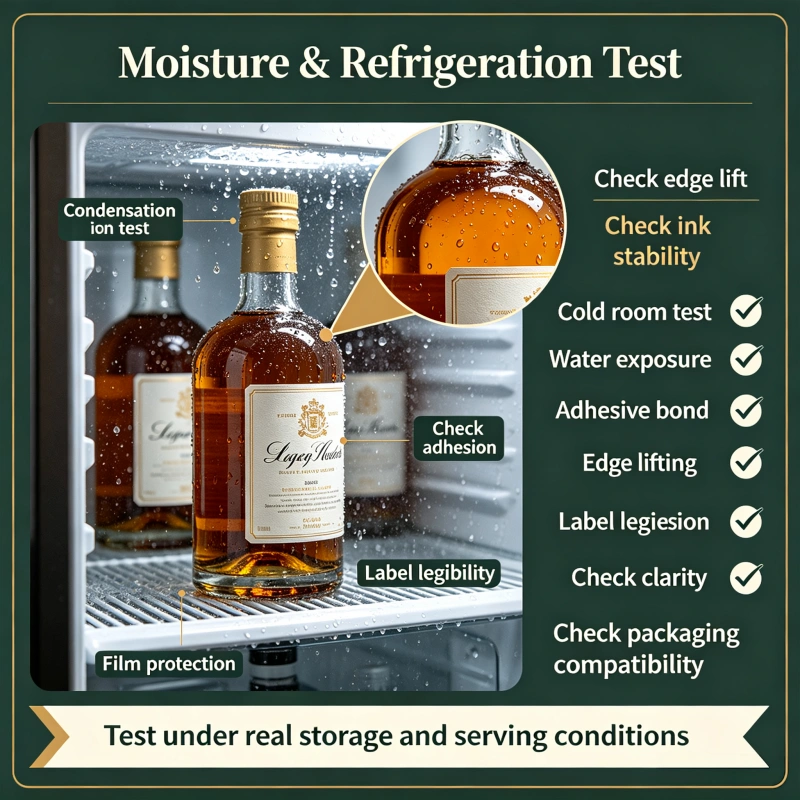
Transparent Labels for Refrigerated Products

Cold-chain products create additional labeling challenges.

A beverage label may encounter:

  • Refrigeration
  • Condensation
  • Ice water
  • Moisture
  • Temperature changes

A clear label needs to remain attached and visually attractive under these conditions.

For refrigerated beverages, transparent film combined with an appropriate adhesive is generally more suitable than ordinary paper.

Test the label under actual refrigeration and condensation conditions before commercial production.


Transparent Labels for Outdoor Products

Outdoor products may be exposed to:

  • Rain
  • Sunlight
  • UV
  • Temperature fluctuations
  • Dust

If a transparent label is intended for outdoor use, evaluate the face material, adhesive, printing ink, and protective coating.

UV exposure can affect printed colors over time.

Therefore, an outdoor transparent label may require additional protection compared with an indoor packaging label.


Custom Transparent Labels: What Can Be Customized?

A professional label manufacturer can customize almost every part of the label structure.

Size

Custom dimensions can be produced according to the container.

Shape

Options include:

  • Rectangle
  • Circle
  • Oval
  • Logo shape
  • Custom die-cut

Material

Possible options include:

  • Clear PET
  • Clear PP
  • Clear PE
  • Specialty transparent films

Adhesive

The adhesive can be selected for:

  • Glass
  • Plastic
  • Metal
  • Coated surfaces

Printing

Possible options include:

  • CMYK
  • White ink
  • Metallic effects
  • Spot colors
  • Variable data

Finishing

Options may include:

  • Gloss
  • Matte
  • Frosted
  • Protective coating
  • Special decorative effects

This makes it possible to create a label specifically around the packaging design rather than adapting the design to a standard label format.


Transparent Labels vs. Direct Screen Printing

Brands sometimes compare transparent labels with direct printing on bottles or containers.

Transparent Labels

Advantages include:

  • Lower packaging modification requirements
  • Easy artwork changes
  • Flexible SKU management
  • Custom shapes
  • Potentially lower setup complexity
  • Suitable for changing product designs

Direct Printing

Advantages can include:

  • Extremely integrated appearance
  • No separate label layer
  • Strong premium effect

However, direct printing requires compatible packaging surfaces and specialized printing processes.

For many brands, transparent labels provide a practical way to achieve a similar visual effect while retaining the flexibility of conventional labeling.


How to Design a Successful No-Label Look

A transparent label should not simply copy the design of a white label.

The design needs to take advantage of transparency.

Use Negative Space

Allow the package to become part of the design.

Keep Typography Clean

Minimal typography often enhances the premium effect.

Use White Strategically

White ink can make critical information stand out.

Consider the Product Color

The liquid or package color becomes part of the visual background.

Avoid Excessive Graphics

Too much printing can eliminate the visual advantage of transparent material.

Test the Real Product

A design that looks excellent on a computer screen may look completely different when applied to a curved bottle containing a colored liquid.


Common Mistakes When Buying Transparent Labels

Choosing a Clear Material Without Testing Clarity

Not all transparent films produce the same visual effect.

Ignoring the Product Color

The background color directly affects printed colors.

Using Too Little White Ink

Light colors may become difficult to see.

Ignoring Condensation

This is particularly important for beverage and refrigerated products.

Designing Only on a Flat Screen

Curved packaging changes how typography and graphics appear.

Focusing Only on Price

A cheaper clear film may not provide the clarity or adhesive performance required for premium packaging.


How Are Custom Transparent Labels Manufactured?

A typical manufacturing process includes several stages.

1. Packaging Assessment

The manufacturer evaluates:

  • Container material
  • Shape
  • Diameter
  • Surface
  • Application environment

2. Material Selection

The appropriate transparent film is selected.

3. Adhesive Selection

The adhesive is matched to the container and environment.

4. Artwork Preparation

The design is adjusted for:

  • Transparent areas
  • White ink
  • Metallic effects
  • Variable data

5. Printing

The artwork is printed using the appropriate technology.

6. Finishing

Gloss, matte, frosting, or protective effects can be added.

7. Die Cutting

The labels are produced in the required shape.

8. Quality Control

The manufacturer checks:

  • Print quality
  • Clarity
  • Dimensions
  • Adhesion
  • Color consistency

9. Application Testing

Samples can be applied to the actual container to verify the final no-label appearance.


Custom Transparent Labels Manufacturer

Perfect Label provides custom Transparent Labels for brands looking to create premium, minimalist, and no-label-look packaging.

As a label manufacturer, Perfect Label can customize:

  • Clear label materials
  • Label dimensions
  • Custom shapes
  • Adhesives
  • CMYK printing
  • White ink
  • Metallic effects
  • Matte finishes
  • Gloss finishes
  • Frosted effects
  • Barcodes
  • QR codes
  • Variable information

Solutions can be developed for:

  • Wine bottles
  • Beverage packaging
  • Cosmetic bottles
  • Food jars
  • Personal care products
  • Essential oil bottles
  • Candles
  • Premium consumer products

The objective is not simply to produce a transparent sticker.

It is to create a transparent labeling system that visually integrates with the packaging.


How to Choose the Right Transparent Labels

Before ordering, consider these seven questions:

1. What Is the Container Material?

Glass and different plastics may require different adhesives.

2. Is the Container Clear or Colored?

The background directly affects the final printed appearance.

3. Do You Need a True No-Label Look?

If yes, high-clarity film and careful application become especially important.

4. Do You Need White Ink?

White ink is useful when text or graphics need strong opacity.

5. Will the Product Be Refrigerated?

If yes, test the label under condensation and low-temperature conditions.

6. Is the Product Exposed to Water or Oil?

Choose materials and adhesives accordingly.

7. What Premium Effect Do You Want?

Choose between:

  • Gloss
  • Matte
  • Frosted
  • Metallic
  • Transparent
  • Partial opaque effects

Answering these questions before production can significantly reduce the risk of selecting an unsuitable label.


FAQ About Transparent Labels

What are Transparent Labels?

Transparent Labels are clear adhesive labels that allow the underlying packaging surface to remain visible. They are commonly used to create minimalist and premium packaging effects.

How do Transparent Labels create a no-label look?

The clear label material visually blends with the packaging while printed graphics remain visible. With suitable film clarity, printing, and application, the label can appear almost as though the design is printed directly on the container.

What material is best for clear labels?

Clear PET and clear PP are common options. The best material depends on clarity, flexibility, durability, container material, and application environment.

Can Transparent Labels be printed with white ink?

Yes. White ink is widely used to improve opacity and contrast on clear labels. It can also be applied selectively to create transparent and opaque areas within the same design.

Can Transparent Labels be used on glass bottles?

Yes. Glass bottles are one of the most common applications, particularly for beverages, wine, cosmetics, sauces, and premium products.

Are Transparent Labels waterproof?

Many transparent film labels can provide strong moisture resistance, but waterproof performance depends on the film, adhesive, printing, and application environment.

Can Transparent Labels be used on refrigerated beverages?

Yes. Suitable film and adhesive constructions can be designed for refrigerated products. Testing under condensation and temperature-cycle conditions is recommended.

Can I customize the size and shape?

Yes. Custom Transparent Labels can be produced in different sizes, shapes, finishes, and printing configurations according to the packaging design.

Are Transparent Labels suitable for premium products?

Yes. Their ability to preserve product visibility and create a clean, minimalist appearance makes them popular for premium beverages, cosmetics, food, personal care, and specialty products.


Final Thoughts

Transparent Labels offer brands a practical way to create the increasingly popular “no label look” without completely changing their packaging manufacturing process.

The biggest advantage is visual integration.

Instead of covering the product with an opaque label, a clear label allows the:

Bottle + Product Color + Brand Design

to work together as one packaging system.

For a premium wine bottle, the wine itself can become part of the design. For cosmetics, the transparent container can reinforce a clean and sophisticated identity. For food jars, customers can see the product while the brand remains clearly visible.

But achieving a convincing no-label effect requires more than transparent film. Film clarity, adhesive, printing technology, white ink, finish, label design, container material, and application quality all influence the final result.

For brands seeking premium packaging, the right transparent label is therefore not simply the clearest material available. It is the combination of design, material, printing, adhesive, and application technology that makes the label visually disappear while allowing the brand to stand out.

High Temperature Labels: Durable Solutions for Extreme Environments

When ordinary labels are exposed to extreme heat, they can quickly lose their printing quality, peel away from the surface, shrink, discolor, or become unreadable. For manufacturers working with metal parts, electronics, automotive components, industrial equipment, laboratory products, appliances, or high-temperature processing environments, choosing the right High Temperature Labels is therefore a performance decision rather than simply a printing decision.

Buyers searching for High Temperature Labels are usually trying to solve a specific application problem. They may need labels that survive soldering, powder coating, painting, sterilization, heat treatment, welding, baking, or prolonged exposure to elevated temperatures. They may also want to know which materials work best, how much temperature resistance they can achieve, whether labels can withstand chemicals, and how to customize labels for industrial identification.

This guide explains what high temperature labels are, how they work, which materials and adhesives are suitable, where they are used, and how to choose a reliable custom labeling solution.

What Are High Temperature Labels?

High-temperature labels are specialized labels designed to remain attached, readable, and functional when exposed to elevated temperatures.

Compared with conventional paper labels, high-temperature labels typically use more durable materials and adhesives.

Depending on the application, a high-temperature label may need to withstand:

  • Short-term exposure to very high temperatures
  • Continuous elevated temperatures
  • Rapid temperature changes
  • Heat combined with chemicals
  • Moisture and steam
  • Abrasion
  • UV exposure
  • Oil and solvents

The exact temperature resistance depends on the complete label construction.

This is important because saying that a label is “high temperature resistant” does not automatically mean it can survive every industrial heating process.

A label suitable for 150°C continuous exposure may be completely inappropriate for a process involving 300°C or higher.

Therefore, always define temperature requirements before selecting the material and adhesive.


Why Do Industrial Applications Need High Temperature Labels?

Industrial products often pass through processes where standard labels cannot survive.

Examples include:

  • Welding
  • Soldering
  • Heat treatment
  • Powder coating
  • Paint curing
  • Baking
  • Sterilization
  • Autoclave processing
  • Engine testing
  • Metal processing
  • Electronics manufacturing

During these processes, labels can experience high heat for seconds, minutes, or hours.

A conventional paper label may:

  • Burn
  • Curl
  • Shrink
  • Peel
  • Become brittle
  • Lose its printing
  • Leave adhesive residue

Once the label becomes unreadable, product identification can be lost.

That can create problems with:

  • Part numbers
  • Serial numbers
  • Batch tracking
  • Production records
  • Safety information
  • Inspection results
  • Traceability

High-temperature labeling solves this problem by creating an identification system designed for the actual operating environment.


High Temperature Labels Are Not All the Same

One of the most important purchasing considerations is understanding the difference between short-term temperature resistance and continuous temperature resistance.

For example, a label may survive a very high temperature for several seconds but have a much lower recommended continuous operating temperature.

Consider three different scenarios:

Short-Term Heat Exposure

The label may enter a heating process briefly and then return to normal temperatures.

Repeated Heat Cycles

The label may repeatedly experience heating and cooling.

Continuous High Temperature

The label remains exposed to elevated temperatures for long periods.

These applications place different demands on the label.

A manufacturer should therefore provide temperature requirements in terms of:

Temperature + Exposure Time + Exposure Frequency + Environment

rather than simply asking for “the highest temperature label.”


Common Temperature Ranges for High Temperature Labels

There is no single universal classification for high-temperature labels because performance depends on material, adhesive, printing, and environmental conditions.

However, buyers may encounter solutions designed for applications around:

Approximate Temperature RangeTypical Applications
100–150°CAppliances, general industrial identification
150–200°CElectronics, manufacturing processes
200–250°CAutomotive and industrial applications
250–300°CHigh-temperature processing
300°C+Specialized metal, ceramic, and industrial applications

These ranges are only a general purchasing framework.

Always confirm the actual maximum temperature using the manufacturer’s technical specifications and application testing.

For extreme applications, the label itself may require a specialized material rather than conventional adhesive labeling.


What Materials Are Used for High Temperature Labels?

Material selection is one of the most important factors affecting performance.

Polyester (PET)

PET is commonly considered for demanding industrial labeling applications because it offers:

  • Good dimensional stability
  • Tear resistance
  • Moisture resistance
  • Chemical resistance
  • Good printability
  • Durability

It can be suitable for equipment identification, electronics, appliances, and industrial components when paired with an appropriate adhesive.

However, standard PET constructions should not automatically be assumed suitable for extreme-temperature processes.


Polyimide Labels

Polyimide labels are widely associated with high-temperature electronics and industrial applications.

They are particularly useful where labels need to survive processes such as:

  • PCB manufacturing
  • Soldering
  • Reflow processing
  • Wave soldering
  • Component identification
  • Electronic assembly

Polyimide offers strong dimensional stability and thermal performance.

This makes it one of the most important materials to consider when selecting labels for electronics manufacturing.


Aluminum and Metal Labels

For extremely demanding applications, metal-based identification solutions may be more suitable than conventional adhesive labels.

Aluminum labels can provide:

  • High durability
  • Strong dimensional stability
  • Excellent resistance to harsh environments
  • Long-term identification capability

They are often used for:

  • Machinery
  • Industrial equipment
  • Automotive components
  • Electrical equipment
  • Outdoor equipment

Metal labels can also be combined with engraving, anodizing, or other identification techniques.


Ceramic-Based Identification

Some extremely high-temperature applications may require ceramic or ceramic-like identification technologies rather than conventional adhesive labels.

These solutions may be considered for:

  • Furnaces
  • Metal processing
  • Engine components
  • Industrial ceramics
  • Extreme-temperature equipment

The manufacturing method is different from standard pressure-sensitive labeling and should be selected based on the actual process temperature and exposure time.


Why Adhesive Matters as Much as the Label Material

A common mistake is to focus entirely on the face material.

However:

Label Material ≠ Complete Temperature Performance

The adhesive is equally important.

A high-temperature face material may survive the heat while the adhesive:

  • Softens
  • Loses adhesion
  • Flows
  • Becomes brittle
  • Leaves residue
  • Detaches from the surface

For this reason, high-temperature labels often use specialized adhesives designed for elevated temperatures.

The adhesive must also match the substrate.

A label applied to:

  • Stainless steel
  • Aluminum
  • Powder-coated metal
  • Plastic
  • Painted surfaces
  • Glass

may require different adhesive characteristics.


High Temperature Labels for Electronics Manufacturing

Electronics manufacturing is one of the most important applications for high-temperature labeling.

During PCB production, labels may encounter processes such as:

  • Reflow soldering
  • Wave soldering
  • Component assembly
  • Cleaning
  • Thermal cycling

A conventional paper label may not maintain dimensional stability or print readability.

Polyimide labels are frequently considered for these applications because they can provide high thermal resistance while remaining suitable for printing and automated identification.

Potential information printed on the label includes:

  • Component number
  • Serial number
  • Batch number
  • Date code
  • Barcode
  • QR code
  • Manufacturing information

This makes high-temperature labels important not only for identification but also for production traceability.


High Temperature Labels for Automotive Parts

Automotive components can experience substantial temperature changes during manufacturing and operation.

High-temperature labels may be used on:

  • Engine components
  • Exhaust-system parts
  • Batteries
  • Electrical components
  • Metal parts
  • Sensors
  • Transmission components

The label may need to survive a combination of:

Heat + Oil + Chemicals + Vibration + Moisture + Abrasion

This makes automotive labeling significantly more demanding than ordinary product labeling.

For long-term identification, the complete label construction should be tested against the actual operating environment.


High Temperature Labels for Metal Parts

Metal manufacturing frequently involves intense heat.

Examples include:

  • Steel processing
  • Aluminum processing
  • Casting
  • Forging
  • Welding
  • Heat treatment
  • Powder coating

Identification needs to remain available throughout production.

For example, a metal component may need to retain:

Part Number → Batch → Production Line → Inspection Data

If the label disappears during heat treatment, traceability can be interrupted.

Depending on the process, manufacturers may use:

  • High-temperature adhesive labels
  • Metal labels
  • Ceramic identification
  • Specialized heat-resistant markings

The right solution depends heavily on the actual process temperature.


High Temperature Labels for Powder Coating

Powder coating involves a curing process in which coated parts are exposed to elevated temperatures.

This creates a challenge for conventional labels.

A suitable high-temperature label may need to maintain:

  • Adhesion
  • Print readability
  • Dimensional stability
  • Barcode readability

However, the right label depends on whether it stays on the product throughout the curing cycle or is intended only for temporary process identification.

This distinction can significantly affect the material and adhesive selection.


High Temperature Labels for Welding

Welding creates localized extreme heat, sparks, and thermal stress.

Traditional adhesive labels may burn or become damaged when placed too close to the welding area.

Possible solutions include:

  • Heat-resistant identification labels
  • Metal tags
  • Specialized high-temperature markings

In welding environments, label placement is also important.

Sometimes the best solution isn’t to buy a higher-temperature label, but to place the identification in an area that provides adequate separation from the heat source.


High Temperature Labels for Appliances

Household and commercial appliances may operate at elevated temperatures.

Applications include:

  • Ovens
  • Furnaces
  • Heating equipment
  • Boilers
  • Industrial ovens
  • Kitchen appliances

Labels may need to identify:

  • Model numbers
  • Serial numbers
  • Electrical specifications
  • Safety information
  • Warning symbols
  • Certifications

For consumer appliances, the label must balance technical performance with appearance.

A durable label that remains readable throughout the expected product life can improve both safety and product identification.


High Temperature Labels for Laboratory and Medical Applications

Some laboratory and healthcare processes involve heat, steam, or sterilization.

Potential applications include:

  • Laboratory containers
  • Medical instruments
  • Sample identification
  • Sterilization processes
  • Autoclave-compatible labeling

When labels are exposed to steam sterilization or autoclave conditions, temperature is only one factor.

The label may also face:

  • Pressure
  • Moisture
  • Condensation
  • Chemicals
  • Repeated thermal cycles

Therefore, buyers should specify the complete sterilization process rather than simply asking for a “high-temperature label.”


High Temperature Labels for Food Processing

Food-processing equipment can experience elevated temperatures during:

  • Baking
  • Cooking
  • Sterilization
  • Processing
  • Cleaning

Labels may be used for equipment identification, containers, trays, and production tracking.

Depending on the application, they may need resistance to:

  • Heat
  • Steam
  • Water
  • Cleaning chemicals
  • Oils

Food-contact requirements are a separate consideration. A label used directly on food-contact surfaces must be evaluated under applicable regulations and intended use.


High Temperature Labels for Industrial Equipment

Industrial equipment often requires labels that remain readable for years rather than days.

Applications include:

  • Motors
  • Pumps
  • Generators
  • Boilers
  • Compressors
  • Machinery
  • Control panels
  • Industrial tools

The label may include:

  • Product model
  • Serial number
  • Warning information
  • Technical specifications
  • Maintenance information
  • QR code
  • Barcode

For industrial identification, long-term durability may be more important than decorative appearance.


High Temperature Labels and Barcode Scanning

Heat resistance alone is not enough when the label contains a barcode.

The barcode must remain:

  • Legible
  • High contrast
  • Dimensionally stable
  • Machine-readable

After heat exposure, some printing systems may fade or distort.

For production environments, manufacturers should test the barcode after the actual thermal process.

This is particularly important for:

  • Manufacturing traceability
  • Warehouse management
  • Quality control
  • Asset tracking

A barcode that looks acceptable to the human eye may still fail automated scanning.


High Temperature Labels With QR Codes

QR codes can provide additional product information.

For example, a high-temperature industrial label could include:

Product Number + Serial Number + QR Code

The QR code may link to:

  • Technical documentation
  • Maintenance instructions
  • Product records
  • Warranty information
  • Inspection data

For industrial products, this can connect the physical equipment with a digital information system.

However, the QR code must remain readable after heat exposure, which means both the printing technology and label surface need to be considered carefully.


High Temperature Labels and Chemical Resistance

Many high-temperature environments also involve chemicals.

Examples include:

  • Industrial cleaning
  • Automotive manufacturing
  • Electronics production
  • Metal processing
  • Laboratory applications

A label may therefore need:

High Temperature Resistance + Chemical Resistance

These are separate performance characteristics.

A label that survives heat may not necessarily resist:

  • Solvents
  • Alcohol
  • Oils
  • Acids
  • Alkalis
  • Cleaning agents

If the application includes chemicals, the buyer should provide the chemical type and concentration to the label manufacturer for compatibility testing.


High Temperature Labels for Harsh Environments

Some industrial applications combine several stress factors.

For example:

250°C + Oil + Abrasion + Outdoor UV

This is much more demanding than:

150°C + Dry Indoor Environment

A high-performance label should therefore be evaluated against the entire environment.

Key variables include:

  • Temperature
  • Humidity
  • Chemical exposure
  • UV exposure
  • Mechanical abrasion
  • Pressure
  • Surface material
  • Duration

This is why application-specific testing is essential.


How to Choose the Right High Temperature Labels

Before requesting a quotation, provide the manufacturer with as much application information as possible.

1. Maximum Temperature

What is the highest temperature?

2. Exposure Duration

How long will the label remain at that temperature?

3. Thermal Cycle

Is the label heated once or repeatedly?

4. Application Surface

Is it:

  • Metal?
  • Plastic?
  • Glass?
  • Painted?
  • Powder-coated?

5. Environmental Conditions

Will the label encounter:

  • Water?
  • Oil?
  • Chemicals?
  • UV?
  • Steam?

6. Required Lifetime

Does the label need to last:

  • Hours?
  • Weeks?
  • Months?
  • Several years?

7. Required Information

Do you need:

  • Text?
  • Barcode?
  • QR code?
  • Serial number?
  • Logo?
  • Warning symbols?

Providing this information allows the manufacturer to recommend a more appropriate construction.


High Temperature Labels: Temporary vs. Permanent

Not every high-temperature label needs to remain on the product permanently.

Temporary Process Labels

These are used during:

  • Manufacturing
  • Heat treatment
  • Coating
  • Assembly
  • Testing

Their main purpose is process identification.

Permanent Labels

These remain attached throughout the product’s service life.

They are used for:

  • Serial numbers
  • Safety information
  • Equipment identification
  • Technical specifications
  • Asset tracking

The distinction matters because a temporary process label may prioritize heat resistance during a specific process, while a permanent label may need long-term resistance to multiple environmental factors.


Common Mistakes When Buying High Temperature Labels

Choosing Based Only on Maximum Temperature

A specification such as “resistant to 300°C” is not enough.

Always ask:

For how long?

Ignoring the Adhesive

The face material may survive the temperature while the adhesive fails.

Ignoring the Surface

Metal, plastic, glass, and painted surfaces can require different adhesive systems.

Forgetting Thermal Cycling

Repeated heating and cooling can create stresses that a single heating event does not reveal.

Not Testing the Printed Information

A label may remain physically attached while the barcode or text becomes unreadable.

Ordering in Bulk Before Testing

High-temperature applications should ideally be tested under actual process conditions before large-scale production.


How Are Custom High Temperature Labels Manufactured?

A professional custom manufacturing process usually begins with application analysis.

Step 1: Application Assessment

The manufacturer evaluates:

  • Temperature
  • Duration
  • Surface
  • Environment
  • Label size
  • Required lifetime

Step 2: Material Selection

Possible materials include:

  • Polyester
  • Polyimide
  • Synthetic materials
  • Aluminum
  • Specialty high-temperature substrates

Step 3: Adhesive Selection

The adhesive is selected according to:

  • Temperature
  • Surface energy
  • Required permanence
  • Chemical exposure

Step 4: Printing

The label can be printed with:

  • Text
  • Logos
  • Barcodes
  • QR codes
  • Serial numbers
  • Variable data

Step 5: Finishing

Depending on the application, finishing may include:

  • Protective coatings
  • Lamination
  • Die cutting
  • Special surface treatments

Step 6: Testing

Test samples under the expected thermal and environmental conditions.

Step 7: Mass Production

After approval, labels can be supplied in rolls, sheets, or other formats suitable for manual or automated application.


Custom High Temperature Labels Manufacturer

Perfect Label provides custom labeling solutions for industrial and commercial applications where standard labels may not provide sufficient thermal performance.

Custom High Temperature Labels can be developed according to:

  • Temperature requirements
  • Exposure time
  • Surface material
  • Adhesive requirements
  • Chemical exposure
  • Label size
  • Printing requirements
  • Application method

Possible solutions include:

  • Polyimide labels
  • High-temperature PET labels
  • Metal labels
  • Industrial identification labels
  • High-temperature barcode labels
  • High-temperature QR labels
  • Heat-resistant equipment labels
  • Custom serialized labels

The label can also be customized with:

Size + Shape + Material + Adhesive + Printing + Barcode + QR Code + Variable Data

For demanding applications, Perfect Label can work from the actual operating conditions rather than simply recommending a generic “high-temperature” material.


High Temperature Labels vs. Standard Labels

FeatureStandard LabelsHigh Temperature Labels
Normal indoor useExcellentExcellent
Elevated temperatureLimitedDesigned for specific ranges
Thermal cyclingLimitedBetter when properly specified
Industrial processesApplication dependentSuitable for demanding applications
Chemical resistanceLimitedAvailable with suitable construction
Long-term industrial identificationApplication dependentStrong potential
Specialized materialsLimitedPolyimide, PET, metal and others
Custom printingYesYes
Barcode/QR codesYesYes

The key difference is not simply the label’s appearance.

It is the ability of the complete construction to maintain adhesion, integrity, and readability under defined conditions.


How to Test High Temperature Labels Before Production

Testing is particularly important for high-temperature applications.

Apply the Label to the Actual Surface

Testing on laboratory metal instead of the actual product may produce misleading results.

Expose It to the Real Temperature

Use the same or representative process temperature.

Match the Exposure Time

A five-minute exposure is different from continuous exposure.

Check Adhesion

Look for:

  • Peeling
  • Curling
  • Edge lifting
  • Adhesive migration

Check Printing

Inspect:

  • Text
  • Barcodes
  • QR codes
  • Logos
  • Fine details

Check After Cooling

Some failures appear only after the label cools down.

Test Repeated Cycles

If the product experiences repeated heating and cooling, simulate the same process.

Testing can reveal problems before they become production problems.


FAQ About High Temperature Labels

What are High Temperature Labels used for?

High Temperature Labels are used for product and process identification in environments exposed to elevated temperatures, including electronics manufacturing, automotive production, metal processing, appliances, industrial equipment, and laboratory applications.

What material is best for high-temperature labeling?

There is no single best material. Polyimide is commonly considered for demanding electronics applications, while PET, aluminum, and specialty materials may be more appropriate for other industrial environments.

Can high-temperature labels survive 200°C?

Some label constructions can be designed for temperatures around 200°C, but actual performance depends on the material, adhesive, exposure time, surface, and environment. Testing is recommended before mass production.

Can high-temperature labels be used on metal?

Yes. High-temperature labels can be designed for metal surfaces. The adhesive and label construction should be selected according to the specific metal and operating conditions.

Can High Temperature Labels include barcodes?

Yes. High-temperature labels can be printed with barcodes, QR codes, serial numbers, and other variable information. The printed code should be tested after thermal exposure to confirm machine readability.

Are High Temperature Labels waterproof?

Some high-temperature label constructions can also provide water resistance. However, temperature and water resistance are separate specifications and should be evaluated together.

Can High Temperature Labels withstand chemicals?

Certain constructions can provide chemical resistance, but compatibility depends on the chemical, concentration, temperature, and exposure time.

Can I customize High Temperature Labels?

Yes. Customization can include material, size, shape, adhesive, printing, barcodes, QR codes, serial numbers, and finishing.

Should I test samples before placing a bulk order?

Yes. For demanding thermal applications, sample testing under actual or simulated production conditions is strongly recommended.


Final Thoughts

High Temperature Labels are specialized identification solutions for environments where conventional labels cannot reliably survive.

The right solution depends on much more than the maximum temperature.

A successful high-temperature label should be evaluated according to:

Temperature + Exposure Time + Thermal Cycling + Surface + Adhesive + Chemicals + Moisture + Required Lifetime

For electronics manufacturing, polyimide labels may provide an effective solution for soldering and thermal-processing environments. For industrial equipment, PET or metal identification labels may be more appropriate. For extreme applications involving very high temperatures, specialized ceramic or metal identification technologies may need to be considered.

The most important purchasing principle is simple:

Do not choose a High Temperature Label based only on a temperature number. Choose it based on the complete operating environment.

By testing the label on the actual product surface and under realistic process conditions, manufacturers can reduce the risk of peeling, fading, unreadable barcodes, and lost product traceability.

For companies that need reliable identification in demanding environments, a properly engineered High Temperature Labels solution can protect critical product information long after ordinary labels have given up and gone on an involuntary thermal vacation.

RFID Labels and Smart Labels: The Future of Product Tracking.

As businesses look for faster inventory management, better product traceability, automated identification, and more connected packaging, RFID Labels and Smart Labels are becoming increasingly important across manufacturing, retail, logistics, healthcare, pharmaceuticals, electronics, and consumer products.

Unlike conventional printed labels, smart labels can connect physical products with digital information. Depending on the technology selected, a label can identify an individual product, record inventory information, support automated scanning, enable product authentication, or provide customers with digital content.

However, buyers searching for RFID Labels and Smart Labels are usually not looking only for a definition. Their actual search intent is more commercial and practical:

  • What are RFID labels and smart labels?
  • How do RFID labels work?
  • What is the difference between RFID, NFC, and ordinary labels?
  • Which RFID chip should I choose?
  • Can RFID labels be customized?
  • What materials are suitable for RFID labels?
  • Where are RFID labels used?
  • Are RFID labels waterproof?
  • How much do RFID labels cost?
  • Can RFID labels be used for inventory and supply-chain management?
  • How can I choose a suitable RFID label manufacturer?

This guide answers these questions from the perspective of product selection, application, customization, and procurement.

What Are RFID Labels?

RFID Labels are adhesive labels that combine a printed label structure with an RFID inlay.

An RFID inlay generally consists of:

  • RFID chip
  • Antenna
  • Substrate
  • Adhesive or label construction

The chip stores identification or other data, while the antenna communicates with an RFID reader through radio frequency technology.

Unlike a traditional barcode, an RFID label does not necessarily need direct line-of-sight scanning.

A typical RFID system includes:

RFID Label → RFID Reader → Antenna → Software/Database

When an RFID reader sends a radio-frequency signal, the RFID tag responds according to the type of RFID technology being used. The reader then transfers the captured information to the relevant software system.

This makes RFID particularly useful when businesses need to identify large numbers of products or assets quickly.


What Are Smart Labels?

Smart Labels are a broader category of labels that combine conventional printed information with additional technologies.

Depending on the application, smart labels may incorporate:

  • RFID
  • NFC
  • QR codes
  • Barcodes
  • Sensors
  • Electronic components
  • Variable data
  • Digital authentication technologies

Therefore:

RFID labels are one type of smart label.

But not every smart label is an RFID label.

For example, a label containing a unique QR code linked to a product database can be considered a smart or connected label, even though it does not contain an RFID chip.


RFID Labels vs. Traditional Labels

Traditional labels primarily communicate information visually.

They may include:

  • Product name
  • Logo
  • Ingredients
  • Instructions
  • Barcode
  • Batch number
  • Price

RFID labels add electronic identification capabilities.

FeatureTraditional LabelRFID Label
Printed informationYesYes
Product identificationVisualElectronic + visual
Line-of-sight scanningUsually required for barcodeGenerally not required
Multiple-item readingLimitedPossible
Unique identificationBarcode/serial numberRFID UID/data
Automated inventoryLimitedStrong
Real-time data integrationLimitedAvailable
Rewritable dataNoDepends on chip
Digital trackingLimitedStrong potential

This does not mean RFID should replace every barcode.

In many applications, RFID and barcodes work effectively together.


How Do RFID Labels Work?

The working principle depends on the RFID frequency and tag type.

For a typical passive UHF RFID label, the process is approximately:

Step 1: Reader Sends a Signal

The RFID reader generates a radio-frequency field.

Step 2: RFID Antenna Receives Energy

A passive RFID tag can harvest energy from the reader’s signal.

Step 3: Chip Activates

The RFID chip uses the available energy to operate.

Step 4: Tag Responds

The chip communicates its stored information through the antenna.

Step 5: Reader Captures the Data

The reader receives and processes the response.

Step 6: Software Uses the Information

The data can be connected to:

  • Inventory systems
  • Warehouse management systems
  • ERP systems
  • Retail systems
  • Production systems
  • Logistics platforms

This allows physical products to become identifiable digital objects within a company’s information system.


What Are the Main RFID Frequencies?

RFID technology is commonly divided into several frequency categories.

LF RFID

Low-frequency RFID typically operates around 125–134 kHz.

It is often used for:

  • Animal identification
  • Access control
  • Industrial applications
  • Specialized asset identification

LF systems generally have relatively short read ranges.

HF RFID

High-frequency RFID operates at 13.56 MHz.

HF technology is used in:

  • Access cards
  • Library systems
  • Smart cards
  • Product authentication
  • NFC-related applications

HF is particularly suitable for applications requiring short-range communication.

UHF RFID

UHF RFID commonly operates in the region of approximately 860–960 MHz, depending on regional regulations.

It is widely used for:

  • Retail inventory
  • Warehouse management
  • Logistics
  • Supply-chain tracking
  • Apparel
  • Asset management

UHF is often selected when longer reading distances and faster bulk identification are important.


RFID Labels vs. NFC Labels

RFID and NFC are related technologies, but their practical applications can differ significantly.

FeatureRFID LabelsNFC Labels
Typical applicationsInventory, logistics, trackingConsumer interaction, authentication
Reading distanceCan be relatively longUsually very short
Bulk scanningExcellent for suitable UHF systemsGenerally not the main use
Smartphone interactionUsually not directlyStrong
Retail inventoryExcellentLimited
Product authenticationPossibleExcellent
Digital marketingPossibleExcellent
Supply-chain applicationsStrongLimited

NFC operates within the HF RFID family, but it is specifically designed for short-range communication and interaction with compatible devices.

For example:

UHF RFID → warehouse inventory

NFC → smartphone product authentication

Of course, real-world applications can overlap.


Why Are RFID Labels Becoming Popular?

The primary reason is simple:

Businesses want to identify physical products faster and with less manual work.

Traditional inventory systems often depend heavily on:

  • Barcode scanning
  • Manual counting
  • Visual inspection
  • Data entry

RFID can automate portions of this process.

Potential benefits include:

  • Faster inventory counting
  • Reduced manual scanning
  • Better product visibility
  • Automated identification
  • Improved traceability
  • Better inventory accuracy
  • Reduced handling time

For companies processing thousands or millions of individual items, these advantages can become commercially significant.


RFID Labels for Retail

Retail is one of the most important applications for RFID technology.

RFID labels can be attached to:

  • Clothing
  • Shoes
  • Bags
  • Accessories
  • Consumer electronics
  • General merchandise

A retailer can use RFID to identify products during:

  • Receiving
  • Storage
  • Inventory counting
  • Replenishment
  • Order fulfillment
  • Returns

For example, instead of manually scanning each barcode one by one, a suitable RFID system can identify multiple tagged products within a reading area.

This can make inventory operations more efficient.


RFID Labels for Warehousing

Warehouses handle large numbers of products moving through multiple stages.

RFID labels can help identify goods during:

Receiving → Storage → Picking → Packing → Shipping

A unique RFID identity can be associated with:

  • SKU
  • Product model
  • Batch
  • Serial number
  • Location
  • Shipment
  • Customer order

The exact data structure depends on the company’s software architecture.

RFID therefore becomes more valuable when it is integrated into a complete warehouse-management system rather than used as an isolated label.


RFID Labels for Supply Chain Management

Supply chains involve multiple parties.

A product may move from:

Manufacturer → Distributor → Warehouse → Retailer → Customer

Each transfer creates opportunities for inventory discrepancies.

RFID can help companies improve visibility by assigning products, cases, pallets, or assets with unique identifiers.

Potential applications include:

  • Shipment verification
  • Receiving confirmation
  • Inventory tracking
  • Distribution management
  • Asset tracking
  • Return management

This can help companies reduce uncertainty about where products are located within their supply network.


RFID Labels for Manufacturing

Manufacturers can use RFID labels throughout production.

Potential applications include:

  • Raw material identification
  • Work-in-progress tracking
  • Finished product identification
  • Production-line management
  • Tool tracking
  • Container tracking
  • Quality control

For example, a reusable production container can carry an RFID tag.

When it enters a production area, the system can identify the container automatically and associate it with the relevant process.

This can reduce manual identification work.


RFID Labels for Healthcare

Healthcare environments involve large numbers of products and assets.

RFID labels may be used for:

  • Medical equipment
  • Pharmaceutical products
  • Laboratory samples
  • Hospital assets
  • Consumables
  • Patient-related identification systems

However, healthcare applications require careful consideration of privacy, regulatory, data-security, and operational requirements.

RFID should therefore be implemented as part of a properly designed identification system rather than treated simply as a replacement for ordinary labels.


RFID Labels for Pharmaceuticals

Pharmaceutical manufacturers and distributors can use RFID technology to improve product identification and supply-chain visibility.

Potential applications include:

  • Medicine packaging
  • Pharmaceutical cartons
  • Medical devices
  • High-value healthcare products
  • Inventory management
  • Authentication systems

RFID can be combined with printed information and other security technologies.

For higher-security applications, a smart label may combine:

RFID + Serialization + QR Code + Tamper Evidence

This creates multiple layers of product identification and protection.


RFID Labels for Electronics

Electronics products often have high unit values and complex supply chains.

RFID labels can be used for:

  • Electronic components
  • Finished devices
  • Spare parts
  • Equipment
  • IT assets
  • Warranty management

A serialized RFID label can associate an individual product with its production and service records.

This can be useful for:

  • Warranty verification
  • Asset management
  • Product returns
  • Maintenance records
  • Inventory control

RFID Labels for Automotive Parts

Automotive manufacturing requires precise identification of components.

RFID labels can be used for:

  • Parts
  • Returnable containers
  • Pallets
  • Production tools
  • Work-in-progress
  • Spare parts

In industrial environments, label durability becomes particularly important.

The label may need to resist:

  • Oil
  • Grease
  • Water
  • Abrasion
  • Heat
  • Chemicals

The correct face material and adhesive must be selected for the application.


What Materials Are Used for RFID Labels?

The RFID inlay itself is only one part of the final product.

The outer label material can be customized.

Paper RFID Labels

Paper is economical and provides excellent printability.

It is suitable for:

  • Cartons
  • Retail products
  • General inventory
  • Logistics labels

Paper is often a practical choice when the label does not require extreme environmental resistance.

PP RFID Labels

PP provides better resistance to:

  • Moisture
  • Tearing
  • Handling

It can be used for products exposed to more demanding conditions.

PET RFID Labels

PET provides higher durability and dimensional stability.

It can be considered for:

  • Industrial applications
  • Electronics
  • Outdoor assets
  • Durable equipment

Synthetic Paper

Synthetic materials can balance paper-like printing performance with improved durability.

The best material depends on the environment, label lifespan, and budget.


Can RFID Labels Be Waterproof?

Yes, RFID labels can be manufactured with waterproof or water-resistant constructions.

However, waterproof performance depends on the complete label structure, not simply the RFID chip.

Important factors include:

  • Face material
  • Adhesive
  • Printing
  • Lamination
  • Edge protection
  • Application surface

For example, a synthetic face material combined with a suitable permanent adhesive and protective finish may be more appropriate for a wet environment than an ordinary paper label.

For products exposed to water, condensation, or outdoor conditions, physical testing is recommended before mass production.


Can RFID Labels Be Used on Metal?

Metal can affect RFID performance, especially with conventional RFID tag constructions.

When the RFID antenna is placed directly on or very close to metal, the radio-frequency characteristics can change significantly.

For metal applications, specialized on-metal RFID tags can be used.

These may incorporate:

  • Spacer layers
  • Specialized antenna designs
  • Foam materials
  • Rigid constructions

Typical applications include:

  • Machinery
  • Metal containers
  • Tools
  • Industrial equipment
  • IT assets
  • Automotive components

If the label will be attached to metal, always tell the RFID label manufacturer before selecting the inlay.


What RFID Chips Can Be Used?

Different applications require different chip capabilities.

Common UHF RFID chip families may include products from major RFID semiconductor manufacturers.

Selection factors can include:

  • Memory capacity
  • Read sensitivity
  • Operating characteristics
  • Security features
  • Encoding requirements
  • Compatibility with the reader system

For HF and NFC applications, different chip families are available.

The right chip should therefore be selected based on:

Frequency + Reader + Application + Required Memory + Security + Read Environment

Choosing a chip simply because it is popular can lead to unnecessary cost or inadequate performance.


What Can Be Customized on RFID Labels?

A major advantage of working with a custom RFID label manufacturer is that the label can be developed around the application.

Customization may include:

Label Size

Examples include:

  • Small product labels
  • Medium retail labels
  • Large logistics labels

Label Shape

Possible formats include:

  • Rectangle
  • Square
  • Circle
  • Oval
  • Custom die-cut

Printing

Options can include:

  • CMYK
  • Spot colors
  • Variable data
  • Serial numbers
  • Barcodes
  • QR codes

Material

Options include:

  • Paper
  • PP
  • PET
  • Synthetic paper
  • Specialty materials

Adhesive

The adhesive can be selected according to:

  • Glass
  • Plastic
  • Metal
  • Cardboard
  • Painted surfaces

RFID Inlay

The inlay can be selected according to:

  • Frequency
  • Read distance
  • Application
  • Required memory
  • Reader compatibility

RFID Labels With QR Codes

RFID and QR codes do not have to compete.

They can complement each other.

For example:

RFID → automated warehouse identification

QR Code → customer-facing digital information

A product can therefore have both technologies on the same label.

This can support different users:

  • Warehouse staff → RFID
  • Retail employees → RFID/barcode
  • Customers → QR code
  • Service technicians → QR code/RFID

Combining technologies can make one physical label useful across multiple stages of the product lifecycle.


Smart Labels for Product Authentication

Counterfeit products remain a concern in many industries.

Smart labels can help brands create digital authentication systems.

A label may contain:

  • Unique QR code
  • NFC chip
  • RFID chip
  • Serial number
  • Holographic feature
  • Tamper evident construction

The customer can scan or interact with the label to access authentication information.

For example:

Physical product → Unique smart label → Digital product record

This creates a connection between the physical product and the brand’s digital platform.

The exact effectiveness of an authentication system depends on the underlying software and data architecture, not just the presence of a QR code or RFID chip.


RFID Labels and Product Traceability

Traceability means being able to understand the movement or history of a product.

An RFID label can provide a unique identifier linked to information in a database.

Depending on the system, this may include:

  • Manufacturing batch
  • Production date
  • SKU
  • Serial number
  • Warehouse location
  • Shipment
  • Distribution channel

For example:

RFID ID: 123456789

can be associated within the customer’s software system with:

Product: Model A
Batch: B2026-08
Production: August 2026
Destination: European warehouse

The RFID label itself does not automatically create traceability. The value comes from integrating the physical identifier with appropriate software.


RFID Labels and Inventory Accuracy

One of the most attractive applications for RFID is inventory management.

A barcode system generally requires scanning each barcode.

RFID systems can automate identification under suitable conditions.

This can potentially improve:

  • Inventory visibility
  • Stock counting
  • Replenishment
  • Receiving
  • Shipping verification

For retailers and warehouses with large SKU volumes, even small improvements in inventory processes can have meaningful operational value.


What Affects RFID Reading Performance?

RFID performance is not determined by the label alone.

Important factors include:

1. Material

Paper, plastic, glass, liquid, and metal can interact differently with radio waves.

2. Tag Orientation

The orientation of the tag relative to the reader antenna can influence performance.

3. Reader Power

Reader settings affect the available operating range.

4. Antenna Design

Different antenna designs are optimized for different applications.

5. Product Density

When many products are packed together, tag interaction and RF conditions can change.

6. Environment

Warehouses containing metal racks, liquids, machinery, or other RF-interacting materials may require specialized testing.

This is why a good RFID project should involve real-world sample testing.


How to Choose the Right RFID Labels

Before ordering RFID labels, buyers should evaluate several questions.

What Are You Tracking?

Is it:

  • Apparel?
  • Cartons?
  • Pallets?
  • Electronics?
  • Industrial equipment?
  • Medical assets?
  • Automotive components?

What Is the Packaging Material?

Is the label attached to:

  • Paperboard
  • Plastic
  • Glass
  • Metal
  • Wood

What Reading Distance Do You Need?

A short-range application may require a different RFID technology from a warehouse gate where longer-range identification is required.

How Much Data Do You Need?

If the RFID chip only needs a unique identifier, a lower-memory option may be sufficient.

If additional information must be stored on the chip, memory requirements change.

Does the Label Need to Be Durable?

For long-term industrial applications, PET or other synthetic materials may be more appropriate than standard paper.

Do You Need Custom Printing?

Consider whether you require:

  • Logo
  • Product information
  • Barcode
  • QR code
  • Serial number
  • Variable data

Common Mistakes When Buying RFID Labels

Choosing the RFID Inlay Without Testing

An inlay that works well on cardboard may not perform the same way on metal or liquid-filled products.

Focusing Only on Read Range

Maximum laboratory read range does not necessarily equal real-world performance.

Ignoring the Adhesive

A technically excellent RFID inlay is useless if the label does not stay attached.

Using the Wrong Frequency

The RFID frequency should match the reader system and regional requirements.

Assuming RFID Replaces Everything

RFID can complement existing barcode and digital systems rather than necessarily replacing them completely.

Ordering Large Quantities Before Testing

Always test samples on the actual products and under real operating conditions.


How Are Custom RFID Labels Manufactured?

A typical custom RFID label manufacturing process may include:

1. Application Analysis

The manufacturer identifies:

  • Product
  • Packaging
  • Environment
  • Reading requirements
  • Label dimensions

2. RFID Inlay Selection

The manufacturer selects an appropriate chip and antenna configuration.

3. Label Material Selection

Choose paper, PP, PET, or another material.

4. Printing

Brand artwork and product information are printed.

5. Encoding

When required, RFID data can be encoded according to the customer’s system.

6. Die Cutting

The label is cut to the required size and shape.

7. Quality Inspection

The finished labels can be checked for:

  • Print quality
  • Dimensions
  • Adhesion
  • Encoding
  • RFID performance

8. Packaging

Labels can be supplied in rolls, sheets, or other formats, depending on application and equipment requirements.


RFID Labels Manufacturer and Custom Smart Label Solutions

For companies implementing RFID for the first time, choosing a supplier based solely on label price can be risky.

The RFID label needs to work as part of the customer’s complete system.

A capable RFID Labels manufacturer should understand:

  • RFID inlays
  • Label materials
  • Adhesives
  • Printing
  • Encoding
  • Product surfaces
  • Application environments
  • Reader compatibility
  • Custom dimensions

Perfect Label provides customized RFID and smart label solutions for manufacturers, retailers, distributors, logistics companies, and brand owners.

Custom solutions can include:

  • UHF RFID Labels
  • HF RFID Labels
  • NFC Smart Labels
  • RFID Product Labels
  • RFID Logistics Labels
  • RFID Asset Labels
  • RFID Inventory Labels
  • RFID Security Labels
  • On-Metal RFID Labels
  • Serialized RFID Labels
  • QR + RFID Labels

The label structure can be customized according to the customer’s product and operating environment.


RFID Labels vs. Smart Labels: Which Should You Choose?

The right solution depends on the application.

Choose RFID Labels When:

  • You need automated identification
  • Large numbers of products must be scanned
  • Inventory efficiency is important
  • Supply-chain tracking is required
  • Manual barcode scanning is inefficient

Choose NFC Smart Labels When:

  • Smartphone interaction is important
  • Customer authentication is required
  • Digital product information is needed
  • Brand engagement is a priority

Choose QR Smart Labels When:

  • Low-cost digital connectivity is needed
  • Customers need to scan the product
  • Product information should be easily updated online

Choose RFID + QR Labels When:

  • Both automated inventory and consumer interaction are required

Choose RFID + Tamper Evident Labels When:

  • Product authentication and package security are both important

There is no universal “best” smart label. The right solution is the one that matches the workflow.


The Future of Smart Labels

Smart labels are moving beyond simple identification.

Future applications are increasingly connected with:

  • Digital product passports
  • Supply-chain visibility
  • Product authentication
  • Automated inventory
  • Circular economy initiatives
  • Recycling information
  • Connected packaging
  • Digital customer experiences

For example, a future product label may simultaneously provide:

Product Identification + Traceability + Authentication + Consumer Information

This creates a bridge between physical products and digital systems.

For manufacturers and brands, that means the label can become an active part of the product lifecycle rather than simply a printed piece of packaging.


FAQ About RFID Labels and Smart Labels

What is an RFID label?

An RFID label is a printed adhesive label containing an RFID inlay made from a chip and antenna. It enables products, assets, or packaging to be identified electronically using compatible RFID readers.

What is a smart label?

A smart label combines traditional printed labeling with additional technologies such as RFID, NFC, QR codes, sensors, or variable digital information.

Are RFID labels waterproof?

Yes. RFID labels can be produced using water-resistant or waterproof materials and adhesives. Select the complete label construction based on the environment.

Can RFID labels be printed with a company logo?

Yes. Custom RFID labels can include logos, product information, barcodes, QR codes, colors, serial numbers, and other printed content.

Can RFID labels work on metal?

Yes, but standard RFID labels may not perform optimally when directly attached to metal. Specialized on-metal RFID tags are generally more appropriate for metal surfaces.

What is the difference between RFID and NFC?

NFC is a short-range technology based on HF RFID technology and is optimized for close-range interaction, particularly with compatible smartphones. RFID, especially UHF RFID, is widely used for inventory, logistics, and automated identification.

Can RFID labels replace barcodes?

RFID can replace barcodes in some applications, but many businesses use RFID and barcodes together. The best approach depends on the operational requirements and existing IT infrastructure.

How much do RFID labels cost?

The price depends on the RFID inlay, chip, material, size, printing, encoding, adhesive, quantity, and special requirements. Large-volume orders generally have different unit economics from small customized batches.

Do RFID labels require a battery?

Many commonly used passive RFID labels do not require an internal battery. They obtain operating energy from the reader’s RF field. Active and battery-assisted RFID products are different categories.

How far can an RFID label be read?

Read distance varies considerably depending on RFID frequency, chip, antenna, reader, environment, tag orientation, and product material. Determine a practical reading distance through testing rather than relying solely on a generic specification.


Final Thoughts

RFID Labels and Smart Labels are transforming the traditional role of product labeling.

A conventional label tells customers what a product is.

A smart label can help a business identify, track, authenticate, manage, and connect that product.

For retail, RFID can improve inventory visibility. For logistics, it can support automated identification. For manufacturing, it can connect products and assets with production processes. For brands, NFC and QR technologies can create digital customer experiences. For high-value products, smart labels can combine identification with authentication and tamper evidence.

The most important step is choosing the right technology for the application.

Consider:

Product → Material → Environment → Reading Distance → RFID Frequency → Chip → Adhesive → Printing → Software Integration

For a simple retail application, a standard paper UHF RFID label may be sufficient. For an outdoor industrial asset, a durable PET construction may be more appropriate. For metal equipment, an on-metal RFID solution may be necessary. For consumer authentication, NFC or QR technology may provide greater value.

Ultimately, the best RFID Labels and Smart Labels are not simply the ones with the most advanced chips. They are the ones that reliably solve a specific identification, tracking, authentication, or digital-connectivity problem while fitting the product’s physical environment and the customer’s business workflow.

How Custom Labels Improve Product Packaging and Brand Value

When consumers compare similar products on a retail shelf, the label is often one of the first elements they notice. Before they read the ingredients, compare prices, or search for reviews, they see the product name, colors, logo, typography, images, and overall packaging design.

This is why Custom Labels are more than a way to attach information to a package. For food brands, beverage companies, cosmetics manufacturers, electronics suppliers, household-product businesses, and private-label companies, a well-designed label can influence product perception, strengthen brand recognition, improve shelf visibility, and communicate important product information.

But buyers searching for Custom Labels are usually looking for more than attractive printing. Their real questions are often practical:

  • What type of label is best for my product?
  • Which material should I choose?
  • How can custom labels improve my packaging?
  • Are custom labels waterproof?
  • How much customization is possible?
  • Which finishes make a product look premium?
  • How can labels support brand differentiation?
  • What should I consider before ordering labels?
  • How can I balance quality and cost?

This guide answers these questions from a practical purchasing perspective and explains how Custom Labels can improve both product packaging and long-term brand value.


What Are Custom Labels?

Custom Labels are labels manufactured according to a company’s specific product, packaging, branding, and application requirements rather than using a standard off-the-shelf label.

Customization can cover almost every part of the label:

  • Material
  • Size
  • Shape
  • Color
  • Artwork
  • Adhesive
  • Printing
  • Surface finish
  • Security features
  • Variable information
  • Packaging format

For example, a premium wine brand may require textured paper with gold foil, while a refrigerated beverage manufacturer may need a waterproof BOPP label.

A cosmetics company could choose a clear PET label with a minimalist design, while an industrial manufacturer may prioritize durable PET, chemical resistance, and strong permanent adhesive.

Therefore, customization is not simply about changing the artwork. It is about creating a label that works with the product and the brand simultaneously.


Why Do Custom Labels Matter for Product Packaging?

Packaging has several functions.

It needs to:

  1. Protect the product
  2. Communicate information
  3. Identify the brand
  4. Attract customers
  5. Differentiate the product
  6. Support the purchasing decision

The label contributes directly to several of these functions.

A generic label can communicate basic information, but a professionally designed custom label can turn the package into a recognizable brand asset.

Consider two products with identical containers.

One has a plain white label containing basic text.

The other has:

  • A distinctive logo
  • Consistent brand colors
  • Premium typography
  • Clear product hierarchy
  • High-quality imagery
  • A carefully selected material
  • Embossing or foil details

The products may contain similar contents, but the second package can communicate a significantly different perceived value.

That is the power of packaging design.


Custom Labels Strengthen Brand Recognition

One of the biggest long-term benefits of custom labeling is brand consistency.

Customers may encounter the same brand across:

  • Retail stores
  • E-commerce websites
  • Social media
  • Advertising
  • Trade shows
  • Product packaging

Consistent visual elements help customers recognize the brand more quickly.

Important brand elements can include:

  • Logo
  • Brand colors
  • Typography
  • Graphic patterns
  • Icons
  • Product photography
  • Label shape
  • Finishing style

For example, a company selling five different skincare products may use different colors for each product while keeping the same typography, logo placement, and label structure.

This creates a recognizable product family.

Instead of designing every label independently, the company develops a visual labeling system.


Custom Labels Help Products Stand Out on the Shelf

Shelf competition is intense.

A consumer may see dozens of similar products within a few seconds.

A custom label can help create visual differentiation through:

  • Strong color contrast
  • Unusual shapes
  • Premium materials
  • Clear typography
  • Minimalist design
  • Metallic effects
  • Transparent labels
  • Textured paper
  • Foil stamping

However, standing out does not mean making the label visually chaotic.

Effective packaging usually establishes a clear hierarchy:

Brand → Product → Key Benefit → Supporting Information

Customers should understand what the product is before they need to read every detail.

A beautiful label that requires detective work is still a bad label.


Material Selection Can Increase Perceived Product Value

Material is one of the most underestimated aspects of label design.

Two labels can use exactly the same artwork but create completely different impressions because they use different materials.

Standard Coated Paper

Suitable for:

  • Mass-market products
  • Food packaging
  • Promotional products
  • Cost-sensitive applications

It offers good print quality at an economical price.

Kraft Paper

Often used to communicate:

  • Natural
  • Handmade
  • Organic
  • Sustainable-looking

It is popular for:

  • Coffee
  • Tea
  • Handmade foods
  • Natural cosmetics
  • Craft products

Textured Specialty Paper

Textured paper can create a premium tactile experience.

Potential applications include:

  • Wine
  • Gourmet food
  • Luxury cosmetics
  • Premium spirits

BOPP / PP

BOPP and PP provide moisture resistance and are suitable for:

  • Beverages
  • Food
  • Cosmetics
  • Personal care
  • Refrigerated products

PET

PET can provide higher durability and is commonly considered for:

  • Electronics
  • Industrial equipment
  • Chemical containers
  • Durable product identification

The material should therefore be selected according to both brand positioning and product environment.


Custom Labels Create a Better Tactile Experience

Packaging is not purely visual.

Consumers also interact physically with products.

They may:

  • Pick up a bottle
  • Touch the label
  • Feel its texture
  • Rotate the package
  • Compare products

A textured or soft-touch label can create a different experience from a standard glossy paper label.

Finishing options can include:

  • Embossing
  • Debossing
  • Soft-touch
  • Matte lamination
  • Gloss lamination
  • Spot UV
  • Foil stamping

For premium products, this tactile experience can reinforce the perception that the product itself is carefully made.

In other words:

The label becomes part of the product experience.


Custom Labels Support Premium Branding

Premium positioning does not necessarily mean using the most expensive materials.

The goal is to make design elements work together.

For example:

Matte black label + gold foil + minimalist typography

can create a luxury appearance.

Alternatively:

Kraft paper + dark green printing + simple botanical graphics

can communicate a natural brand identity.

Another option:

Clear film + white ink + metallic details

can create a modern appearance for transparent packaging.

The right combination depends on the target customer.

A luxury perfume label and a children’s snack label should not look identical—and thankfully, they don’t have to.


Custom Labels Improve Product Information Hierarchy

A label has limited space.

It may need to communicate:

  • Product name
  • Brand
  • Flavor
  • Ingredients
  • Instructions
  • Warnings
  • Net quantity
  • Barcode
  • QR code
  • Manufacturer information
  • Certifications
  • Batch information

If all information has the same visual importance, customers may struggle to understand it.

Custom label design allows brands to establish a hierarchy.

For example:

Primary Information

Brand + Product Name

Secondary Information

Flavor + Main Product Benefit

Supporting Information

Ingredients + Usage + Other Details

Machine-Readable Information

Barcode + QR Code

This structure makes packaging easier to understand without sacrificing essential information.


Custom Labels Help Communicate Product Positioning

A label can communicate what a brand wants consumers to think about the product.

For example:

Natural Positioning

Potential elements:

  • Kraft paper
  • Earth tones
  • Botanical graphics
  • Simple typography

Luxury Positioning

Potential elements:

  • Dark colors
  • Metallic foil
  • Embossing
  • Specialty paper

Modern Technology

Potential elements:

  • Minimalist layout
  • Clear film
  • Metallic effects
  • Geometric graphics

Family-Oriented Products

Potential elements:

  • Bright colors
  • Friendly typography
  • Illustrations
  • Simple product messaging

The important point is that label design should reflect the target market rather than simply follow current design trends.


Custom Labels Improve Brand Differentiation

Many product categories contain similar packaging.

Examples include:

  • Coffee
  • Wine
  • Cosmetics
  • Sauces
  • Supplements
  • Candles
  • Pet products
  • Household cleaners

If competitors all use similar bottle shapes, custom labels provide another opportunity to differentiate.

A distinctive:

  • Label shape
  • Color system
  • Typography
  • Material
  • Finish
  • Graphic style

can make the product easier to identify.

Over time, these visual elements can become associated with the brand itself.


Custom Labels for Different Industries

The ideal custom label solution changes by industry.

Food Packaging Labels

Food labels often need to balance:

  • Branding
  • Product information
  • Moisture resistance
  • Barcode readability
  • Retail appearance

Popular materials include paper, BOPP, PP, and specialty papers.

Beverage Labels

Beverage labels may face:

  • Condensation
  • Refrigeration
  • Ice
  • Wet handling

BOPP and other synthetic materials can be considered where moisture resistance is required.

Premium wine and spirits brands may also use:

  • Textured paper
  • Foil
  • Embossing
  • Metallic finishes

Cosmetics Labels

Cosmetic packaging often emphasizes premium appearance.

Potential solutions include:

  • Clear labels
  • PET
  • BOPP
  • Metallic labels
  • Soft-touch finishes
  • Gold and silver foil

Pharmaceutical Labels

Pharmaceutical labels prioritize accurate information and reliable identification.

Depending on the application, they may include:

  • Barcodes
  • Variable data
  • Batch numbers
  • Security features
  • Tamper evident elements

Industrial Labels

Industrial products may require greater durability.

PET and specialized synthetic materials can be considered where labels face:

  • Chemicals
  • Heat
  • Oil
  • Water
  • Abrasion
  • UV exposure

Custom Labels Can Improve Packaging Durability

Brand value is important, but a label also has to survive its actual environment.

A label may encounter:

  • Moisture
  • Condensation
  • Friction
  • Temperature changes
  • Oil
  • Chemicals
  • UV exposure

A label that looks excellent when manufactured but peels after two days is not exactly a packaging success story.

Material and adhesive selection should therefore reflect the application.

For example:

Refrigerated beverage → BOPP + suitable moisture-resistant adhesive

Outdoor equipment → PET or durable synthetic material + suitable adhesive

Dry food carton → Paper label + standard permanent adhesive

The best label is not necessarily the strongest label. It is the label whose performance matches the product’s actual requirements.


Custom Labels Can Support Product Security

Custom labels can also become part of an anti-counterfeiting strategy.

Security features may include:

  • Holograms
  • VOID patterns
  • Destructible materials
  • Microtext
  • UV printing
  • Serial numbers
  • QR codes
  • RFID
  • NFC

These features can help brands address:

  • Counterfeiting
  • Warranty fraud
  • Unauthorized opening
  • Product diversion
  • Product authentication

For higher-value products, combining multiple security elements can create a stronger protection system.

For example:

Holographic feature + unique QR code + tamper evident adhesive

provides both visual and digital authentication.


Custom Labels Can Add Digital Value to Packaging

A printed label no longer has to be purely physical.

QR codes, NFC, and RFID can connect packaging with digital services.

A QR code could direct customers to:

  • Product instructions
  • Authentication
  • Product registration
  • Warranty information
  • Recipes
  • Brand stories
  • Promotional campaigns

NFC can provide a more interactive experience for compatible devices.

This creates an opportunity to transform the label from a static information carrier into a digital touchpoint.


Custom Labels Can Support Multiple SKUs

Growing brands often have multiple product variations.

For example, a beverage company may sell:

  • Original
  • Lemon
  • Berry
  • Orange
  • Zero Sugar

Instead of creating completely unrelated designs, the brand can develop a standardized label system.

For example:

Same layout + same logo + different color coding

This creates consistency while allowing consumers to identify individual SKUs quickly.

It also simplifies brand management and can make future product launches easier.


Custom Labels and Private Label Products

Private-label businesses often need packaging that looks unique, even when another company manufactures the underlying product.

Custom labels allow private-label brands to establish their own identity.

They can customize:

  • Brand name
  • Product description
  • Color palette
  • Label shape
  • Product information
  • Barcode
  • Finishing

This is particularly useful for:

  • Supermarkets
  • E-commerce sellers
  • Distributors
  • Importers
  • Boutique brands
  • Contract manufacturers

A professionally designed custom label can help a private-label product compete visually with established brands.


Custom Labels Can Improve E-Commerce Branding

Even though customers may first discover a product online, the physical packaging still matters.

When a customer receives the product, the packaging becomes part of the unboxing experience.

A customized label can:

  • Reinforce brand recognition
  • Make packaging more professional
  • Encourage social-media sharing
  • Improve perceived quality
  • Communicate product instructions
  • Provide QR-based customer engagement

For emerging e-commerce brands, packaging can be an important part of building repeat recognition.


How Much Do Custom Labels Cost?

There is no universal price for Custom Labels because many variables affect the final cost.

Important factors include:

  • Label material
  • Label dimensions
  • Quantity
  • Printing method
  • Number of colors
  • Adhesive
  • Finishing
  • Die-cutting
  • Variable data
  • Security features
  • Packaging format

Generally, increasing production volume can reduce the unit cost because setup and production expenses are distributed across more labels.

However, the cheapest label is not necessarily the most economical solution.

If a low-cost label:

  • Peels off
  • Fades
  • Tears
  • Cannot be scanned
  • Looks inconsistent

the resulting replacement and brand costs can be much higher.

The better approach is to optimize total value, not simply unit price.


How to Choose the Right Custom Labels

Before requesting a quotation, answer these questions.

1. What product will the label be used on?

Food, beverage, cosmetics, electronics, industrial products, or another category?

2. What is the packaging material?

Glass, PET, PP, metal, cardboard, or flexible packaging?

3. Where will the product be stored?

Indoor, outdoor, refrigerated, frozen, or high-humidity conditions?

4. How long should the label last?

Temporary, seasonal, retail-life, or long-term industrial use?

5. Does the label need special features?

For example:

  • Waterproof
  • Removable
  • Tamper evident
  • Security
  • UV resistant
  • Chemical resistant

6. What brand image do you want?

Natural, premium, luxury, modern, industrial, playful, or minimalist?

7. What finish do you need?

  • Matte
  • Gloss
  • Foil
  • Embossing
  • Soft-touch
  • Spot UV

Answering these questions before production can dramatically reduce the risk of ordering the wrong label.


Common Mistakes When Ordering Custom Labels

Choosing Material Based Only on Appearance

A beautiful paper may not survive refrigeration.

Ignoring Adhesive Compatibility

The face material may be perfect while the adhesive fails on the actual packaging.

Designing Without Considering Label Shape

A label that looks good on a computer screen may wrinkle on a curved bottle.

Using Too Many Design Elements

More effects do not automatically create a premium appearance.

Forgetting Barcode Testing

A barcode must be reliably readable, not merely visually correct.

Skipping Physical Samples

Digital artwork cannot fully reproduce the tactile and visual characteristics of the final label material.


How to Test Custom Labels Before Mass Production

A professional sampling process can help prevent expensive production mistakes.

Step 1: Apply the Label to the Actual Packaging

Do not test only on a flat piece of material.

Step 2: Simulate Real Conditions

Depending on the product, test:

  • Refrigeration
  • Humidity
  • Water exposure
  • Friction
  • Temperature changes
  • Chemical contact
  • Outdoor exposure

Step 3: Check Adhesion

Look for:

  • Edge lifting
  • Peeling
  • Wrinkling
  • Bubbles

Step 4: Check Printing

Verify:

  • Color
  • Text
  • Barcode
  • QR code
  • Fine details

Step 5: Evaluate Appearance

Check the label under actual retail lighting and from normal viewing distance.

This process helps ensure that the final Custom Labels meet both functional and branding requirements.


Custom Labels Manufacturer: Perfect Label

Perfect Label provides customized label manufacturing solutions for brands, manufacturers, distributors, retailers, and private-label businesses.

Custom label solutions can include:

  • Food labels
  • Beverage labels
  • Wine labels
  • Cosmetic labels
  • Pharmaceutical labels
  • Industrial labels
  • Waterproof labels
  • Security labels
  • RFID labels
  • Specialty paper labels
  • Clear labels
  • Foil labels
  • Tamper evident labels

Customization can cover the complete label structure:

Material + Adhesive + Size + Shape + Printing + Finishing + Security Features

Perfect Label can help customers develop label solutions according to their product packaging and application environment rather than relying on a one-size-fits-all specification.

For businesses launching a new product, changing packaging, developing a private-label product, or upgrading an existing label, this approach can help balance appearance, performance, production efficiency, and brand value.


Custom Labels vs. Standard Labels

FeatureStandard LabelsCustom Labels
DesignPredefinedFully customized
SizeLimitedCustom
ShapeStandardCustom die-cut
MaterialLimited optionsWide selection
AdhesiveStandardApplication-specific
BrandingBasicBrand-focused
FinishingLimitedMultiple options
SecurityUsually limitedAvailable
Variable DataLimitedAvailable
Product differentiationLowHigh

Standard labels can be useful for simple applications, but custom labels provide much greater control when packaging and branding are important.


The Relationship Between Custom Labels and Brand Value

Brand value is not created by a label alone.

It comes from the entire customer experience:

Product Quality + Packaging + Brand Identity + Customer Experience

However, the label connects many of these elements.

A customer sees the label.

They touch the label.

They read the label.

They associate its visual style with the brand.

They may scan its QR code.

They may keep the package.

They may see the same design again months later.

Over time, these repeated interactions can strengthen brand recognition.

That means a label can have value far beyond its production cost.


FAQ About Custom Labels

What are Custom Labels used for?

Custom labels are used for product identification, branding, product information, barcodes, promotions, security, traceability, and packaging decoration across industries such as food, beverages, cosmetics, pharmaceuticals, electronics, and industrial products.

Can Custom Labels be made waterproof?

Yes. Materials such as BOPP, PP, PET, and certain synthetic substrates can provide strong moisture resistance. The adhesive and printing system should also be selected according to the application.

Can I customize the shape of a label?

Yes. Custom labels can be produced in rectangles, circles, ovals, squares, irregular die-cut shapes, and other designs according to the packaging.

What material should I choose for premium packaging?

Specialty papers, textured papers, clear films, metallic materials, and premium finishing techniques can all create a higher-end appearance. The best choice depends on the product and brand positioning.

Can Custom Labels include QR codes?

Yes. QR codes, barcodes, serial numbers, variable data, RFID, and NFC can be incorporated into suitable label constructions.

Are Custom Labels more expensive than standard labels?

They can have higher initial setup costs, but larger production volumes can reduce unit costs. The final price depends on material, size, quantity, printing, finishing, and security requirements.

Can Custom Labels be used on refrigerated products?

Yes. For refrigerated products, moisture-resistant materials and adhesives designed for the expected temperature and condensation conditions should be considered.

Can I order a sample before mass production?

A physical sample or proof is strongly recommended, especially when material appearance, color, adhesive performance, or special finishing is important.


Final Thoughts

Custom Labels can improve product packaging in ways that go far beyond adding a logo.

The right label can make a product easier to recognize, more attractive on the shelf, easier to understand, more resistant to its operating environment, and more consistent with the brand’s positioning.

For brands, the most important principle is to treat the label as part of the overall packaging strategy.

Start with the product.

Then consider:

Packaging Surface → Application Environment → Material → Adhesive → Design → Printing → Finishing → Security → Testing

A dry snack may need an economical paper label. A refrigerated beverage may require moisture-resistant BOPP. A premium wine brand may benefit from textured paper and foil stamping. An electronic product may require PET and tamper evident features. A private-label product may need a completely customized visual identity.

The right solution depends on the job.

Ultimately, the strongest Custom Labels are those that successfully combine function and branding. They protect important information, survive the product’s environment, communicate the brand’s personality, and create a consistent experience from the retail shelf to the customer’s hands.

A label may be physically small, but when designed strategically, it can carry a surprisingly large share of a product’s brand value.

Security Labels and Tamper Evident Labels: Protecting Products and Brands

For manufacturers, brand owners, pharmaceutical companies, electronics suppliers, food producers, cosmetics brands, and distributors, product packaging is no longer only about appearance. Counterfeiting, unauthorized opening, product diversion, warranty fraud, and supply-chain tampering can create significant commercial risks.

This is why Security Labels and Tamper Evident Labels have become important tools for product protection.

However, these two label categories are not exactly the same. A tamper-evident label is primarily designed to provide visible evidence when someone attempts to open, remove, or interfere with a package. A security label can go further by incorporating authentication, anti-counterfeiting, traceability, serialization, holographic effects, QR codes, RFID, or other security technologies.

For buyers searching for security labels, the real question is usually not simply “What is a security label?” Their underlying needs are more practical:

  • How can I prevent unauthorized opening?
  • How can customers identify genuine products?
  • How can I make counterfeit packaging harder to reproduce?
  • Which security label material should I choose?
  • Should I use void labels, holograms, fragile labels, or serialized labels?
  • How can labels support product traceability?
  • Which solution is appropriate for pharmaceuticals, electronics, cosmetics, food, or luxury products?

This guide addresses these questions and explains how to choose the right Security Labels and Tamper Evident Labels for different product protection requirements.

What Are Security Labels and Tamper Evident Labels?

Security Labels are specialized labels designed to help protect products, packaging, brands, and supply chains against unauthorized activities such as counterfeiting, tampering, unauthorized opening, or product substitution.

They can incorporate one or more security features, including:

  • Holographic effects
  • Serialized numbering
  • QR codes
  • Barcodes
  • Microtext
  • UV printing
  • Variable data
  • Tamper evident materials
  • Void patterns
  • Destructible films
  • RFID/NFC technology
  • Hidden authentication features

Tamper Evident Labels, meanwhile, are specifically designed to show visible evidence when someone attempts to remove, open, or manipulate the label or package.

The fundamental principle is simple:

Before tampering → label appears intact

After tampering → label changes, breaks, separates, or reveals a warning

This provides a visual indication to distributors, retailers, service personnel, and consumers that the package may have been interfered with.


Security Labels vs. Tamper Evident Labels

Although the terms are sometimes used interchangeably, they address different security requirements.

FeatureSecurity LabelsTamper Evident Labels
Main purposeProduct authentication and protectionShow evidence of tampering
Counterfeit protectionYesLimited
Tamper detectionOftenPrimary function
SerializationAvailableAvailable
Holographic effectsAvailableOptional
QR authenticationAvailableOptional
Void technologyAvailableCommon
Destructible materialAvailableCommon
TraceabilityStrong potentialLimited unless serialized
Brand protectionStrongModerate to strong
Typical useHigh-value and sensitive productsPackaging and closure protection

A business may use either solution independently or combine several technologies.

For example:

Holographic Security Label + Serialized QR Code + Tamper Evident Adhesive

can provide a stronger multi-layer protection system than any single feature alone.


Why Do Brands Need Security Labels?

Counterfeiting is not limited to luxury goods.

Today, counterfeit or unauthorized products can affect:

  • Electronics
  • Automotive parts
  • Pharmaceuticals
  • Cosmetics
  • Food and beverages
  • Industrial components
  • Electrical products
  • Agricultural products
  • Machinery
  • Consumer goods
  • Branded packaging

A counterfeit product can cause more than lost revenue.

It may result in:

  • Brand reputation damage
  • Customer complaints
  • Warranty disputes
  • Safety problems
  • Regulatory concerns
  • Loss of distributor confidence
  • Unauthorized distribution
  • Intellectual-property issues

Security labels create an additional barrier between the genuine product and a counterfeit copy.

They do not replace broader anti-counterfeiting measures, but they can become an important part of a layered product-security strategy.


How Do Tamper Evident Labels Work?

Tamper evident labels are engineered so that an attempt to remove or open them causes a visible change.

Several technologies are commonly used.

Void Labels

Void labels leave a visible message or pattern when removed.

Depending on the construction, the label may reveal:

VOID

or another predetermined pattern.

The important advantage is that the original label cannot simply be removed and reapplied without leaving evidence.

Void labels are widely applicable to:

  • Electronics
  • Packaging
  • Equipment
  • Warranty protection
  • IT hardware
  • Industrial products
  • Security closures

Destructible Labels

Destructible labels are manufactured using fragile materials that break into small pieces when someone attempts to remove them.

This makes unauthorized removal difficult.

They are useful for:

  • Warranty seals
  • Electronics
  • Serial-number labels
  • Asset identification
  • Product authentication

A counterfeit operator cannot easily remove the original label intact and transfer it to another product.


Fragile Paper Void Labels

Fragile paper security labels combine a delicate face material with tamper-evident adhesive technology.

When someone attempts to remove the label, the material tears or the security pattern becomes visible.

These labels are particularly useful where:

  • Low-cost protection is required
  • The label needs to be visibly damaged after removal
  • Product packaging is paper or cardboard
  • Warranty protection is required

Tamper Evident Sticker Tapes

Tamper evident sticker tapes can protect larger closures or packaging areas.

They can be used for:

  • Cartons
  • Boxes
  • Shipping packages
  • Industrial containers
  • Security bags
  • Logistics packaging

If the tape is removed or disturbed, the security message or pattern can become visible.


Holographic Security Labels

Holographic labels are among the most recognizable anti-counterfeiting solutions.

They use optical effects to create visual elements that are difficult to reproduce using ordinary printing.

Possible features include:

  • 2D holograms
  • 3D holograms
  • Kinetic effects
  • Microtext
  • Hidden images
  • Custom logos
  • Diffractive patterns
  • Color-shifting effects

Holographic security labels can serve two purposes simultaneously:

Brand presentation + security

They are therefore popular for premium consumer products.

Applications include:

  • Cosmetics
  • Electronics
  • Alcohol packaging
  • Luxury products
  • Certificates
  • Consumer electronics
  • Automotive components

A custom holographic label can incorporate a company logo or proprietary security design, making unauthorized reproduction more difficult.


Serialized Security Labels

A security label becomes more useful when every label has a unique identity.

Serialization means assigning a unique number, code, QR code, barcode, or other identifier to individual labels or products.

For example:

Product A → Security Label #000001

Product B → Security Label #000002

Product C → Security Label #000003

This enables brands to connect the physical label with digital product information.

Serialized labels can support:

  • Product authentication
  • Inventory management
  • Anti-counterfeiting
  • Warranty verification
  • Distribution tracking
  • Batch management
  • Recall management

For businesses with large distribution networks, serialization can provide substantially more information than a simple printed logo.


QR Code Security Labels

QR codes have become an accessible way to connect physical products with digital information.

A custom security label can contain a QR code that directs users to:

  • Product authentication pages
  • Product registration
  • Warranty registration
  • Product manuals
  • Manufacturing information
  • Distributor verification
  • Promotional campaigns

For stronger authentication, the QR code should not simply contain a static URL.

Instead, businesses can use a system where each code is unique and linked to a specific product or batch.

This allows the brand to identify unusual scanning behavior and potentially detect suspicious activity.


RFID and NFC Security Labels

For businesses requiring automated identification or more advanced traceability, RFID and NFC can be integrated into labels.

RFID

RFID can support:

  • Inventory management
  • Supply-chain tracking
  • Product identification
  • Automated scanning
  • Anti-counterfeiting

NFC

NFC labels can allow compatible smartphones to interact with the product label.

Potential applications include:

  • Product authentication
  • Brand storytelling
  • Warranty registration
  • Digital manuals
  • Customer engagement
  • Smart packaging

These technologies are especially useful when security needs to extend beyond the visual label itself.


Security Labels for Pharmaceutical Products

Pharmaceutical products require particularly careful product identification and packaging security.

Security labels can support:

  • Tamper detection
  • Product authentication
  • Batch identification
  • Serialization
  • Supply-chain visibility
  • Anti-counterfeiting

Potential applications include:

  • Medicine boxes
  • Bottles
  • Medical devices
  • Diagnostic products
  • Healthcare packaging

The exact security architecture should be developed according to the applicable market regulations and pharmaceutical packaging requirements.

For pharmaceutical brands, the label should not be treated as a decorative component. It is part of a broader product-security and traceability system.


Security Labels for Electronics

Electronics manufacturers frequently use security labels for warranty and product identification.

Applications include:

  • Smartphones
  • Computers
  • Servers
  • Networking equipment
  • Batteries
  • Electronic components
  • Appliances

A tamper evident label can be placed across a panel or opening.

If the customer or unauthorized technician opens the product, the label breaks or reveals a security message.

This helps manufacturers identify potential unauthorized access during warranty claims.


Security Labels for Cosmetics

Counterfeit cosmetics can be particularly damaging because consumers associate the product directly with the brand.

Security labels can help protect:

  • Skincare
  • Perfume
  • Makeup
  • Haircare
  • Personal-care products

Suitable solutions may include:

  • Holographic labels
  • Transparent security labels
  • Void labels
  • Serialized QR labels
  • Tamper evident seals
  • Gold and silver security labels

Premium finishing can also make security elements part of the overall packaging design.


Security Labels for Food and Beverage

Food and beverage brands may use tamper evident labels to show whether packaging has been opened.

Common applications include:

  • Sauce bottles
  • Jars
  • Beverage bottles
  • Food containers
  • Nutritional products
  • Premium food packaging

A tamper evident seal can provide an immediate visual signal to consumers.

For example:

Seal intact → package appears unopened

Seal broken → consumer can investigate before purchase

This simple visual communication can improve consumer confidence.


Security Labels for Automotive and Industrial Products

Counterfeit industrial components can create serious commercial and operational risks.

Security labels can be applied to:

  • Spare parts
  • Bearings
  • Electrical components
  • Hydraulic equipment
  • Machinery components
  • Automotive parts
  • Tools

A durable security label may combine:

PET + Permanent Adhesive + Serialized QR Code + Holographic Feature

This provides physical durability while allowing digital authentication.

For industrial environments, the label material should also be selected according to exposure to:

  • Oil
  • Water
  • Chemicals
  • Heat
  • UV
  • Abrasion

What Materials Are Used for Security Labels?

Different applications require different face materials.

Paper

Paper security labels are suitable for:

  • Boxes
  • Cartons
  • Documents
  • Consumer packaging

They can provide economical security solutions.

PET

PET is suitable for demanding applications requiring:

  • High durability
  • Tear resistance
  • Dimensional stability
  • Moisture resistance
  • Chemical resistance

PP / BOPP

PP-based films can provide:

  • Moisture resistance
  • Flexibility
  • Attractive appearance
  • Good printability

They are useful for many consumer products.

Destructible Film

Destructible film is designed to break when removed.

This makes it suitable for warranty and anti-transfer applications.

Specialty Security Materials

Advanced security labels can incorporate proprietary films or constructions designed specifically for a customer’s authentication system.


What Security Features Can Be Customized?

One of the major advantages of working with a custom security label manufacturer is the ability to combine multiple security elements.

Customization can include:

Visual Security

  • Holograms
  • Metallic effects
  • Color-shifting effects
  • Fine-line patterns
  • Microtext

Tamper Evidence

  • VOID messages
  • Destructible material
  • Frangible films
  • Security cuts
  • Residue-revealing adhesives

Digital Security

  • QR codes
  • Unique URLs
  • Serialized codes
  • NFC
  • RFID

Authentication

  • UV-visible printing
  • Hidden graphics
  • Invisible inks
  • Variable data
  • Multi-level verification

A multi-layer design makes it more difficult for counterfeiters to reproduce the complete security system.


Overt, Covert and Forensic Security Features

A strong security strategy often separates security features into different levels.

Overt Security

These features are visible to ordinary users.

Examples:

  • Holograms
  • Security graphics
  • Color effects
  • Visible VOID patterns

Their purpose is to provide quick visual verification.

Covert Security

These features are not immediately obvious.

Examples include:

  • UV elements
  • Microtext
  • Hidden images
  • Special authentication patterns

They can be checked using specific tools or procedures.

Forensic Security

These features require specialized equipment or professional verification.

They are useful when a brand needs higher-level authentication.

A layered system can therefore provide:

Consumer verification → Distributor verification → Professional authentication


Security Labels for Brand Protection

Security labels can also strengthen the perceived authenticity of a product.

A customer who sees a professional authentication feature may feel more confident about purchasing the product.

This is particularly important for:

  • Premium brands
  • Luxury goods
  • Imported products
  • High-value electronics
  • Cosmetics
  • Pharmaceuticals
  • Automotive parts

Security therefore becomes part of the overall brand experience.

The label should not look like an afterthought.

Instead, the security feature can be integrated into the product’s visual identity.


Security Labels and Traceability

Anti-counterfeiting and traceability are closely related, but they are not identical.

Authentication asks:

Is this product genuine?

Traceability asks:

Where did this product come from, and where has it been?

A serialized security label can support both.

For example, a manufacturer could connect:

Unique Label ID → Product SKU → Production Batch → Manufacturing Date → Distribution Information

This can help businesses understand product movement and investigate suspicious products.

QR, RFID, and NFC technologies can make this approach more powerful.


How to Choose the Right Security Labels

Before ordering, evaluate the following factors.

1. What are you trying to prevent?

Is the primary concern:

  • Counterfeiting?
  • Unauthorized opening?
  • Warranty fraud?
  • Product substitution?
  • Unauthorized distribution?
  • Label transfer?

Different problems require different technologies.

2. What is the product surface?

Consider whether the label will be applied to:

  • Glass
  • Plastic
  • Metal
  • Paper
  • Cardboard
  • Painted surfaces

3. What environment will the label face?

Consider:

  • Water
  • Heat
  • Cold
  • UV
  • Oil
  • Chemicals
  • Abrasion

4. Does the label need to be transferred?

If the answer is no, destructible or tamper evident constructions may be appropriate.

5. Does each product need a unique identity?

If yes, consider:

  • Serial numbers
  • QR codes
  • Barcodes
  • RFID
  • NFC

6. Who needs to verify authenticity?

The answer could be:

  • Consumers
  • Retailers
  • Distributors
  • Service technicians
  • Manufacturers
  • Inspectors

This determines whether overt, covert, or digital security features are most appropriate.


Common Mistakes When Buying Security Labels

Choosing Only a Hologram

A hologram can make copying more difficult, but it should not automatically be considered a complete anti-counterfeiting system.

Ignoring the Adhesive

Even a sophisticated security label is ineffective if it falls off the package.

Using the Same Label for Every Product

Different substrates and environments require different constructions.

Making QR Codes Static

A simple QR code that only links to a public webpage provides limited authentication value.

Skipping Sample Testing

Security labels should be tested on the actual product and packaging before mass production.

Focusing Only on Appearance

A beautiful security label that does not survive transportation, storage, or handling is not a successful security solution.


How Are Security Labels Manufactured?

A typical custom security label production process may include:

1. Requirement Analysis

The manufacturer evaluates the product, packaging, security objective, and application environment.

2. Material Selection

The appropriate face material and adhesive are selected.

3. Security Design

Security features such as holograms, serial numbers, QR codes, or tamper patterns are integrated.

4. Printing

The approved artwork and variable information are printed.

5. Special Finishing

Options may include:

  • Foil stamping
  • Lamination
  • UV printing
  • Embossing
  • Die cutting

6. Inspection

Labels are inspected for print quality, dimensions, variable data, and security feature accuracy.

7. Packaging

Labels are supplied in rolls, sheets, or other formats according to the customer’s application equipment.

For high-security projects, production and data management procedures should also be controlled to prevent unauthorized access to security artwork and variable data.


Custom Security Labels Manufacturer

For brands requiring more than standard printed stickers, working directly with a custom security label manufacturer can provide greater control over the complete solution.

Perfect Label provides customized Security Labels and Tamper Evident Labels for manufacturers, brand owners, distributors, and product suppliers.

Custom solutions can include:

  • Tamper-evident labels
  • Void labels
  • Fragile paper labels
  • Destructible labels
  • Holographic security labels
  • Anti-counterfeit labels
  • Serialized labels
  • QR code labels
  • Barcode labels
  • RFID labels
  • NFC labels
  • UV security labels
  • Foil security labels

Customization can cover:

Material + Adhesive + Size + Shape + Printing + Security Features + Variable Data + Finishing

The goal is not simply to produce a label with a security symbol. The goal is to develop a label construction that matches the customer’s actual security problem.


Security Labels and Tamper Evident Labels: Which Solution Do You Need?

A simple decision framework can help.

Choose Tamper Evident Labels When:

  • You primarily need evidence of package opening
  • The label acts as a seal
  • Warranty protection is important
  • Consumers need an obvious visual warning

Choose Holographic Security Labels When:

  • Visual authentication is important
  • Brand protection is a priority
  • The product has a premium positioning

Choose Destructible Labels When:

  • Label transfer must be prevented
  • Warranty protection is required
  • The label should break during removal

Choose Serialized QR Labels When:

  • Each product needs a unique identity
  • Digital authentication is required
  • Traceability is important

Choose RFID/NFC Labels When:

  • Automated identification is required
  • Supply-chain visibility matters
  • Digital product interaction is desired

Choose a Multi-Layer Security Label When:

  • Counterfeiting risk is high
  • Multiple verification levels are required
  • Product value justifies a more sophisticated security system

FAQ About Security Labels and Tamper Evident Labels

What is the difference between a security label and a tamper evident label?

A tamper evident label primarily provides visible evidence that a product or package has been opened or interfered with. A security label can incorporate additional anti-counterfeiting and authentication technologies such as holograms, serialization, QR codes, UV features, RFID, or NFC.

Are tamper evident labels reusable?

Most tamper evident labels are designed to prevent reuse or transfer. Depending on the technology, removal may reveal a VOID message, destroy the label, or leave another visible indication.

Can security labels be customized with a company logo?

Yes. Custom security labels can incorporate logos, brand colors, holographic designs, serialized information, QR codes, microtext, and other security elements.

Are security labels waterproof?

They can be manufactured with moisture-resistant materials such as PET or PP and suitable adhesives. The final construction should be selected according to the actual environmental conditions.

Can I add a unique QR code to every security label?

Yes. Variable-data printing can be used to produce unique QR codes or serial numbers for individual products, batches, or packaging units.

Are security labels suitable for electronics?

Yes. Tamper evident and destructible labels are widely suited to electronics for warranty protection, product identification, and unauthorized-opening detection.

What is a VOID security label?

A VOID label is designed to reveal a predetermined message or pattern when someone attempts to remove it. This provides visible evidence that the label has been disturbed.

What is the best anti-counterfeit label?

There is no single best solution for every product. The best system depends on product value, counterfeit risk, packaging, verification method, environment, and budget. High-risk products may benefit from combining several overt, covert, and digital security features.


Final Thoughts

Security Labels and Tamper Evident Labels should be selected according to the specific problem a brand needs to solve.

If the primary concern is unauthorized opening, a tamper evident or VOID label may provide a straightforward solution. If label transfer is a concern, a destructible label can make removal much more difficult. If counterfeit products are the major risk, brands can consider holographic, serialized, covert, or digitally authenticated security labels.

For more advanced applications, several technologies can be combined:

Tamper Evidence + Hologram + Serialization + QR Code + Digital Authentication

This layered approach makes the physical product harder to manipulate and provides additional ways for distributors, retailers, service personnel, and consumers to verify authenticity.

The most effective strategy is therefore not to ask, “Which security label is the most advanced?”

Instead, ask:

“What security problem are we trying to solve, who needs to verify the product, and what conditions must the label survive?”

Once those questions are answered, the right material, adhesive, security technology, printing process, and finishing can be selected.

For manufacturers and brands, a well-designed Security Labels and Tamper Evident Labels solution can become an important part of product protection, brand trust, warranty management, and supply-chain security—turning a small label into a surprisingly serious security tool.

Product security has become increasingly important for global brands. Security labels help prevent unauthorized opening, counterfeiting, and product manipulation.

Types of Security Labels

Void Labels

When removed, they leave a visible security message.

Destructible Labels

The label breaks into pieces when removal is attempted.

Holographic Labels

Provide visual anti-counterfeit protection.

QR Code Tracking Labels

Allow product verification and traceability.

Applications

  • Pharmaceuticals
  • Electronics
  • Luxury products
  • Cosmetics
  • Industrial equipment

Custom Food Packaging Labels: Complete Guide for Food Brands

Choosing the right Custom Food Packaging Labels is an important decision for food brands, manufacturers, retailers, and private-label businesses. A food label does much more than display a logo. It communicates product information, supports brand recognition, helps customers understand what they are buying, and must remain readable throughout transportation, storage, retail display, and consumer use.

The challenge is that food packaging environments vary significantly. A dry snack pouch, refrigerated yogurt container, frozen food package, sauce bottle, coffee bag, and glass jar may all require completely different label materials and adhesive systems.

For this reason, the best Custom Food Packaging Labels are designed around the product, packaging material, storage environment, and market requirements—not simply around the artwork.

This guide explains how to select, customize, and manufacture food packaging labels, covering materials, adhesives, printing, finishes, applications, compliance considerations, common problems, and practical purchasing advice.


What Are Custom Food Packaging Labels?

Custom Food Packaging Labels are product labels manufactured according to the specific branding, packaging, functional, and regulatory requirements of a food product.

Unlike standard stock labels, custom labels can be produced in different:

  • Sizes
  • Shapes
  • Materials
  • Colors
  • Adhesives
  • Printing methods
  • Finishes
  • Thicknesses
  • Roll formats
  • Security features

They can be applied to many types of food packaging, including:

  • Glass jars
  • Plastic bottles
  • Plastic containers
  • Paper bags
  • Pouches
  • Cartons
  • Cans
  • Boxes
  • Food trays
  • Flexible packaging

A food label may need to perform several functions simultaneously:

Branding + Product Identification + Consumer Information + Traceability + Packaging Performance

That makes label selection more technical than it may initially appear.


Why Custom Food Packaging Labels Matter

For many consumers, the label is the first part of a packaged food product they see.

Before purchasing, customers may look at:

  • Product name
  • Brand
  • Flavor
  • Ingredients
  • Nutrition information
  • Allergen information
  • Net quantity
  • Certifications
  • Storage instructions
  • Expiration or best-before information

At the same time, the label has to visually communicate the brand’s positioning.

A premium organic food brand may prefer textured paper, muted colors, and embossed details.

A children’s snack brand may require bright colors and playful graphics.

A premium sauce manufacturer may choose clear film and metallic finishing.

Therefore, a successful food label has two jobs:

It must communicate information clearly while making the product visually attractive.


Custom Food Packaging Labels Start With the Packaging

One of the biggest mistakes food brands make is choosing the label material before considering the package itself.

The same label material may perform differently on different substrates.

Common packaging surfaces include:

Glass

Common for:

  • Jams
  • Sauces
  • Pickles
  • Honey
  • Beverages
  • Premium food products

Glass usually provides a relatively smooth labeling surface, but condensation and refrigeration can create additional adhesive challenges.

PET Plastic

Used for:

  • Drinks
  • Sauces
  • Food containers
  • Condiments

The label needs to be compatible with the specific plastic surface.

PP Plastic

PP is common in food containers and flexible packaging. Because polypropylene can be challenging for some adhesive systems, select an adhesive specifically for the application.

Cardboard

Common in:

  • Cereal boxes
  • Snack boxes
  • Frozen food cartons
  • Gift food packaging

Paper-based labels can often provide a cost-effective solution for dry cardboard applications.

Flexible Pouches

Pouches can be more challenging because they may bend, flex, or have textured surfaces.

The label should therefore be selected according to the flexibility and surface characteristics of the pouch.


How to Choose the Right Material for Custom Food Packaging Labels

Material selection directly affects appearance, durability, moisture resistance, and cost.

1. Paper Food Labels

Paper remains one of the most popular materials for food labels.

Common options include:

  • Coated paper
  • Semi-gloss paper
  • Matte paper
  • Kraft paper
  • Textured paper
  • Specialty art paper

Paper is particularly suitable for dry products.

Typical applications include:

  • Coffee
  • Tea
  • Snacks
  • Bakery products
  • Dry foods
  • Cereal
  • Gift food products

Advantages

  • Cost-effective
  • Excellent printability
  • Natural appearance
  • Wide range of finishes
  • Easy to customize

Limitation

Standard paper is less suitable for prolonged exposure to water or condensation.

For refrigerated or wet products, a synthetic label may be a better choice.


2. BOPP / PP Food Packaging Labels

BOPP and PP films are popular when food labels need improved moisture resistance.

Typical applications include:

  • Beverage bottles
  • Sauces
  • Condiments
  • Refrigerated food
  • Fresh food packaging
  • Cooking products

Advantages include:

  • Moisture resistance
  • Good printability
  • Flexible construction
  • Attractive appearance
  • Good durability

White BOPP provides a strong background for colorful graphics, while clear BOPP can create a transparent or “no-label” appearance.

For food brands selling products in refrigerators or humid environments, BOPP can provide a significant advantage over conventional paper.


3. PET Food Packaging Labels

PET labels are suitable when greater durability is required.

They can provide resistance to:

  • Moisture
  • Tearing
  • Abrasion
  • Temperature changes
  • Certain chemicals

Potential applications include:

  • Industrial food containers
  • Refrigerated products
  • Beverage packaging
  • Food-processing environments
  • Durable product identification

PET is particularly useful when the label needs to maintain dimensional stability.


4. Kraft and Specialty Paper Labels

For natural, organic, handmade, or premium food brands, specialty papers can make a significant difference.

Popular choices include:

  • Kraft paper
  • Cotton paper
  • Textured paper
  • Recycled-look paper
  • Embossed paper
  • Pearl paper

These materials can communicate qualities such as:

Natural + Handmade + Premium + Sustainable-looking

For example, a small-batch honey brand may benefit from kraft paper, while a premium chocolate brand may choose textured art paper with gold foil.

The key is that the material should support the brand positioning.


Waterproof Custom Food Packaging Labels

Moisture is one of the most common reasons food labels fail.

Consider products such as:

  • Chilled beverages
  • Sauces
  • Pickles
  • Refrigerated foods
  • Frozen foods
  • Fresh products

Condensation can appear when cold products are moved into warmer environments.

If a conventional paper label absorbs moisture, it may:

  • Wrinkle
  • Tear
  • Lose visual quality
  • Lift at the edges
  • Become difficult to scan

For these applications, food brands can consider:

BOPP + suitable adhesive

or

PET + suitable adhesive

depending on the required durability.

However, waterproof performance depends on the complete construction—not just the face material.


Choosing the Right Adhesive

The adhesive is one of the most important but frequently overlooked components of Custom Food Packaging Labels.

The right adhesive depends on:

  • Packaging material
  • Application temperature
  • Storage temperature
  • Moisture
  • Surface cleanliness
  • Product lifetime
  • Removal requirements

Permanent Adhesive

Permanent adhesive is appropriate when the label should remain attached throughout the product’s normal life.

Common applications include:

  • Food jars
  • Beverage bottles
  • Sauce bottles
  • Retail packaging
  • Product identification

Removable Adhesive

Removable adhesives are useful when the label is intended to be removed.

Potential applications include:

  • Promotional labels
  • Temporary packaging
  • Reusable containers
  • Seasonal campaigns

Freezer Adhesive

Frozen food requires special attention.

Low temperatures can affect adhesive performance, while frost and condensation may further complicate bonding.

For frozen products, provide the manufacturer with the actual:

  • Application temperature
  • Storage temperature
  • Transportation conditions
  • Expected duration

rather than simply requesting a “strong adhesive.”


Custom Food Packaging Labels for Different Food Categories

Different food products have different labeling environments.

Snack Food Labels

Common products include:

  • Potato chips
  • Nuts
  • Cookies
  • Crackers
  • Dried fruit
  • Granola
  • Candy

These products often use:

  • Paper labels
  • BOPP labels
  • Matte finishes
  • Gloss finishes
  • Bright full-color printing

For dry products, moisture resistance may be less critical than branding and print quality.


Coffee Packaging Labels

Coffee brands often emphasize premium visual identity.

Popular label materials include:

  • Kraft paper
  • Textured paper
  • Matte paper
  • White BOPP
  • Clear BOPP

Finishes may include:

  • Gold foil
  • Silver foil
  • Embossing
  • Soft-touch
  • Spot UV

For specialty coffee, the label can communicate roast type, origin, flavor profile, processing method, and brand story.

A premium label can therefore become part of the customer’s perception of product quality.


Sauce and Condiment Labels

Sauces and condiments create a more demanding environment.

Products may include:

  • Ketchup
  • Chili sauce
  • Hot sauce
  • Soy sauce
  • Salad dressing
  • Mustard
  • Mayonnaise
  • Cooking sauces

The packaging may encounter:

  • Water
  • Oil
  • Food residue
  • Refrigeration
  • Repeated handling

For these products, BOPP or other moisture-resistant films can be considered.


Frozen Food Labels

Frozen food presents two major challenges:

Low temperature + moisture

Common products include:

  • Frozen vegetables
  • Frozen meat
  • Frozen seafood
  • Frozen fruit
  • Frozen meals
  • Ice cream

The label needs to maintain adhesion and readability under cold-storage conditions.

A freezer-compatible adhesive and moisture-resistant face material should be evaluated together.


Fresh Food Labels

Fresh food packaging can include:

  • Fruit
  • Vegetables
  • Meat
  • Seafood
  • Bakery products
  • Dairy products

These products may encounter refrigeration, condensation, and frequent handling.

The appropriate label construction depends heavily on whether the label is applied to:

  • Plastic trays
  • Film
  • Cardboard
  • Glass
  • Flexible packaging

Food Label Printing Options

Printing quality has a direct impact on shelf appeal.

Digital Printing

Digital printing is useful for:

  • Short runs
  • Multiple SKUs
  • Seasonal products
  • Personalized packaging
  • Product testing
  • Frequent artwork changes

It can be especially useful for emerging food brands that do not want to commit to very large quantities.

Flexographic Printing

Flexographic printing can be suitable for larger production volumes.

Advantages may include:

  • Efficient high-volume production
  • Consistent color reproduction
  • Competitive unit cost at scale

For established food brands with stable artwork and large quantities, flexographic printing may be attractive.

Variable Data Printing

Variable data can be used for:

  • Batch numbers
  • Lot codes
  • Serial numbers
  • Expiration information
  • QR codes
  • Promotional codes

This allows each label or label group to contain unique information.


Custom Food Packaging Label Finishes

Finishing is where a standard food label can become a strong branding tool.

Matte Finish

Matte labels create a soft and sophisticated appearance.

Suitable for:

  • Organic foods
  • Premium coffee
  • Natural products
  • Gourmet foods

Gloss Finish

Gloss can make colors appear more vibrant and provide a polished appearance.

Suitable for:

  • Snacks
  • Beverages
  • Children’s foods
  • Retail products

Gold and Silver Foil

Foil stamping can create a premium visual effect.

Popular applications include:

  • Chocolate
  • Wine
  • Gourmet foods
  • Premium sauces
  • Specialty coffee

Embossing

Embossing adds physical texture to selected elements.

Commonly used for:

  • Logos
  • Brand names
  • Decorative patterns

Spot UV

Spot UV creates selective gloss on specific areas of the label.

For example, a brand may use:

Matte background + Spot UV logo

to create contrast without adding additional colors.


Clear Custom Food Packaging Labels

Clear labels are increasingly popular for premium food packaging.

A transparent label can be applied to:

  • Glass bottles
  • Clear plastic containers
  • Transparent jars

The result can create a visual effect where the packaging itself becomes part of the design.

Clear labels are especially effective when the food product has attractive visual qualities.

Examples include:

  • Sauces
  • Beverages
  • Honey
  • Premium oils
  • Gourmet products

However, clear labels require careful consideration of:

  • Ink opacity
  • White ink
  • Surface color
  • Printing technology
  • Adhesive clarity

For example, printing white ink underneath selected graphics can make colors more visible on transparent packaging.


Food Packaging Label Size and Shape

There is no universal food label size.

The correct dimensions depend on:

  • Container size
  • Available labeling area
  • Product information
  • Barcode requirements
  • Brand logo
  • Labeling equipment
  • Container curvature

Common shapes include:

  • Rectangle
  • Square
  • Circle
  • Oval
  • Custom die-cut
  • Wrap-around

For bottles and jars, label curvature is particularly important.

An oversized label may wrinkle around a curved surface.

An undersized label may fail to provide enough space for required information.

The best approach is to measure the actual packaging before finalizing label dimensions.


Food Packaging Labels and Regulatory Information

Food labels are not purely a marketing tool.

Depending on the destination market and product category, regulations may govern information such as:

  • Product name
  • Net quantity
  • Ingredient list
  • Allergen declarations
  • Nutrition information
  • Manufacturer information
  • Country of origin
  • Storage instructions
  • Date marking
  • Claims and certifications

For example, the U.S. Food and Drug Administration provides guidance covering food labeling requirements, including nutrition labeling, ingredient declarations, and major food allergens. (fda.gov)

In the European Union, Regulation (EU) No 1169/2011 governs food information requirements, including mandatory information such as the name of the food, ingredients, allergens, net quantity, date marking, and other applicable details. (eur-lex.europa.eu)

The exact requirements depend on the product and market.

Therefore, the food brand should provide the label manufacturer with approved regulatory artwork.

A label manufacturer can help produce the label accurately, but the food business remains responsible for ensuring that the final product information meets the applicable regulations.


Barcode and QR Code Requirements

Modern food packaging labels increasingly incorporate machine-readable information.

Common technologies include:

  • EAN/UPC barcodes
  • QR codes
  • Data Matrix codes
  • Batch codes
  • Variable data

A barcode label needs:

  • Adequate contrast
  • Sufficient quiet zone
  • Correct dimensions
  • Consistent printing
  • Appropriate surface finish

A visually attractive label is not useful if the barcode cannot be reliably scanned.

Therefore, brands should test printed samples with the scanners used in their distribution or retail environment.


Sustainable Custom Food Packaging Labels

Sustainability has become an important consideration for food brands.

Potential approaches include:

  • FSC-certified paper
  • Recycled-content paper
  • Lightweight label materials
  • Reduced liner weight
  • Paper-based constructions
  • Wash-off label systems where appropriate
  • Material combinations designed for packaging recycling systems

However, sustainability claims should be based on the actual material construction and applicable recycling infrastructure.

A label described as “eco-friendly” is not automatically environmentally preferable in every packaging system.

For brands selling internationally, it is useful to evaluate:

Label material + adhesive + packaging material + recycling process

as one system.


Common Food Packaging Label Problems

Problem 1: Label Peeling

Possible causes:

  • Wrong adhesive
  • Wet surface
  • Low application temperature
  • Contaminated packaging
  • Difficult substrate

Solution

Select an adhesive specifically for the packaging material and application environment.


Problem 2: Wrinkled Labels

Possible causes:

  • Incorrect material
  • Curved container
  • Excessive label size
  • Poor application process

Solution

Test the label on the actual container before mass production.


Problem 3: Water Damage

Possible causes:

  • Conventional paper
  • Unprotected printing
  • Moisture entering the label edges

Solution

Consider BOPP, PP, PET, or other moisture-resistant constructions.


Problem 4: Barcode Cannot Be Scanned

Possible causes:

  • Insufficient contrast
  • Poor print resolution
  • Excessive gloss
  • Incorrect dimensions

Solution

Create a barcode testing process before production approval.


Problem 5: Colors Look Different From the Design

Possible causes:

  • Different printing processes
  • Material color
  • Screen-to-print differences
  • Incorrect color management

Solution

Request a physical proof or production sample for critical brand colors.


How to Order Custom Food Packaging Labels

Before contacting a label manufacturer, prepare the following information.

Product Information

  • Food category
  • Packaging type
  • Target market
  • Storage conditions

Label Specifications

  • Width
  • Height
  • Shape
  • Quantity
  • Roll or sheet format

Material

  • Paper
  • Kraft
  • BOPP
  • PP
  • PET
  • Specialty paper

Adhesive

  • Permanent
  • Removable
  • Freezer
  • Moisture-resistant
  • Specialized adhesive

Printing

  • CMYK
  • Pantone
  • Digital
  • Flexographic
  • Variable data

Finishing

  • Matte
  • Gloss
  • Lamination
  • Foil
  • Embossing
  • Spot UV

The more complete the information, the more accurately the manufacturer can recommend the label construction.


Custom Food Packaging Labels Manufacturer: Perfect Label

Perfect Label provides Custom Food Packaging Labels manufacturing and customization services for food brands, manufacturers, distributors, retailers, and private-label businesses.

Custom solutions can be developed around different food products and packaging environments.

Available customizations can include:

  • Paper food labels
  • Kraft food labels
  • BOPP labels
  • PP labels
  • PET labels
  • Waterproof food labels
  • Freezer labels
  • Clear labels
  • Metallic labels
  • Premium specialty paper labels
  • Barcode labels
  • QR code labels
  • Variable-data labels

Perfect Label can also customize:

Material + Adhesive + Size + Shape + Printing + Finishing + Packaging

The recommended manufacturing process is:

Application analysis → Material selection → Artwork review → Sampling → Performance testing → Mass production

This approach allows brands to evaluate both visual appearance and practical performance before committing to a large order.


How to Choose the Best Custom Food Packaging Labels

A simple decision framework can help.

Choose Paper When:

  • The product is dry
  • Moisture exposure is low
  • Cost efficiency is important
  • A traditional paper appearance is preferred

Choose BOPP/PP When:

  • Moisture resistance is required
  • The package may be refrigerated
  • The product is exposed to condensation
  • Flexible synthetic material is preferred

Choose PET When:

  • High durability is required
  • The label may face abrasion
  • Temperature resistance is important
  • Industrial-style performance is required

Choose Specialty Paper When:

  • Premium appearance matters
  • The brand emphasizes craftsmanship
  • Texture is part of the packaging experience

Choose Clear Film When:

  • A transparent appearance is desired
  • The container itself should remain visible
  • Premium packaging is the goal

FAQ About Custom Food Packaging Labels

What are Custom Food Packaging Labels?

Labels manufactured to the specific size, shape, material, adhesive, printing, finishing, and functional requirements of a food product.

What material is best for food packaging labels?

There is no universal best material. Paper suits many dry products, while BOPP and PP are often better for moisture-prone environments. Consider PET when you need greater durability.

Are food packaging labels waterproof?

They can be. BOPP, PP, PET, and other synthetic materials can provide good moisture resistance, but waterproof performance also depends on the adhesive, printing, protective coating, and application conditions.

Can food labels be customized in different shapes?

Yes. Custom food labels can be produced as rectangles, circles, ovals, squares, wrap-around labels, or custom die-cut shapes.

Can I add a barcode or QR code?

Yes. You can incorporate barcodes, QR codes, batch numbers, lot numbers, and other variable information into custom food labels.

Can food labels be used in freezers?

Yes, but frozen products require appropriate face materials and low-temperature adhesives. Test the label under actual freezing and condensation conditions.

Can I order custom food labels with gold foil?

Yes. Gold foil, silver foil, embossing, debossing, spot UV, matte lamination, and other finishing techniques can be used for premium food packaging.

What information should I provide when requesting a quotation?

At minimum, provide the packaging material, label size, quantity, application temperature, storage environment, artwork, material preference, and required finishing. More detail helps the manufacturer recommend a more suitable construction.


Final Thoughts

Custom Food Packaging Labels are much more than printed stickers. They are an important part of the product’s packaging system and have to balance branding, information, durability, application performance, and regulatory requirements.

The right solution depends on the product.

A dry snack may work well with an economical paper label. A refrigerated beverage may require BOPP and a moisture-resistant adhesive. Frozen food needs a construction designed for low temperatures. A premium coffee or gourmet product may benefit from textured paper, foil, or embossing. Industrial food containers may require PET and higher durability.

The most reliable selection process is:

Product → Packaging Surface → Environment → Material → Adhesive → Size → Printing → Finishing → Testing

For food brands, the best label is not necessarily the most expensive one. It is the label that looks right on the shelf, performs correctly throughout the supply chain, communicates essential product information clearly, and supports the brand’s positioning.

By working with a manufacturer such as Perfect Label, brands can customize the complete label construction rather than being restricted to a standard material or size. That makes it easier to create Custom Food Packaging Labels that are visually distinctive, technically appropriate, and ready for commercial production.

Waterproof Labels: Durable Label Solutions For Moisture.

When a product is exposed to water, condensation, humidity, ice, cleaning agents, or repeated handling with wet hands, an ordinary paper label can quickly become a weak point in the packaging. It may wrinkle, absorb moisture, lose print quality, lift at the edges, or completely detach from the container.

This is where Waterproof Labels provide a practical solution.

Waterproof labels are designed with moisture-resistant face materials, suitable adhesives, durable printing, and, when necessary, protective coatings or laminates. Common film materials include BOPP/PP, PET/polyester, and vinyl, while the adhesive must also be selected according to the product surface and exposure conditions.

For buyers, however, choosing waterproof labels is not simply a matter of asking for the “strongest waterproof material.” A label used on a chilled beverage bottle has different requirements from one used on outdoor machinery, a shampoo bottle, frozen food, or an industrial chemical container.

This guide explains what waterproof labels are, how they work, which materials and adhesives are available, where they are used, and how to choose the right waterproof label solution for your product.

What Are Waterproof Labels?

Waterproof Labels are labels engineered to maintain their physical integrity, print quality, and adhesion when exposed to defined levels of moisture or water.

Unlike conventional paper labels, waterproof labels generally use synthetic film face materials that do not absorb water in the same way paper fibers do. Common materials include:

  • BOPP
  • PP
  • PET
  • Polyester
  • Vinyl
  • Synthetic paper

The complete label construction normally involves several components:

Face Material + Adhesive + Printing + Protective Finish

The face material prevents water from damaging the label structure, while the adhesive maintains the bond with the product surface. Printing and protective coatings determine whether graphics, text, barcodes, and QR codes remain readable after exposure.

This is why a waterproof label should be treated as a complete labeling system, rather than simply a piece of waterproof plastic.


Waterproof vs. Water-Resistant Labels: What’s the Difference?

One of the most important search-intent questions buyers have is:

Are waterproof labels and water-resistant labels the same thing?

Not necessarily.

A water-resistant label may be designed to tolerate:

  • Humidity
  • Condensation
  • Occasional splashes
  • Wet handling

A waterproof label is generally intended for more demanding exposure, potentially including prolonged water contact or immersion, depending on the exact specification and testing conditions.

For example:

EnvironmentPossible Label Direction
Dry indoor packagingPaper
Occasional splashesCoated paper or synthetic film
Refrigerated bottleBOPP / PP
Shower productsBOPP / PP / PET
Outdoor equipmentPET / vinyl
Frequent washingFilm + protective finish
Freezer productsSynthetic film + freezer adhesive
Chemical exposurePET or specialized construction

There is no single universal “waterproof” construction for every application. The actual exposure should be defined before selecting materials.


Why Do Ordinary Labels Fail in Moisture?

Paper labels are made from cellulose-based fibers. When exposed to water, moisture can penetrate the material, causing:

  • Swelling
  • Wrinkling
  • Tearing
  • Ink damage
  • Edge wicking
  • Adhesive failure
  • Label lifting

Even when paper has a coating, water can potentially enter through cut edges or damaged areas.

Film-based materials avoid this particular problem because PP, PET, and vinyl are non-porous synthetic materials.

However, switching to a film alone does not automatically create a waterproof label.

If the adhesive is unsuitable, the label can still peel.

If the ink is not properly protected, graphics can still become damaged.

If the label is applied to a wet or contaminated surface, adhesion can still fail.

Therefore, waterproof performance depends on the entire label construction.


Best Materials for Waterproof Labels

1. BOPP Waterproof Labels

BOPP, or biaxially oriented polypropylene, is one of the most widely used materials for moisture-resistant consumer-product labels.

It offers a useful combination of:

  • Water resistance
  • Lightweight construction
  • Good printability
  • Flexibility
  • Attractive appearance
  • Cost efficiency

BOPP Waterproof Labels are particularly suitable for:

  • Bottled beverages
  • Food packaging
  • Shampoo
  • Shower gel
  • Cosmetics
  • Household products
  • Refrigerated products

White BOPP is popular when strong graphic contrast is required, while clear BOPP can create a “no-label” appearance on transparent containers.

For many everyday wet-product applications, BOPP provides a practical balance between performance and cost.


2. PET Waterproof Labels

PET, or polyester, is suitable when durability is a higher priority.

PET can provide excellent:

  • Tear resistance
  • Dimensional stability
  • Heat resistance
  • Abrasion resistance
  • Chemical resistance
  • Moisture resistance

Typical applications include:

  • Industrial equipment
  • Electronics
  • Automotive components
  • Laboratory products
  • Durable asset identification
  • Outdoor equipment

PET is generally more rigid than PP, which makes it excellent for durable rigid surfaces but potentially less suitable for highly squeezable packaging.


3. Vinyl Waterproof Labels

Vinyl is flexible and conformable, making it useful for curved and irregular surfaces.

It can be used for:

  • Outdoor equipment
  • Marine products
  • Promotional decals
  • Product identification
  • Equipment labels
  • Outdoor branding

Its flexibility makes it useful when a label needs to follow complex curves.

However, material selection should also consider the environmental requirements, especially chemical exposure, UV exposure, and the expected service life.


4. Synthetic PP Paper

Synthetic paper combines a paper-like visual appearance with the moisture and tear resistance of a synthetic substrate.

It can be considered for:

  • Logistics
  • Outdoor tags
  • Plant labels
  • Retail identification
  • Product packaging

For brands that want a paper-style appearance without relying entirely on conventional paper, synthetic paper can be a useful alternative.


Choosing the Right Waterproof Adhesive

A common mistake is to focus entirely on the label face material.

In reality, the adhesive is equally important.

A waterproof film label can still fail if the adhesive cannot withstand moisture, temperature changes, or the target surface.

Permanent Waterproof Adhesive

Permanent adhesives are appropriate when the label needs to remain attached throughout the product’s life.

Common applications include:

  • Beverage bottles
  • Cosmetics
  • Industrial equipment
  • Product identification
  • Chemical containers

Acrylic adhesive systems are often considered for demanding moisture environments because of their durability and environmental resistance.

Removable Waterproof Adhesive

Some applications require the label to withstand moisture while still being removable.

These can include:

  • Temporary promotions
  • Reusable containers
  • Retail displays
  • Temporary equipment identification

However, removable waterproof labels are technically more challenging because the adhesive must balance water resistance with clean removability.

Freezer-Grade Adhesive

For frozen food and cold-chain products, standard adhesive may not be sufficient.

Low-temperature conditions can affect adhesive tack and bonding performance, especially when condensation or frost is present.

Freezer applications should therefore specify:

  • Application temperature
  • Storage temperature
  • Exposure duration
  • Condensation conditions
  • Product surface

Cold-storage adhesive selection should be based on the actual application rather than simply choosing a label described as “waterproof.”


Waterproof Labels for Chilled and Refrigerated Products

Refrigerated products create a particularly difficult labeling environment.

Imagine a cold beverage bottle taken from a refrigerator and placed in a warm room.

Condensation forms on the surface.

The label now faces:

Cold temperature + water + handling + friction

This is very different from a dry bottle stored at room temperature.

Common applications include:

  • Bottled water
  • Beer
  • Soft drinks
  • Juice
  • Dairy products
  • Refrigerated sauces
  • Ready-to-eat foods

BOPP or other synthetic film labels can be considered, but the adhesive and application conditions must also be evaluated. Applying a label to a cold or damp surface can produce a different bonding result from applying it to a clean, dry container at room temperature.


Waterproof Labels for Food & Beverage

Food and beverage packaging is one of the largest application areas for waterproof labels.

Common products include:

  • Water
  • Juice
  • Beer
  • Soft drinks
  • Sauces
  • Pickles
  • Jams
  • Frozen food
  • Refrigerated food

The label may encounter:

  • Condensation
  • Ice
  • Refrigeration
  • Wet hands
  • Washing
  • Transportation friction

For these applications, white BOPP, clear BOPP, PP, and other synthetic constructions are frequently considered.

Clear waterproof labels can also create a premium transparent appearance on glass or clear plastic bottles.


Waterproof Labels for Cosmetics & Personal Care

Bathroom environments can be surprisingly aggressive toward labels.

Think about a shampoo bottle sitting inside a shower:

Water + steam + humidity + repeated handling + oils + cleaning products.

Ordinary paper labels may not be appropriate for this environment.

Waterproof labels are commonly used for:

  • Shampoo
  • Conditioner
  • Body wash
  • Facial cleanser
  • Lotion
  • Hand soap
  • Bath products
  • Hair-care products

BOPP and PET are commonly considered for these applications because they combine moisture resistance with attractive printing surfaces.

Premium finishes can include:

  • Matte lamination
  • Gloss lamination
  • Soft-touch
  • Clear film
  • Metallic effects
  • Spot UV
  • Foil stamping

The result is a label that can protect both product information and brand presentation.


Waterproof Labels for Household Cleaners

Household cleaning products may face a more difficult combination of moisture and chemicals.

Applications include:

  • Glass cleaners
  • Bathroom cleaners
  • Kitchen cleaners
  • Disinfectants
  • Laundry products
  • Spray bottles

Here, water resistance alone may not be enough.

The label may also encounter:

  • Alcohol
  • Detergents
  • Oils
  • Solvents
  • Repeated wiping
  • Abrasion

For these products, PET or PP can be considered depending on the formulation and application. Protective laminates can also provide an additional barrier against rubbing and chemical contact.


Waterproof Labels for Outdoor Applications

Outdoor labels face a combination of environmental stresses.

These can include:

  • Rain
  • Humidity
  • UV radiation
  • Temperature changes
  • Dirt
  • Abrasion
  • Snow
  • Long-term water exposure

Typical applications include:

  • Outdoor machinery
  • Agricultural equipment
  • Electrical cabinets
  • Garden products
  • Vehicle components
  • Construction equipment
  • Marine products

For outdoor applications, a waterproof construction may need additional UV and abrasion protection. Film material alone does not guarantee long-term outdoor durability.

For demanding outdoor applications, PET or vinyl can be considered depending on the required flexibility and durability.


Waterproof Labels for Industrial Products

Industrial labels often have tougher requirements than consumer packaging.

They may need to withstand:

  • Water
  • Oil
  • Chemicals
  • Heat
  • Cold
  • Abrasion
  • UV
  • Repeated cleaning

Typical uses include:

  • Machine identification
  • Serial-number labels
  • Asset tags
  • Electrical equipment
  • Automotive components
  • Control panels
  • Warning labels

PET is often a strong candidate when durability and dimensional stability are important.

For highly demanding applications, the label should be tested against the actual chemicals, temperatures, and cleaning methods encountered in service.


Printing and Finishing for Waterproof Labels

A waterproof face material does not automatically mean waterproof printing.

The printing system must also be selected for the environment.

Potential solutions include:

  • UV-cured inks
  • Durable solvent-based inks
  • Protective varnish
  • Gloss laminate
  • Matte laminate
  • PET overlaminate
  • PP overlaminate

Lamination can provide an additional protective barrier over the printed surface, improving resistance to water, rubbing, and some chemical exposure.

For example:

BOPP + permanent adhesive + durable printing + protective laminate

can provide a very different performance level from:

paper + standard adhesive + conventional printing.


White, Clear and Colored Waterproof Labels

Waterproof labels are not limited to white.

White Waterproof Labels

Best for:

  • Product information
  • Barcodes
  • QR codes
  • Full-color branding
  • Industrial identification

Clear Waterproof Labels

Best for:

  • Glass bottles
  • Transparent packaging
  • Premium cosmetics
  • “No-label” appearance

Metallic Waterproof Labels

Best for:

  • Premium beverages
  • Electronics
  • Automotive products
  • Luxury packaging

Colored Waterproof Labels

Red, yellow, blue, green, and other colors can be used for:

  • Product differentiation
  • Promotions
  • Inventory identification
  • Visual categorization

Color is primarily a visual and communication choice. Material and adhesive determine much of the label’s physical performance.


Benefits of Waterproof Labels

1. Better Moisture Resistance

Synthetic film materials prevent water from penetrating the label structure like conventional paper can.

2. Reduced Peeling

A suitable adhesive helps maintain bonding during wet conditions and temperature changes.

3. Better Print Protection

Protective finishes can help prevent smudging, abrasion, and deterioration.

4. Longer Label Life

A properly specified waterproof label can remain functional for longer in demanding environments.

5. Better Product Presentation

Wrinkled or peeling labels can make even a high-quality product look cheap. Durable labels help maintain a professional appearance.

6. Improved Barcode Readability

For logistics, retail, and inventory applications, keeping barcodes and QR codes clean and readable is critical. Waterproof label constructions can help preserve printed information under wet conditions.


How to Choose the Right Waterproof Labels

Before ordering, answer these questions:

1. What surface will the label be applied to?

Glass, PET, PP, PE, metal, cardboard, or another material?

2. How much water will the label encounter?

Occasional splashes are different from continuous condensation or immersion.

3. Will the product be refrigerated or frozen?

If yes, specify the actual temperature range.

4. Will chemicals or oils contact the label?

Cleaning products and industrial chemicals may require additional protection.

5. How long must the label last?

A three-month promotional label and a five-year equipment label require different constructions.

6. Will the product be outdoors?

If yes, consider UV and weathering requirements in addition to waterproofing.

7. Does the label need to be flexible?

For squeezable bottles and curved containers, conformability becomes important.

8. Does the label require a premium appearance?

Consider:

  • Matte
  • Gloss
  • Transparent
  • Metallic
  • Embossed
  • Foil
  • Soft-touch

Waterproof Labels: Quick Material Comparison

MaterialWater ResistanceFlexibilityDurabilityTypical Applications
BOPPExcellentGoodGoodFood, beverage, cosmetics
PPExcellentGoodGoodPersonal care, packaging
PETExcellentModerateExcellentIndustrial, electronics
VinylExcellentExcellentExcellentOutdoor, curved surfaces
Synthetic PaperVery GoodGoodGoodRetail, logistics
Coated PaperLimited to moderateGoodLowerDry or splash-resistant applications

This table is a starting point rather than a universal performance guarantee. Actual performance depends on the complete label construction, adhesive, printing, package surface, application conditions, and exposure conditions.


Why Work With a Custom Waterproof Label Manufacturer?

For simple applications, a standard waterproof label may be sufficient.

For commercial production, however, custom manufacturing provides greater control over:

  • Label dimensions
  • Material
  • Adhesive
  • Color
  • Printing
  • Finish
  • Die-cut shape
  • Roll direction
  • Core size
  • Packaging
  • Variable data

A professional manufacturer can evaluate the application and recommend a construction based on the actual conditions.

For example:

Chilled beverage → White BOPP + cold/moisture-resistant adhesive

Shampoo bottle → Flexible PP/BOPP + permanent adhesive + protective finish

Outdoor machine → PET or vinyl + durable adhesive + UV protection

Industrial chemical container → PET + chemical-resistant construction + protective laminate

This application-driven approach can reduce the risk of selecting an unnecessarily expensive material—or worse, a material that fails after the product reaches the customer.


FAQ About Waterproof Labels

Are waterproof labels completely waterproof?

Not every product marketed as “waterproof” performs the same. Define waterproof performance based on the actual exposure, such as splashing, condensation, repeated washing, or immersion. The face material, adhesive, printing, and protective finish all matter.

What is the best material for waterproof labels?

There is no single best material. BOPP is a strong choice for many beverage, food, and personal-care applications, while PET is often better suited to demanding industrial applications. Vinyl can be useful where flexibility and outdoor durability are important.

Are waterproof labels suitable for refrigerated products?

Yes, but the adhesive and application conditions are important. Condensation and low temperatures can affect adhesion, so the construction should be tested under the actual refrigeration conditions.

Can waterproof labels be used outdoors?

Yes. Depending on the expected service life, outdoor labels may require waterproof film, suitable adhesive, durable printing, and UV/abrasion protection.

Are waterproof labels suitable for shampoo bottles?

Yes. Shampoo, body wash, lotion, and other bathroom products are common applications for moisture-resistant synthetic labels.

Can waterproof labels be customized?

Yes. Custom waterproof labels can be manufactured in different sizes, shapes, materials, colors, adhesives, printing methods, and finishes to match the product and application environment.


Final Thoughts

Choosing Waterproof Labels should never begin with the question, “Which waterproof material is the cheapest?”

The better question is:

“What type of moisture exposure will this label actually experience?”

A label exposed to occasional splashes has different requirements from one sitting inside an ice bucket. A shampoo bottle faces different conditions from an outdoor machine. A frozen-food label needs different adhesive performance from a dry retail carton.

The most reliable selection process is:

Application → Surface → Moisture Exposure → Temperature → Material → Adhesive → Printing → Protective Finish → Testing

For most moisture-sensitive consumer packaging, BOPP and PP provide an effective balance of water resistance, appearance, flexibility, and cost. PET is a stronger option for demanding industrial, chemical, and high-durability applications, while vinyl can be valuable for flexible outdoor and curved-surface labeling.

Ultimately, the best Waterproof Labels are not simply labels that “don’t get wet.” They are complete label constructions designed to keep the product information readable, the graphics attractive, and the label securely attached throughout its intended service life.

Self Adhesive Labels: Materials, Applications and Benefits.

Self Adhesive Labels are one of the most versatile labeling solutions for modern product packaging, retail, logistics, industrial identification, and promotional applications. Unlike labels that require water, heat, or a separate bonding process, self-adhesive labels use a pressure-sensitive adhesive that bonds when pressure is applied.

For buyers, however, choosing the right label is not as simple as selecting a color or ordering a “standard sticker.” The performance of a self-adhesive label depends on the face material, adhesive, liner, printing method, application surface, temperature, moisture, chemicals, and expected service life.

This is particularly important when selecting white self adhesive labels, red self adhesive labels, or yellow self adhesive labels. Color affects visibility and branding, but it does not determine whether a label will survive refrigeration, outdoor exposure, abrasion, or chemical contact.

This guide explains what Self Adhesive Labels are, how they are constructed, which materials are available, where different types are used, and how to select the right solution for your products.


What Are Self Adhesive Labels?

Self Adhesive Labels are labels with a pressure-sensitive adhesive layer on the reverse side. The adhesive is protected by a release liner until the label is ready to be applied.

A typical construction contains three primary functional components:

  1. Face stock – the printable top layer
  2. Pressure-sensitive adhesive – the bonding layer
  3. Release liner – the backing that protects the adhesive before application

Some constructions also include printable coatings, varnishes, laminates, or other functional layers.

The application process is straightforward:

Peel → Position → Apply Pressure → Bond

No water, heat, or solvent activation is normally required. This makes Self Adhesive Labels particularly suitable for automated and manual labeling processes.

The apparent simplicity of the product can be misleading. A label intended for a dry cardboard box may require a completely different construction from a label applied to a refrigerated beverage bottle or an outdoor machine.


How Do Self Adhesive Labels Work?

The adhesive used in Self Adhesive Labels is designed to remain tacky under normal conditions.

When the label is pressed onto a surface, the adhesive flows into microscopic irregularities in the substrate and creates contact between the label and the surface.

The actual bonding result depends on several factors:

  • Surface material
  • Surface cleanliness
  • Surface energy
  • Adhesive formulation
  • Application pressure
  • Temperature
  • Label flexibility
  • Contact area
  • Storage conditions

For example, glass and stainless steel generally provide relatively favorable surfaces for adhesive bonding, while low-surface-energy plastics such as polyethylene and polypropylene can require specially selected adhesives.

This is why simply requesting a “strong adhesive” is not always the correct solution. The right adhesive is one that matches the surface and operating environment.


Main Materials Used for Self Adhesive Labels

Material selection is one of the most important decisions when sourcing Self Adhesive Labels.

1. Paper Self Adhesive Labels

Paper remains one of the most widely used label face materials because it provides good printability at a relatively low cost. It is suitable for many indoor and dry applications.

Common paper options include:

  • Semi-gloss paper
  • Gloss paper
  • Matte paper
  • Coated paper
  • Kraft paper
  • Textured paper
  • Thermal paper
  • Specialty art paper

Best applications

Paper Self Adhesive Labels are commonly used for:

  • Retail packaging
  • Food products
  • Cartons
  • Promotional products
  • Product identification
  • Shipping and logistics
  • Price labels
  • Wine and specialty packaging

The main limitation is moisture. Ordinary paper can absorb water and may become damaged or lose appearance when exposed to prolonged moisture.

For dry indoor products, however, paper can offer an excellent balance of cost, print quality, and appearance.


2. BOPP / PP Self Adhesive Labels

Polypropylene film is widely used when a label needs greater resistance to moisture and tearing than ordinary paper.

PP/BOPP labels can be produced in:

  • White
  • Clear
  • Metallic
  • Gloss
  • Matte

They are suitable for:

  • Beverages
  • Food packaging
  • Cosmetics
  • Personal care
  • Household products
  • Refrigerated products
  • Retail packaging

A major advantage is that polypropylene is resistant to water and offers good flexibility. Current label-material guidance identifies PP as a common durable face material for applications where moisture resistance and flexibility are required.


3. PET Self Adhesive Labels

PET is a strong synthetic film commonly selected for demanding applications.

Compared with ordinary paper, PET can offer improved:

  • Tear resistance
  • Dimensional stability
  • Chemical resistance
  • Abrasion resistance
  • Temperature resistance
  • Moisture resistance

PET Self Adhesive Labels are particularly useful for:

  • Electronics
  • Automotive components
  • Industrial equipment
  • Electrical products
  • Laboratory containers
  • Outdoor identification
  • Chemical packaging

For long-life industrial labels, PET is often a better starting point than conventional paper.


4. PE Self Adhesive Labels

Polyethylene is a flexible film that can be useful when labels need to conform to squeezable or flexible packaging.

Potential applications include:

  • Personal-care containers
  • Flexible bottles
  • Household products
  • Specialty packaging

The key advantage is flexibility. However, PE is a relatively low-surface-energy substrate, so the adhesive construction must be selected carefully when PE itself is the application surface.


5. Synthetic Paper

Synthetic paper combines a paper-like appearance with improved resistance to moisture and tearing.

It can be considered for:

  • Outdoor tags
  • Logistics labels
  • Retail labels
  • Industrial identification
  • Product packaging

For products that need a paper appearance but require greater durability, synthetic paper can be a useful middle-ground option.

White Self Adhesive Labels

White self adhesive labels are the most versatile option for general-purpose branding and identification.

White provides a neutral background that allows:

  • Black text
  • Full-color graphics
  • Product photographs
  • Barcodes
  • QR codes
  • Logos
  • Regulatory information

to remain easy to read.

White labels can be produced using both paper and synthetic materials.

Common applications

White self adhesive labels are widely suitable for:

  • Food packaging
  • Cosmetics
  • Electronics
  • Logistics
  • Retail products
  • Pharmaceutical packaging
  • Industrial identification
  • Shipping cartons

For a standard indoor product, white coated paper may be sufficient.

For refrigerated, wet, or outdoor applications, a white PP, BOPP, or PET construction can provide greater durability.

The important point is that “white” describes the appearance, not the technical performance.

A white paper label and a white PET label can look similar on a computer screen while performing very differently in the real world.


Red Self Adhesive Labels

Red self adhesive labels are often selected when visibility and visual attention are priorities.

Red has strong visual impact and can be used to highlight:

  • Promotions
  • Warnings
  • Discounts
  • Special offers
  • Product variations
  • Priority information
  • Brand identity

Typical applications

Red Self Adhesive Labels can be used for:

  • Retail promotions
  • Clearance products
  • Warning identification
  • Food packaging
  • Warehouse marking
  • Industrial identification
  • Event products

For example, a retailer may use a red label to make promotional pricing immediately visible.

An industrial manufacturer may use red labels to differentiate a specific component or identification category.

However, color alone should not be relied upon to communicate safety information. Where labels are used for regulated hazard communication, the applicable standard determines the required label elements, not simply the buyer’s preferred color.


Yellow Self Adhesive Labels

Yellow self adhesive labels are commonly selected for high visibility and quick visual recognition.

Yellow can be particularly effective when labels need to stand out against:

  • Black
  • White
  • Gray
  • Metallic
  • Dark-colored surfaces

Potential applications include:

  • Warehouse identification
  • Industrial marking
  • Warning labels
  • Inventory management
  • Promotional packaging
  • Product classification
  • Temporary identification

Yellow labels can also be combined with black printing for strong contrast.

For industrial environments, however, the final design should follow the relevant safety or regulatory requirements rather than using yellow simply because it is highly visible.


White vs. Red vs. Yellow Self Adhesive Labels

The best color depends on what the label needs to accomplish.

Label ColorMain AdvantageTypical Applications
WhiteVersatile, clean appearanceProduct packaging, barcodes, branding
RedStrong visual attentionPromotions, warnings, special identification
YellowHigh visibilityIndustrial marking, inventory, warnings
ClearNo-label appearanceGlass, cosmetics, premium packaging
SilverMetallic appearanceElectronics, automotive, premium products

Color should be treated as part of the communication and branding strategy, while material and adhesive should be selected according to performance requirements.


Choosing the Right Adhesive for Self Adhesive Labels

The adhesive is just as important as the face material.

Permanent Adhesive

Permanent adhesives are designed for long-term attachment.

Suitable applications include:

  • Product packaging
  • Industrial equipment
  • Electronics
  • Automotive components
  • Asset identification

Removable Adhesive

Removable adhesives are designed for applications where the label needs to be removed with minimal residue.

Suitable for:

  • Temporary promotions
  • Retail displays
  • Temporary identification
  • Reusable packaging

Repositionable Adhesive

Repositionable adhesives allow the label to be adjusted during application.

This can be helpful when:

  • Labels are manually applied
  • Accurate positioning is critical
  • Operators need additional adjustment time

Freezer Adhesive

Products exposed to refrigeration or freezing may require a specialized adhesive designed to maintain bonding performance at low temperatures.

Examples include:

  • Frozen food
  • Cold-chain products
  • Laboratory samples
  • Refrigerated beverages

High-Temperature Adhesive

Industrial products exposed to elevated temperatures may require specialized adhesive systems.

Examples include:

  • Automotive components
  • Electronics
  • Industrial machinery
  • Manufacturing processes

Adhesive selection should always consider the actual substrate and environment. A permanent adhesive that works well on glass may not provide the same result on polyethylene or polypropylene.


Self Adhesive Labels for Different Applications

Food & Beverage

Food and beverage labels need to combine attractive graphics with reliable adhesion.

Typical applications include:

  • Bottles
  • Jars
  • Sauces
  • Coffee
  • Snacks
  • Frozen food
  • Beverages

For refrigerated products, condensation is a major consideration.

A conventional paper label may not be the best choice if the package repeatedly moves between cold storage and room temperature.

In these cases, BOPP, PP, PET, or other moisture-resistant constructions can be considered.


Cosmetics & Beauty

Cosmetic packaging is highly visual.

Labels need to support both branding and functional information.

Common products include:

  • Shampoo
  • Skincare
  • Serum
  • Lotion
  • Perfume
  • Hair-care products
  • Makeup

Popular materials and finishes include:

  • White BOPP
  • Clear PET
  • Specialty paper
  • Gold foil
  • Silver foil
  • Matte coating
  • Soft-touch coating
  • Embossing
  • Spot UV

For premium cosmetics, the tactile experience of the label can be almost as important as the printed design.


Wine & Liquor

Wine and liquor labels often prioritize premium appearance.

Popular materials include:

  • Textured paper
  • Cotton paper
  • Pearl paper
  • Kraft paper
  • Clear film
  • Metallic paper

Decorative processes can include:

  • Hot stamping
  • Embossing
  • Debossing
  • Spot UV
  • Metallic printing

Bottle curvature should also be considered before selecting label dimensions.

A material that performs well on a flat carton may not be appropriate for a curved wine bottle.


Pharmaceutical & Healthcare

Pharmaceutical and healthcare labels require accurate information and reliable identification.

Applications include:

  • Medicine bottles
  • Medical devices
  • Laboratory containers
  • Healthcare packaging
  • Diagnostic products

Depending on the market and application, labels may require:

  • Barcodes
  • QR codes
  • Lot numbers
  • Expiration dates
  • Serial numbers
  • Variable data
  • Tamper-evident features

For regulated products, the label specification should be developed around approved artwork and applicable market requirements.


Electronics & Industrial Equipment

Industrial labels often need durability rather than decorative effects.

They may be exposed to:

  • Heat
  • Cold
  • Oil
  • Chemicals
  • Moisture
  • Abrasion
  • UV exposure

PET, polyester, and other synthetic constructions can be considered for demanding environments. Polyester is widely used where resistance to solvents, abrasion, and elevated temperatures is required.

Typical applications include:

  • Serial-number labels
  • Equipment identification
  • Rating plates
  • Control panels
  • Electrical products
  • Automotive components

Benefits of Self Adhesive Labels

1. Easy Application

Self Adhesive Labels require only pressure to bond, eliminating the need for water, heat, or separate glue activation.

2. Flexible Customization

Labels can be customized in:

  • Size
  • Shape
  • Material
  • Color
  • Adhesive
  • Printing
  • Finish

3. Suitable for Automation

Self-adhesive labels are available in roll formats compatible with many automated labeling systems.

This makes them suitable for high-volume manufacturing.

4. Excellent Branding Potential

The same basic label format can support:

  • Full-color graphics
  • Metallic effects
  • Textures
  • Embossing
  • QR codes
  • Variable information

5. Wide Material Selection

Paper, PP, PE, PET, synthetic paper, transparent films, foil, and specialty materials allow labels to be matched to different environments.

6. Cost Efficiency

For many packaging applications, self-adhesive labels provide an efficient combination of printing quality, application speed, customization, and production scalability.


Common Self Adhesive Label Problems and Solutions

ProblemPossible CauseRecommended Direction
Label peelingWrong adhesive/surfaceMatch adhesive to substrate
WrinklingCurved surface or rigid face materialUse more conformable material
Water damagePaper face stockConsider PP/BOPP/PET
Ink fadingUV exposureUse suitable inks/protection
Barcode failurePoor print quality or contrastOptimize artwork and printing
Edge liftingSmall diameter or difficult surfaceUse flexible construction
Residue after removalPermanent adhesiveUse removable adhesive
Poor cold adhesionUnsuitable adhesiveUse freezer-grade construction
Chemical damageIncompatible face materialConsider PET or specialized material

The important lesson is that label failure is rarely solved by changing only one component. Face material, adhesive, surface, and environment work as a system.


How to Choose the Right Self Adhesive Labels

A practical selection process can be reduced to eight questions.

1. What surface are you labeling?

Glass, cardboard, PET, PP, PE, metal, wood, or another substrate?

2. What environment will the label experience?

Indoor, outdoor, refrigerated, frozen, humid, or chemically aggressive?

3. How long must the label last?

Hours, months, one year, or several years?

4. Is the label permanent or removable?

This determines the adhesive direction.

5. Does the label need to resist water?

If yes, consider synthetic materials such as PP or PET.

6. Does the label need to resist heat or chemicals?

If yes, a durable synthetic construction may be more appropriate than ordinary paper.

7. What information must be printed?

Consider:

  • Logo
  • Product name
  • Barcode
  • QR code
  • Variable data
  • Regulatory information

8. What visual effect does the brand require?

Choose among:

  • Matte
  • Gloss
  • Transparent
  • Metallic
  • Textured
  • Embossed
  • Foil

This process is much more reliable than choosing a label solely by color or price.


Custom Self Adhesive Labels from Perfect Label

Perfect Label provides custom Self Adhesive Labels manufacturing and OEM/ODM solutions for brands, manufacturers, distributors, retailers, and packaging companies.

Custom options can include:

  • White self adhesive labels
  • Red self adhesive labels
  • Yellow self adhesive labels
  • Clear labels
  • Metallic labels
  • Paper labels
  • PP/BOPP labels
  • PET labels
  • Synthetic paper labels
  • Permanent adhesive labels
  • Removable labels
  • Repositionable labels
  • Freezer labels
  • High-temperature labels

Perfect Label can also customize:

Size + Shape + Material + Adhesive + Printing + Finishing + Packaging

For demanding projects, the recommended workflow is:

Application analysis → Material selection → Adhesive selection → Artwork → Sample → Application testing → Mass production

This approach allows the label construction to be evaluated under actual conditions before a large production order is placed.


Self Adhesive Labels vs. Traditional Labels

One reason Self Adhesive Labels are so widely used is their simplicity.

Traditional wet-glue labeling may require a separate adhesive application process. Heat-activated systems require thermal activation. Self Adhesive Labels arrive with the adhesive already integrated into the label construction.

This can simplify:

  • Manual application
  • Automated labeling
  • Product changeovers
  • Short production runs
  • Packaging customization

The exact production advantages depend on the labeling equipment and application process, but the fundamental benefit remains the same: the label is ready to bond when the liner is removed and pressure is applied.


FAQ About Self Adhesive Labels

What are Self Adhesive Labels?

Self Adhesive Labels are labels with a pressure-sensitive adhesive that bonds to a surface when pressure is applied. They generally consist of a face material, adhesive, and release liner.

What are the main materials for Self Adhesive Labels?

Common materials include paper, PP/BOPP, PE, PET, synthetic paper, foil, and specialty films. The best choice depends on the application environment and required durability.

What are white self adhesive labels used for?

White self adhesive labels are suitable for general product identification, packaging, barcodes, retail products, food, cosmetics, logistics, and industrial applications. They provide a neutral background for text and graphics.

What are red self adhesive labels used for?

Red self adhesive labels are commonly used for promotions, visual identification, special product markings, and applications where high visual impact is required.

What are yellow self adhesive labels used for?

Yellow self adhesive labels are useful when high visibility is important, including inventory identification, warehouse marking, industrial applications, and promotional labeling.

Are Self Adhesive Labels waterproof?

Not all Self Adhesive Labels are waterproof. Standard paper labels can be affected by moisture, while PP/BOPP, PET, and other synthetic constructions generally provide better water resistance.

Can Self Adhesive Labels be removed?

Yes, if they are manufactured with a removable adhesive. Permanent and removable adhesives are designed for different applications, so the adhesive should be specified before production.

Can Self Adhesive Labels be customized?

Yes. Perfect Label can customize the material, adhesive, color, size, shape, printing, barcode, QR code, and finishing according to the application.


Final Thoughts

The best Self Adhesive Labels are not simply the labels with the strongest adhesive or the lowest unit price. They are labels engineered around the actual product and its environment.

White self adhesive labels are a versatile choice for general packaging and identification. Red self adhesive labels can provide strong visual emphasis for promotions and product identification. Yellow self adhesive labels are useful when visibility and quick recognition are important.

But color is only one part of the specification.

For reliable performance, consider the complete system:

Surface → Environment → Face Material → Adhesive → Printing → Finish → Application → Service Life

Paper may be ideal for a dry retail carton. BOPP can be more suitable for a wet beverage environment. PET may be better for industrial equipment exposed to abrasion, chemicals, or temperature changes.

The right specification can reduce peeling, wrinkling, fading, residue, and re-labeling costs while improving both product presentation and operational efficiency.

For brands and manufacturers sourcing Self Adhesive Labels in bulk, the most effective approach is to provide the label manufacturer with the product surface, environmental conditions, required service life, label dimensions, quantity, artwork, and performance requirements before production. That gives the supplier enough information to recommend a construction based on actual performance rather than simply selecting a label from a color chart.