
Types of Tags on Clothing: A Complete Guide
Clothing tags do much more than display a brand name or price. They help apparel brands communicate product information, improve garment presentation, support inventory management, and create a consistent customer experience. The main types of clothing tags include woven labels, printed labels, care labels, hang tags, heat-transfer labels, size labels, leather and silicone patches, barcode tags, and RFID tags.
As a custom label and packaging manufacturer, we help B2B buyers select and customize clothing labels based on garment materials, branding requirements, retail channels, order quantities, and budgets. A fashion brand may need a soft woven neck label, a printed washing instruction label, a premium paper hang tag, or an RFID-enabled tag for item-level tracking. Each serves a different purpose, and choosing the right combination works better than using one tag type for every function.
In this guide, we explain the major types of clothing tags, compare their materials and applications, provide indicative wholesale pricing and minimum order quantities, and show how we approach OEM and ODM customization for apparel brands, garment factories, wholesalers, and retailers.
What Are the Different Types of Clothing Tags?
Clothing tags fall into four functional groups: brand identity, garment information, retail presentation, and digital identification.
| Clothing tag type | Main purpose | Common materials | Best applications |
|---|---|---|---|
| Woven label | Display brand identity | Polyester yarn, satin-style woven fabric | T-shirts, hoodies, denim, premium apparel |
| Printed label | Display detailed information | Satin, polyester, nylon, cotton tape | Everyday clothing and fashion basics |
| Care and content label | Provide washing and fiber information | Printed satin, nylon, polyester | Most apparel categories |
| Size label | Identify garment size | Woven or printed fabric | Shirts, trousers, jackets, underwear |
| Hang tag | Branding and retail information | Art paper, kraft paper, specialty card | Retail clothing and private-label products |
| Heat-transfer label | Provide a tagless branding or information solution | TPU, PU-based transfer films and inks | Sportswear, activewear, children’s clothing |
| Leather or imitation-leather patch | Create a premium decorative feature | Genuine leather, synthetic leather | Denim, jackets, workwear |
| Silicone or TPU label | Add a raised, modern brand mark | Silicone, TPU | Sportswear, outdoor clothing, streetwear |
| Barcode or QR-code tag | Support product identification | Paper, synthetic label stock, printed card | Warehouses, retail, e-commerce |
| RFID clothing tag | Enable wireless item identification | Paper inlay, textile label, RFID chip and antenna | Apparel inventory, distribution, retail |
A complete garment does not necessarily need all ten types. In our experience, a practical private-label clothing program often combines two to four label or tag types, depending on the product, destination market, retail channel, and brand positioning.
For example, a branded hoodie may use a woven neck label, a printed care label, and a paper hang tag. A premium denim brand may add a leather patch, while an apparel retailer with item-level inventory requirements may incorporate RFID.
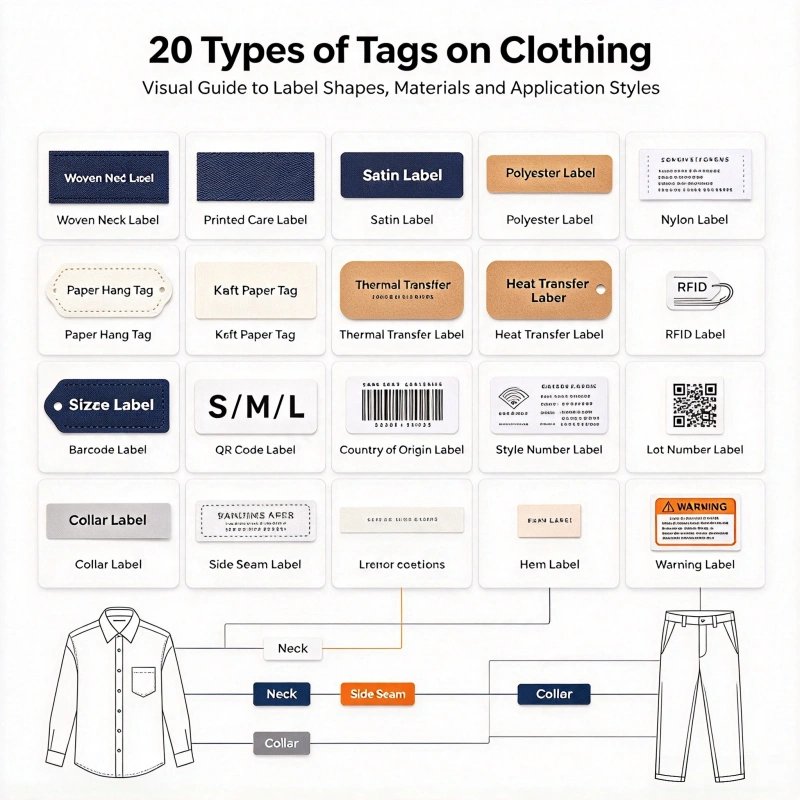
1. Woven Clothing Labels
Woven labels are produced by weaving colored yarns into a fabric label that carries the brand name, logo, or other information. Because the yarn structure forms the design rather than printing it only on the surface, woven labels are widely used for long-term brand identification.
Common woven label types
- Damask woven labels: Suitable for detailed logos and a refined appearance.
- Satin-style woven labels: Designed for a smooth, soft-looking finish.
- Taffeta woven labels: Often used for simpler designs and cost-conscious applications.
- Cotton woven labels: Suitable for brands seeking a natural textile appearance, subject to the required construction and sourcing options.
Where are woven labels used?
Woven labels are commonly sewn into:
- Necklines
- Waistbands
- Side seams
- Pockets
- Garment hems
- Bags and textile accessories
For a premium fashion brand, a woven label can look more integrated than a separate paper tag.
What should buyers consider?
Woven labels work best when the artwork is designed for weaving. Extremely small text, very fine lines, and complicated gradients may not reproduce as intended.
We recommend preparing the logo at its actual finished size and checking the readability of small lettering before approving production. Buyers should also specify the fold type, finished dimensions, background color, thread colors, and sewing position.
Important sourcing note: Woven labels require specialized weaving equipment. If you need a fully woven product, confirm whether the supplier manufactures it in-house or works with a qualified weaving partner.
2. Printed Clothing Labels
Printed labels use ink on a suitable fabric or film substrate. They are particularly useful when a label needs small text, detailed care instructions, multiple languages, or more complex graphics.
Common materials include satin, polyester, nylon, cotton tape, and selected synthetic films.
Advantages of printed labels
- Clear text and care symbols
- Flexible layout and dimensions
- Suitable for multilingual information
- Practical for variable information and different product SKUs
- Multiple printing options depending on artwork and order size
People often choose printed labels for T-shirts, dresses, uniforms, children’s apparel, sportswear, and everyday garments.
Printed vs. woven labels
| Comparison | Printed label | Woven label |
|---|---|---|
| How the design is made | Ink is applied to the substrate | Colored yarns form the design |
| Fine text | Generally well suited | Depends on weave density and artwork |
| Brand appearance | Clean and versatile | Textile-based, often premium |
| Care instructions | Very suitable | Possible, depending on construction |
| Main cost factors | Material, printing, quantity, colors | Yarn colors, weave complexity, dimensions |
| Key quality test | Print durability and legibility | Weave clarity, edge comfort, and construction |
Neither type is automatically better. We recommend choosing according to the information content, desired appearance, garment construction, and target cost.
3. Care Labels and Content Labels
Care labels provide information about how to wash, dry, iron, and maintain a garment. Content labels identify the textile fiber composition, while origin and business identification information may also be required depending on the market and product.
For many apparel brands, this is the most important label for compliance.
What information may be required?
Depending on the destination market and garment category, the label set may need to include:
- Fiber composition
- Country of origin
- Business or responsible-party identification
- Permanent care instructions
- Size information
- Additional information required for specific products
Requirements vary by jurisdiction. For example, the US Federal Trade Commission regulates textile fiber labeling and care labeling, while EU textile rules cover fiber-composition disclosure. Children’s products can also have separate tracking requirements.
We advise buyers to confirm the applicable rules before finalizing artwork. A visually attractive label is not sufficient if required information is missing or unreadable.
How to select a care-label material
| Material | Potential advantage | Consideration |
|---|---|---|
| Satin polyester | Smooth surface and clear printing | Confirm softness and print durability |
| Nylon | Flexible and suitable for detailed information | Test the ink and finish |
| Polyester tape | Practical for many garment applications | Choose the appropriate weave or surface |
| Cotton tape | Natural textile appearance | Check shrinkage and wash performance |
| Heat-transfer film | No separate sewn-in label | Test adhesion, hand feel, and wash durability |
For care labels, we recommend testing the finished garment rather than approving the label in isolation. Repeated washing, heat, detergent, friction, and fabric stretch can affect readability and attachment.
4. Clothing Hang Tags
Hang tags, also called swing tags, are removable tags attached to clothing with string, cord, a plastic fastener, or another attachment method.
They matter for retail presentation because shoppers can read them before buying the garment.
What should a clothing hang tag include?
A custom hang tag may contain:
- Brand logo and product name
- Product description
- Size or style number
- Retail price
- Barcode or QR code
- Website or brand story
- Material or sustainability claims, when properly substantiated
- Product collection or seasonal information
Not every hang tag needs all these elements. We recommend prioritizing the brand identity on the front and putting secondary information on the reverse.
Common hang-tag materials
Coated art paper: Suitable for full-color printing and polished retail presentation.
Uncoated paper: Offers a natural, understated appearance.
Kraft paper: Commonly used by casual, outdoor, denim, and eco-positioned brands.
Recycled or certified paper: Can support specific sourcing goals when the relevant material and chain-of-custody claims are verified.
Specialty card: Used for premium designs with embossing, debossing, foil stamping, or other finishing effects.
Popular finishing options
- Matte or gloss lamination
- Gold or silver foil stamping
- Embossing and debossing
- Spot UV
- Rounded corners
- Custom die-cut shapes
- Cotton string, cord, or customized fasteners
For a premium clothing brand, the combination of paper weight, finishing, hole position, and attachment method matters as much as the artwork.
We recommend ordering a physical proof when foil, embossing, specialty paper, or an unusual shape is involved. A digital file cannot fully represent the texture, rigidity, or reflectivity of the finished tag.
5. Size Labels
Size labels help customers and retail staff identify the correct garment size.
They may be woven, printed, or incorporated into another label. Common formats include standalone size tabs and size information integrated into a neck or waistband label.
Typical size information includes XS, S, M, L, XL, numerical sizing, or region-specific sizing systems.
What buyers should specify
- Size range
- Garment category
- Finished label dimensions
- Size notation
- Label placement
- Color and typography
- Whether size labels must be separated by SKU
For large size runs, we recommend using a size matrix to prevent errors. For example, a garment collection with six sizes and three colors may require 18 SKU combinations even if the basic label design remains the same.
Before bulk production, confirm the exact quantities for every size. This helps prevent overstock of slow-moving sizes and shortages of high-demand sizes.
6. Heat-Transfer and Tagless Labels
Heat-transfer labels place branding or information directly onto the garment using a transfer material and a controlled heat-and-pressure process.
They are popular for sportswear, activewear, underwear, performance clothing, and garments where a sewn label may cause irritation.
Key advantages
- No traditional sewn-in label edge
- Clean internal appearance
- Suitable for logos, sizes, and selected care information
- Flexible graphic and color options
- Can be designed for specific fabric types
What can go wrong?
The main risks include peeling, cracking, color migration, and poor bonding.
The result depends on the transfer construction, garment fabric, surface treatment, temperature, pressure, dwell time, and washing conditions.
We recommend testing the transfer on the actual garment fabric, especially when working with stretch fabrics, moisture-management finishes, nylon, or heat-sensitive materials.
A heat-transfer label should not be considered wash-durable merely because it looks good immediately after application. Approve it only after the agreed wash and stretch tests.
7. Leather and Imitation-Leather Clothing Patches
Leather patches are often used on denim jeans, jackets, workwear, bags, and heritage-style garments. They can display a brand logo through embossing, debossing, printing, engraving, or a combination of processes.
Buyers can choose from genuine leather, synthetic leather, and other leather-look materials.
What makes a good leather patch?
A well-designed patch should match the garment’s overall style and intended use. The material, thickness, edge treatment, logo depth, color, and sewing method all affect the final appearance.
For washable garments, buyers should verify whether the selected patch and decoration method can tolerate the required washing conditions. Not all leather-look materials resist water, heat, or detergent equally.
If sustainability claims are important, clearly identify the actual material rather than using vague terms such as “eco leather” without supporting details.
8. Silicone and TPU Clothing Labels
Silicone and TPU labels offer a modern, raised, rubber-like look. They are frequently used for sportswear, outdoor clothing, streetwear, uniforms, and performance apparel.
They can be manufactured in different colors, thicknesses, shapes, and surface finishes, depending on the material and production method.
Typical applications
- Chest logos
- Sleeve badges
- Hem labels
- Waistband branding
- Sportswear logos
- Decorative patches
- Waterproof-oriented product branding, when the complete construction supports it
These labels work well when a brand wants a distinctive three-dimensional look.
However, evaluate the label’s flexibility, adhesion or sewing construction, surface finish, and durability against the garment’s intended use. A decorative label for casual apparel may not need the same performance as a label on frequently stretched outdoor equipment.
9. Barcode and QR-Code Clothing Tags
Barcode and QR-code tags connect a physical garment with a product record.
A barcode can support point-of-sale scanning and inventory operations. A QR code can link to product information, product registration, size guidance, digital care information, or brand content.
You can print these codes on hang tags, adhesive labels, packaging, or other suitable surfaces.
What information can a tag connect to?
Depending on the system, a tag may identify:
- SKU or style number
- Size and color
- Product identifier
- Retail price
- Batch information
- Product page
- Warranty or registration information
- Traceability records
The most important consideration is data accuracy. A code is useful only when it resolves to the correct product or record.
For barcode labels, check print contrast, code dimensions, quiet zones, and scanning performance. For QR codes, test the printed code at the final size with common mobile devices and under realistic lighting conditions.
10. RFID Clothing Tags
RFID tags use a chip and antenna to communicate with compatible readers through radio waves. Unlike a conventional barcode, RFID can identify a tagged item without requiring a direct optical view of the code.
In apparel supply chains, RFID can support item-level inventory, stocktaking, distribution, and retail operations. Actual performance depends on the tag design, reader system, placement, garment construction, and operating environment.
Common RFID clothing tag formats
RFID hang tags: Paper or card tags with an RFID inlay, often used for retail inventory and source tagging.
RFID textile labels: RFID components integrated into textile-label constructions for selected applications.
RFID adhesive labels: Used on packaging or other suitable surfaces when a removable label is more appropriate.
Specialized washable textile RFID tags: Designed for selected textile tracking or industrial laundry applications. These require construction-specific durability validation.
What should buyers specify?
- RFID frequency and protocol
- Chip model
- Antenna design
- Tag dimensions
- Required read performance
- Encoding and data format
- Printing and barcode requirements
- Attachment location
- Whether the tag must withstand washing
- Compatibility with the customer’s reader system
Do not assume that all RFID tags are interchangeable. A retail hang tag, a washable textile tag, and a label attached to a polybag are different products with different performance requirements.
For standard apparel inventory applications, UHF/RAIN RFID is often considered. NFC or other RFID technologies may be more appropriate for different consumer-interaction or identification scenarios.
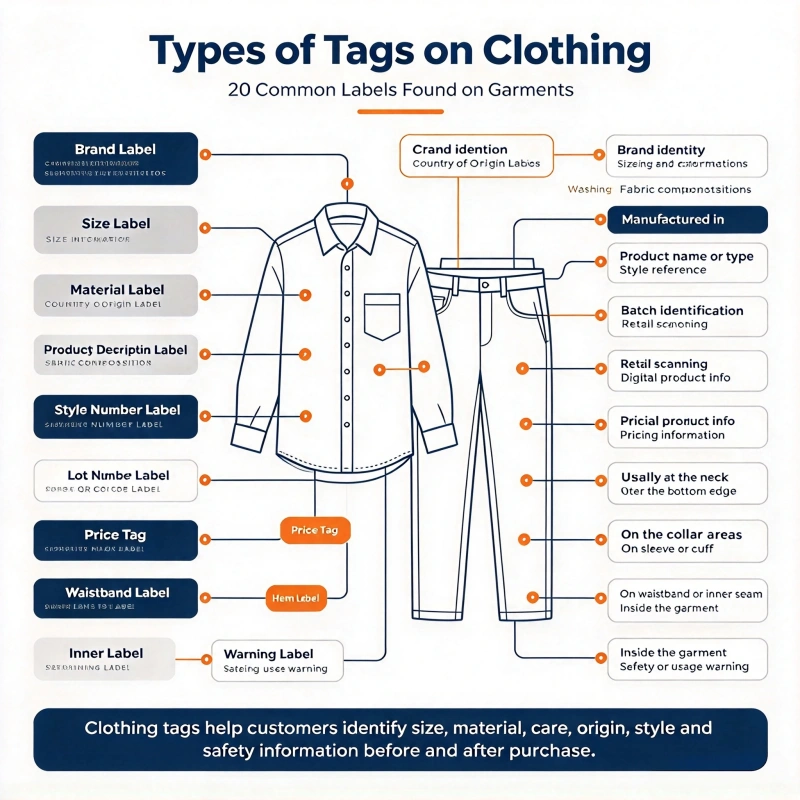
How to Choose the Right Clothing Tags for Your Brand
The right combination depends on your target market, garment type, branding strategy, and supply-chain requirements.
| Buyer requirement | Recommended starting point | Additional consideration |
|---|---|---|
| Premium brand identity | Woven label + premium hang tag | Logo clarity, texture, finishing |
| Low-cost everyday apparel | Printed label + standard hang tag | Unit cost and production volume |
| Soft sportswear | Heat-transfer label + printed care label | Stretch and wash testing |
| Denim and workwear | Woven label + leather-look patch + hang tag | Abrasion and attachment strength |
| Children’s clothing | Soft label construction + appropriate care/content labeling | Comfort and destination-market requirements |
| Eco-positioned clothing | Verified recycled or responsibly sourced materials | Substantiate environmental claims |
| E-commerce apparel | Barcode or QR hang tag + care label | SKU accuracy and fulfillment |
| Retail inventory automation | RFID hang tag or suitable RFID label | Reader compatibility and encoding |
Our recommendation is to start with the function of each tag, not the material. First decide what information or experience the tag must deliver, then choose the construction that meets the requirement.
Custom Clothing Tags: Materials, Sizes, and Specifications
As a custom label supplier, we recommend confirming the following details before requesting a quotation.
| Specification | Information to provide |
|---|---|
| Label type | Woven, printed, care, hang tag, heat transfer, RFID, or a combination |
| Finished dimensions | Width × height, diameter, or custom shape |
| Material | Satin, polyester, nylon, paper, kraft, synthetic film, or specified alternative |
| Artwork | AI, PDF, EPS, SVG, or high-resolution artwork |
| Colors | CMYK, Pantone references, or approved physical samples |
| Finishing | Matte, gloss, foil, embossing, debossing, die cutting |
| Attachment | Sew-in, fold-in, heat-applied, string, cord, adhesive, or other method |
| Data | Size, SKU, barcode, QR code, RFID encoding requirements |
| Quantity | Total quantity and quantity per design or SKU |
| Packing | Bulk packed, counted bundles, sheets, rolls, or customized packaging |
| Quality requirements | Color tolerance, print durability, wash testing, scan or read testing |
| Destination market | Country or region where the garments will be sold |
The more complete the specification, the less likely the project will face delays from artwork revisions, material substitutions, or unclear packing requirements.
Our Customization Capabilities for B2B Buyers
We support custom label and packaging projects for apparel brands, garment manufacturers, private-label sellers, wholesalers, and retailers. We match product construction to the buyer’s use case instead of offering the same specifications to every customer.
Depending on the selected product and production route, customization can include:
- Custom dimensions and die-cut shapes
- Brand logos and artwork
- Material selection
- Printed colors and variable information
- Paper and specialty finishing options
- Barcode and QR-code printing
- RFID label configuration and encoding requirements
- Different designs for separate product lines
- Customized packing and labeling for bulk shipments
- OEM production based on customer artwork and specifications
- ODM support for buyers who need help developing a suitable label construction
Equipment and production route: The appropriate production equipment depends on the product. Printed labels and tags may require digital or conventional printing, cutting or die-cutting, finishing, inspection, and packing. RFID projects may additionally require inlay integration, encoding, and verification. Woven labels require weaving equipment, while heat-transfer products require suitable transfer-production and application processes.
We confirm the production route based on the actual order, rather than assuming every label type can be made on the same line. For specialized products, buyers should clarify which processes we complete in-house and which qualified manufacturing partners handle.
MOQ and Wholesale Price Guide for Custom Clothing Tags
MOQ and unit prices vary by material, size, color, printing method, finishing, order quantity, and number of designs. The following ranges are indicative budgeting estimates in USD, not fixed quotations or guarantees of availability from every production line.
| Product type | Indicative MOQ per design | Indicative unit price (USD) |
|---|---|---|
| Basic printed clothing label | 1,000–5,000 pcs | $0.005–$0.03 |
| Custom woven brand label | 1,000–5,000 pcs | $0.01–$0.05 |
| Printed care label | 1,000–5,000 pcs | $0.004–$0.025 |
| Standard paper hang tag | 500–1,000 pcs | $0.03–$0.10 |
| Premium foil or embossed hang tag | 500–1,000 pcs | $0.06–$0.20 |
| Heat-transfer label | 500–3,000 pcs | $0.01–$0.06 |
| Silicone or TPU label | 500–1,000 pcs | $0.05–$0.30 |
| Leather or imitation-leather patch | 500–1,000 pcs | $0.08–$0.50 |
| RFID apparel hang tag | 1,000–5,000 pcs | $0.03–$0.15 |
| Specialized RFID textile label | 500–3,000 pcs | $0.10–$0.50+ |
These are broad planning ranges assembled from common product configurations and publicly listed supplier benchmarks; they should not be treated as verified prices for a specific order. Actual quotes can fall outside them, especially for premium materials, complex finishing, specialized RFID chips, or small customized batches.
What affects the final price?
1. Order quantity
Higher quantities can spread setup, tooling, and preparation costs across more pieces. However, increasing quantity is not always economical if you have many designs or sizes with uneven demand.
2. Material
Specialty paper, metallic substrates, premium woven constructions, leather, silicone, and RFID components vary in cost.
3. Printing and finishing
Foil stamping, embossing, multiple colors, unusual shapes, and special coatings may increase setup or processing costs.
4. RFID requirements
RFID chip selection, antenna construction, encoding, verification, and testing can materially affect the price.
5. Number of designs
A 10,000-piece order with one design is not necessarily priced like an order of 10 designs with 1,000 pieces each. Artwork setup, tooling, color changes, and packing may be repeated for every design.
6. Packing and shipping
Individual packing, SKU separation, export cartons, and freight terms can change the landed cost.
How to request an accurate quotation
Send us the product type, finished size, material, artwork, quantity per design, finishing requirements, destination country, and any testing or compliance requirements. For RFID products, include the intended reader system and encoding specifications.
We can then assess the suitable construction, identify any technical questions, and quote the project based on a defined specification.
Our OEM and ODM Customization Process
We use a specification-led workflow to reduce uncertainty before bulk production.
Step 1: Understand your project
We confirm the garment category, target market, label function, estimated annual volume, and budget.
Step 2: Review the artwork
We check the logo, dimensions, small text, color references, cutting lines, and any variable data.
Step 3: Recommend materials and construction
We propose suitable materials, printing or manufacturing methods, finishing, attachment options, and packing formats.
For OEM orders, we follow the customer’s approved specifications. For ODM projects, we help develop the construction based on the buyer’s requirements.
Step 4: Confirm MOQ and quotation
We confirm the quantity per design, setup requirements, unit price, lead time, sample arrangements, and shipping terms.
Step 5: Produce and approve samples
When the construction is new or the requirements are demanding, we recommend a physical sample or prototype before bulk production.
Step 6: Complete bulk production and quality inspection
Inspection criteria are agreed according to the product. They may include dimensions, color consistency, print quality, fold accuracy, die-cutting, attachment strength, wash performance, barcode readability, or RFID encoding verification.
Step 7: Pack and ship
We pack according to the agreed SKU structure and shipping requirements, helping buyers maintain clear inventory and avoid mixing different label designs.
Lead time depends on the product, quantity, artwork approval, sampling, and material availability. We confirm the schedule after the specification is agreed rather than promising one universal production time for every label type.
Quality Control: What We Recommend Testing Before Bulk Orders
A clothing tag may look good when it leaves the factory but fail after sewing, washing, handling, or retail scanning. We recommend a quality plan based on the tag’s actual purpose.
| Quality check | Suitable product types | What to verify |
|---|---|---|
| Dimensional inspection | All types | Width, height, shape, fold and cutting accuracy |
| Color and artwork check | Printed, woven and hang tags | Approved artwork and color consistency |
| Rub or print durability test | Printed labels and hang tags | Smudging, fading, and surface damage |
| Wash test | Care labels and garment-applied labels | Readability, attachment, peeling, shrinkage |
| Heat and stretch test | Heat-transfer labels | Cracking, peeling, and fabric compatibility |
| Attachment-strength check | Sew-in labels and patches | Seam strength and edge comfort |
| Barcode or QR scan test | Printed identification tags | Readability using the intended scanners or devices |
| RFID verification | RFID products | Encoding accuracy and performance in the intended system |
For wash durability, we recommend defining the washing temperature, detergent, number of cycles, and acceptance criteria before testing. A test performed under one set of conditions does not automatically prove durability under all laundering conditions.
For RFID, test the tag on the intended garment or packaging. Body proximity, folds, liquids, metallic components, tag orientation, and reader settings can affect read performance.
Common Mistakes When Ordering Clothing Tags
Mistake 1: Using the same label for every garment
A label that works for a cotton T-shirt may not work for stretch sportswear, denim, or children’s clothing.
Our recommendation: Match the label to the fabric, wear comfort, and care conditions.
Mistake 2: Putting too much information on the hang tag
Small text can be hard to read, especially on a narrow tag.
Our recommendation: Keep the front focused on brand identity and organize secondary information on the reverse or a separate label.
Mistake 3: Ordering by total quantity without separating SKUs
If a garment collection has multiple sizes and colors, a single total quantity can hide the actual requirements for each label variation.
Our recommendation: Provide a clear SKU matrix with quantities per design, size, and color.
Mistake 4: Skipping the physical sample
A digital proof cannot fully demonstrate paper stiffness, woven texture, foil appearance, or the feel of a heat-transfer label.
Our recommendation: Approve a sample for new materials, specialty finishes, and critical applications.
Mistake 5: Treating RFID as a printed barcode
RFID requires compatible hardware and correctly configured data. Printing a product number on an RFID label does not automatically encode that number into its chip.
Our recommendation: Confirm chip selection, encoding format, data ownership, reader compatibility, and verification procedures before production.
Frequently Asked Questions About Types of Tags on Clothing
What are the most common types of clothing tags?
Common types include woven labels, printed labels, care labels, size labels, hang tags, heat-transfer labels, leather patches, silicone labels, barcode tags, and RFID tags. Most brands choose only the types they need for their garments and sales channels.
What is the difference between a clothing label and a hang tag?
A clothing label is usually sewn, bonded, or otherwise attached to the garment for branding or product information. A hang tag is normally removable and is used for retail presentation, pricing, product identification, and marketing.
Which clothing tag is best for a premium brand?
Common options include woven labels, premium paper hang tags, foil-stamped tags, and selected leather or silicone patches. The best choice depends on the brand identity, garment type, target price, and desired tactile effect.
What is the most economical clothing tag?
A simple printed label or standard paper hang tag can be economical at suitable production quantities. The lowest unit price depends on material, size, setup, quantity per design, and finishing.
Can you customize clothing tags with our logo?
Yes. Customization can include artwork, dimensions, material, colors, printing, finishing, shape, attachment method, and packing. The available production route depends on the tag type you select.
What is the MOQ for custom clothing tags?
MOQ depends on the product and manufacturing process. As a starting budget guide, many standard printed labels and hang tags are quoted from hundreds to several thousand pieces per design. Specialized woven, silicone, or RFID constructions may have different minimums. We confirm the applicable MOQ after reviewing the specification.
Can clothing tags include barcodes or QR codes?
Yes. You can print barcodes and QR codes on suitable labels or hang tags. Buyers should provide the data structure and confirm that the finished codes can be scanned reliably at their intended size.
What is the difference between barcode and RFID clothing tags?
A barcode is read optically, generally requiring the scanner to see the code. RFID communicates wirelessly with a compatible reader and may identify tags without direct line of sight. RFID requires a compatible system and appropriate data configuration.
Can you produce OEM and ODM clothing tags?
Yes. For OEM projects, buyers provide the approved artwork and specifications. For ODM projects, we help develop a suitable label construction based on the garment, brand style, performance requirements, and budget.
What information should I send to get a quotation?
Please provide the label type, dimensions, material, artwork, quantity per design, colors, finishing, attachment method, destination market, and required tests. For RFID, also provide the intended use, reader requirements, chip or protocol preference, and encoding specifications.
Request a Custom Clothing Tag Quotation
As a custom label and packaging supplier, we help apparel brands and B2B buyers develop label solutions that balance brand presentation, product information, production feasibility, and budget.
Whether you need printed care labels, custom paper hang tags, barcode labels, RFID apparel tags, or a coordinated set of branding components, we recommend defining the specifications before committing to bulk production.
To receive a project-specific quotation, please send us:
- Product type: woven label, printed label, hang tag, heat transfer, RFID, or other
- Dimensions and material: finished size and preferred substrate
- Artwork: logo, design file, or reference image
- Quantity: total order and quantity per design or SKU
- Customization: colors, foil, embossing, folds, codes, or other finishes
- Application: garment type, attachment method, and intended use
- Destination: country and preferred shipping terms
- Testing requirements: wash durability, barcode scanning, RFID encoding, or other criteria
We will review the information, confirm the feasible production route, and provide a quotation based on the agreed specifications.
Contact our team to discuss your custom clothing tag project, request a sample, and develop an OEM or ODM solution for your apparel business.
Company Address:
No. 1, Xiguozhuang Industrial Park, Chengyang Subdistrict, Chengyang District, Qingdao City, Shandong Province
Email: info@perfectlabel.net
Tel: +86 532 83388181
WhatsApp: +86 19011585175

Jgs is a custom labeling professional with 15 years of industry experience in labeling solutions.