
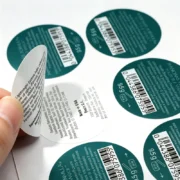
Double Layer Stickers: Types, Materials, Applications, and Custom
Double layer stickers are a practical labeling solution for businesses that need to display more information without increasing the size of the product label. By combining two label layers in one construction, manufacturers can create additional space for instructions, multilingual content, promotional messages, variable data, or product information that would otherwise overcrowd the packaging.
For importers, brand owners, packaging distributors, and industrial buyers, choosing the right double layer sticker involves more than selecting a shape and printing a design. Material compatibility, adhesive performance, opening structure, printing quality, and application conditions all influence the final result.
As a custom label manufacturer, we recommend evaluating double layer stickers based on their actual use environment and production requirements, not appearance alone.
What Are Double Layer Stickers?
Double-layer stickers are a type of multi-layer label andself-adhesive labels constructed with two functional label layers. Depending on the design, you can peel back, lift, or separate the upper layer to reveal additional information underneath. Some designs use a resealable structure, while others use two adhesive labels arranged in a piggyback configuration.
Unlike a conventional single-layer sticker, which provides one main printable surface, a double-layer sticker offers additional usable space within approximately the same external label footprint.
The exact construction varies by application. In the label industry, related products may be described as double layer labels, peel-and-reveal labels, sandwich labels, piggyback labels, or multi-layer labels. These terms are related but are not always interchangeable.
For procurement purposes, buyers should confirm the opening mechanism, layer arrangement, adhesive positions, and whether the top layer must be resealable.
How Does a Double Layer Sticker Work?
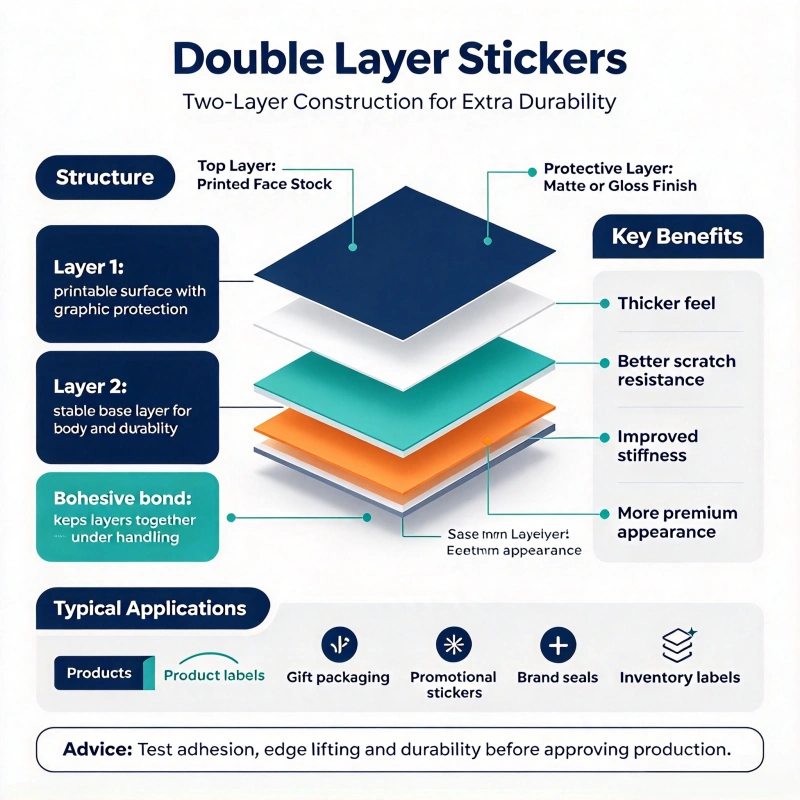
A typical peel-and-reveal sticker consists of the following components:
- Top layer: Displays the main branding, product name, or essential information.
- Release or opening structure: Allows the user to lift or peel the upper layer.
- Lower printable layer: Contains additional instructions, translations, promotional content, or technical details.
- Adhesive system: Keeps the label attached to the package and may also control how the layers separate.
- Release liner: Protects the application adhesive before you apply the sticker.
The precise arrangement depends on whether the label is intended for a bottle, carton, flexible package, product housing, or another surface.
For comparison, Avery Dennison explains that conventional pressure-sensitive labels generally consist of a facestock, adhesive, and liner. Double-layer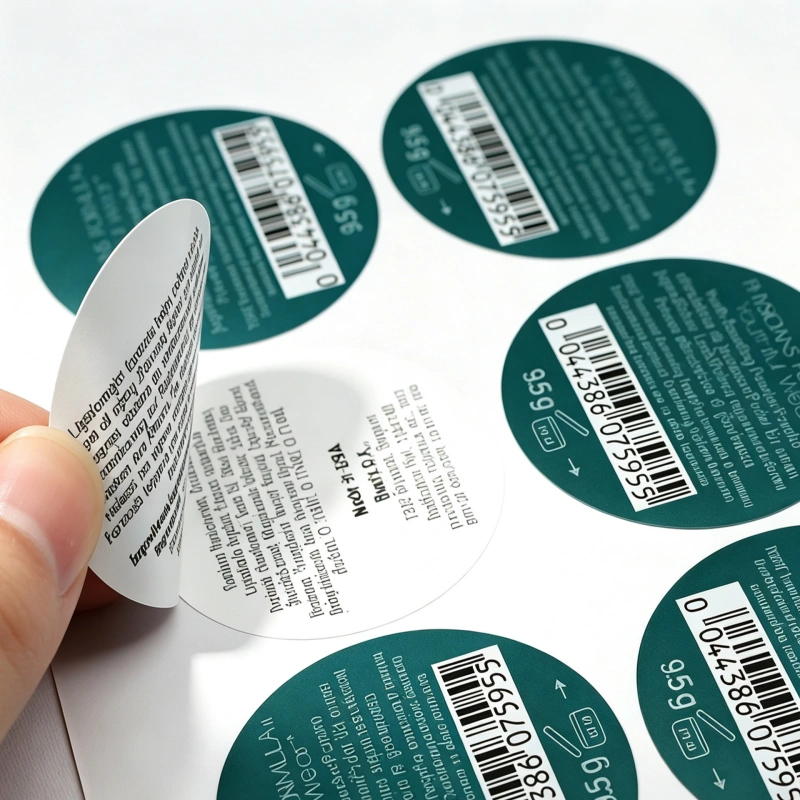 constructions add further design considerations because the interaction between layers and adhesives must be controlled.
Why Do B2B Buyers Choose Double Layer Stickers?
The main purchasing motivation is usually to solve an information or packaging problem without changing the entire package design.
| Buyer requirement | How double layer stickers help |
|---|---|
| Limited packaging space | Add a second printable surface without substantially increasing the label footprint |
| Multiple languages | Separate the primary language from translations and supplementary information |
| Detailed instructions | Place short instructions on top and longer guidance underneath |
| Promotional campaigns | Reveal coupons, offers, or additional product messages |
| Product variations | Organize model-specific, batch-specific, or market-specific information |
| Packaging consistency | Retain a common outer design while adding application-specific content |
The value is not simply having two layers. It’s about organizing information so the package is easier to understand and more practical to manufacture.
For example, a cosmetic brand selling the same product in several export markets may use the upper layer for its consistent brand design and the lower layer for translated usage instructions. This can help reduce visual clutter while supporting different market requirements. The final content and layout must still comply with the applicable labeling regulations.
Types of Double Layer Stickers
Before requesting a quotation, buyers should identify the construction that matches their application.
1. Peel-and-Reveal Stickers
Peel-and-reveal stickers feature an upper layer that lifts to expose the information underneath. Depending on the construction, the top layer may be resealable or designed to open only once.
Typical applications include:
- Cosmetics and personal care products
- Food and beverage packaging
- Household chemical products
- Promotional packaging
- Products requiring additional instructions
Best for: Brands that need additional information while keeping the front-facing package design compact.
The key specification is the opening experience. If the top layer is difficult to lift, tears during opening, or fails to close as expected, customers may find the label frustrating to use.
2. Piggyback Double Layer Stickers
Piggyback labels generally consist of a top label attached to a second label, with a construction that allows the upper label to be removed and transferred to another surface.
They are often used for:
- Shipping and logistics
- Warehouse identification
- Return labels
- Inventory management
- Forms and administrative workflows
Best for: Applications where a removable label needs to be transferred from one surface to another.
Buyers should confirm whether the removed label must adhere permanently, remain repositionable, or be removed cleanly from the original label.
3. Sandwich or Laminated Double Layer Labels
Sandwich constructions combine multiple materials into a layered label structure. Depending on the design, they can support additional printing space, protective layers, or specialized functional requirements.
Potential applications include industrial identification, product instructions, technical labels, and packaging that needs additional information capacity.
Best for: Projects that require a defined combination of printed layers, protective materials, and specific adhesive behavior.
A laminated structure is not automatically peelable. If the user must open the top layer, the manufacturer needs to design an appropriate opening and release mechanism.
4. Promotional Double Layer Stickers
Promotional versions may place a coupon, campaign message, QR code, or reward information under the main printed surface.
Applications include:
- Retail promotions
- Product sampling campaigns
- Loyalty programs
- Consumer engagement
- Limited-edition packaging
For large campaigns, buyers should test opening performance and printing consistency across production batches. Also verify any QR code or variable data before shipment.
Which Materials Are Suitable for Double Layer Stickers?
Material selection affects print quality, durability, flexibility, cost, and how the label performs on the final package.
The correct combination depends on the substrate, exposure conditions, printing method, and required opening behavior.
| Material | Main advantages | Common applications | Important considerations |
|---|---|---|---|
| Coated paper | Good print quality and economical for many applications | Consumer packaging, promotions, general product labels | Moisture and abrasion resistance depend on the paper, coating, and protective finish |
| Synthetic paper | Better resistance to tearing and moisture than many ordinary paper stocks | Household products, industrial packaging, frequently handled labels | Confirm compatibility with the printing and converting process |
| PP film | Lightweight, flexible, and suitable for many packaging labels | Cosmetics, personal care, food packaging, household products | Adhesive selection and label stiffness must suit the package surface |
| PE film | Flexible and suitable for some squeezable containers | Bottles, tubes, flexible plastic packaging | Stretching and dimensional stability need to be considered |
| PET film | Useful where dimensional stability and durability are priorities | Industrial products, technical labels, selected premium packaging | May increase material cost and affect the feel and flexibility of the label |
| Protective laminate or coating | Can improve resistance to handling, moisture, or abrasion when properly selected | Labels requiring additional surface protection | Must not interfere with peeling, resealing, or printing |
Avery Dennison’s published material portfolio includes examples of transparent PP film at approximately 50 microns and PE film around 80–85 microns. These are examples of available facestock specifications, not universal requirements for double layer stickers. Actual material thickness should be selected according to the label construction and end use.
Source: Avery Dennison Japan — Pressure-Sensitive Label Material Listings.
How to Select the Right Adhesive
The adhesive system deserves special attention because a double layer sticker may need to perform two different jobs: remain securely attached to the product and allow the upper layer to open as intended.
Consider these questions before approving a material specification:
- Is the label applied to paperboard, glass, metal, PET, PP, PE, or another substrate?
- Is the application surface flat, curved, textured, oily, or low in surface energy?
- Will the product be exposed to moisture, refrigeration, heat, chemicals, or outdoor conditions?
- Must the top layer be resealable, removable, or transferable?
- Will the labels be applied by hand or on an automatic labeling line?
Avery Dennison’s technical information explains that adhesive selection depends on application requirements and the properties of the receiving surface. Its guidance also emphasizes that pressure-sensitive materials should be evaluated under the intended conditions.
Source: Avery Dennison — Adhesion Characteristics.
Our manufacturing recommendation: Do not approve an adhesive based only on a general description such as “strong adhesive.” Define the required behavior and test the complete label on the actual packaging material.
What Information Can Be Printed on Double Layer Stickers?
A double layer sticker can separate the information that customers need immediately from details they may need to consult later.
Common content includes:
- Product names, branding, and key benefits
- Usage instructions and warnings
- Ingredients or technical information
- Multilingual product information
- Batch numbers and variable data
- QR codes, barcodes, and traceability information
- Promotional offers and campaign messages
- Storage guidance and product-specific instructions
However, extra label space does not automatically make a product compliant with local regulations.
For pharmaceutical products, for example, the U.S. Food and Drug Administration provides specific resources on carton and container labeling, including applicable requirements for product information and barcodes. Buyers must verify which requirements apply to their particular product and market before finalizing the artwork.
Source: FDA — Carton and Container Labeling Resources.
For regulated products, we recommend that the buyer’s regulatory or compliance team approve all mandatory text, warning statements, and layout requirements before mass production.
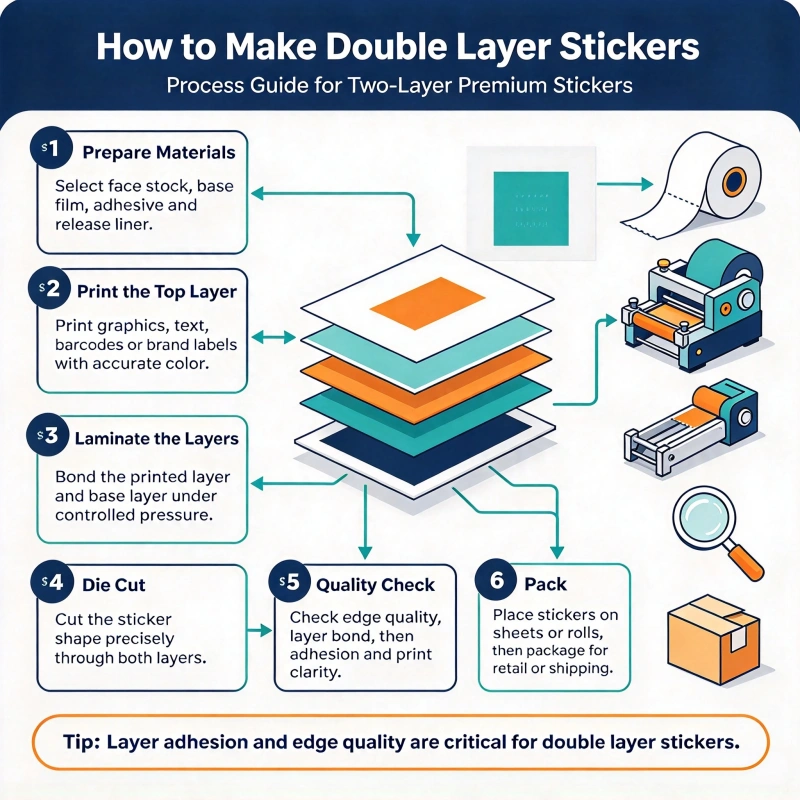
How Are Custom Double Layer Stickers Manufactured?
A reliable production process starts with the intended use, not the printing machine. The structure must be designed around the information, packaging material, opening mechanism, and production volume.
Step 1: Confirm the Application Requirements
The buyer and manufacturer should establish:
- Final label dimensions and shape
- Package material and surface geometry
- Number of printable layers
- Required opening and closing behavior
- Environmental exposure
- Printing and variable-data requirements
- Application method and order quantity
This information reduces the risk of selecting a structure that looks correct in the artwork but fails during actual use.
Step 2: Design the Layer Structure
The manufacturer determines the face materials, adhesive positions, release characteristics, and any protective coatings or laminations.
For peel-and-reveal labels, the design must balance the force needed to open the label with the need to keep the top layer stable during storage, transportation, and application.
For piggyback labels, the structure must support the intended transfer and adhesion behavior.
Step 3: Prepare Artwork and Printing
Arrange artwork according to the printable area of each layer. Important information must not fall within die-cutting tolerances, opening areas, or sections that hide when the top layer closes.
Depending on the design and production requirements, printing may include flexographic, digital, offset, or other suitable processes.
For projects involving barcodes or QR codes, verify readability after printing and converting, rather than relying only on the digital artwork file.
Step 4: Laminate, Convert, and Die-Cut
The printed materials are combined according to the approved construction. The manufacturer then performs the required converting operations, such as lamination, adhesive application, die-cutting, and slitting.
For complex double layer structures, registration between the printed layers and die-cut lines is particularly important. Misalignment may hide text, affect opening performance, or make the finished label look inconsistent.
Step 5: Inspect and Test the Finished Labels
A suitable quality plan may include:
- Print clarity and color consistency
- Layer alignment and die-cut accuracy
- Adhesion to the intended package
- Ease of opening and, where applicable, resealing
- Resistance to handling and transportation
- Barcode or QR-code readability
- Performance under relevant temperature and moisture conditions
The exact tests and acceptance limits should be agreed upon before mass production. There is no single universal test specification for every double layer sticker.
Step 6: Approve Samples Before Mass Production
We recommend testing production-representative samples on the customer’s actual packaging.
A sample should be checked under realistic conditions, including the intended application method, storage environment, handling process, and opening behavior.
For automatic application, the buyer should also confirm roll direction, core size, roll diameter, label gap, and other machine-specific requirements with the label manufacturer.
Common Double Layer Sticker Problems and Practical Solutions
| Common problem | Likely cause | Recommended solution |
|---|---|---|
| Top layer is difficult to peel | Opening design or release characteristics are unsuitable | Adjust the opening feature and layer-release behavior; test with intended users |
| Top layer lifts during transportation | Insufficient layer stability or unsuitable adhesive combination | Review adhesive compatibility, construction, and packaging conditions |
| Label edges curl | Material stiffness, adhesive, package curvature, or application conditions are unsuitable | Test alternative materials and adhesives on the actual container |
| Printed layers are misaligned | Registration or converting tolerances are not adequately controlled | Define alignment tolerances and inspect samples during production |
| Text is too small to read | Too much information is placed in a limited area | Reorganize content across the layers and confirm legibility before printing |
| QR codes or barcodes fail to scan | Artwork, print quality, contrast, size, or converting affects readability | Verify the code size and contrast, then test the finished label with suitable scanners |
| Labels do not adhere reliably | The adhesive is incompatible with the substrate or application environment | Test the intended adhesive on the actual surface under end-use conditions |
| The top layer cannot be resealed reliably | The structure was designed for opening rather than repeated closure | Specify resealability as a functional requirement from the beginning |
The most cost-effective solution is usually to identify the failure mode during sampling rather than after the full order has been printed and converted.
How Much Do Double Layer Stickers Cost?
There is no single factory price for double layer stickers. The cost depends on the construction, materials, printing coverage, dimensions, order quantity, and quality requirements.
For B2B buyers, the main cost factors are:
| Cost factor | How it affects the quotation |
|---|---|
| Label size | Larger labels typically require more material |
| Number and type of layers | Additional layers and specialized constructions can increase converting costs |
| Face material | Paper and film options differ in price and performance |
| Adhesive system | Specialized adhesion, removability, or resealability may require a different construction |
| Printing colors and coverage | Artwork complexity and printing method affect production costs |
| Die-cutting and finishing | Custom shapes, perforations, laminations, and special opening features may add cost |
| Order quantity | Setup costs are distributed differently across small and large orders |
| Inspection and testing | Special performance requirements may add sampling or quality-control costs |
| Packaging and delivery | Roll specifications, packing requirements, freight, and destination affect total landed cost |
When comparing suppliers, buyers should request quotations based on the same specifications. A low unit price is not a meaningful comparison if one supplier quotes a basic two-layer structure while another includes protective finishing, specialized adhesive, or additional quality testing.
To obtain an accurate quote, provide the target dimensions, material preference, number of layers, artwork, order quantity, package substrate, opening requirements, and delivery destination.
How to Choose a Reliable Double Layer Sticker Manufacturer
For importers, wholesalers, and brand owners, a capable supplier should do more than print the submitted artwork.
Evaluate potential manufacturers using the following checklist:
1. Construction design capability
Ask whether the supplier can recommend an appropriate structure for your packaging and information requirements, including the opening mechanism and adhesive system.
2. Material selection
Confirm that the supplier can explain the differences between paper, PP, PE, PET, and relevant adhesive options in relation to your actual use case.
3. Printing and converting consistency
Request production samples and confirm the supplier’s controls for print quality, layer alignment, die-cutting, and roll specifications.
4. Quality testing
Ask which tests are available for adhesion, opening performance, barcode readability, and environmental exposure. Ensure that the proposed test conditions match your requirements.
5. Artwork and sampling support
A reliable supplier should identify potential layout and production problems before approving the final artwork.
6. Export and packaging experience
If you are purchasing for multiple markets, discuss packaging protection, carton labeling, shipment requirements, and any documentation your procurement process needs.
7. Transparent quotations
Require the supplier to specify the material construction, dimensions, printing, finishing, quantity, packaging, and delivery terms. This makes supplier comparisons more meaningful.
Custom Double Layer Stickers for Wholesale and OEM Projects
As a custom label manufacturer, we can help B2B buyers evaluate double-layer sticker structures based on the intended application, required information, package material, and order volume.
For OEM and private-label projects, start with clear specifications rather than a generic request for “two-layer stickers.” We recommend confirming the following details before production:
- Product type and application
- Label dimensions and shape
- Number of printable layers
- Face material and adhesive requirements
- Opening or resealing mechanism
- Artwork and language requirements
- Printing method and finishing preferences
- Estimated order quantity
- Application method and delivery requirements
With these details, the manufacturer can recommend a suitable construction, prepare samples, and provide a quotation based on the actual requirements.
Planning a double layer sticker project? Send your label dimensions, artwork, intended use, and estimated quantity to your supplier. A properly specified sample is the best starting point for evaluating print quality, adhesion, opening performance, and production suitability before placing a bulk order.
Frequently Asked Questions About Double Layer Stickers
1. What is the difference between double layer stickers and regular stickers?
A regular sticker typically has one primary printable face, while a double layer sticker combines two functional label layers. The second layer adds space for information, promotions, or a removable label.
2. Are double-layer stickers waterproof?
They can be designed for moisture-resistant applications, but waterproof performance depends on the face materials, inks, adhesives, edges, and overall construction. Buyers should test the complete label under their actual exposure conditions rather than assuming all double-layer stickers are waterproof.
3. Can double layer stickers be customized in size and shape?
Yes. We can generally develop custom dimensions, shapes, printing, and finishing based on the selected construction and manufacturing capabilities. The design should be checked against die-cutting tolerances and the available printable area of each layer.
4. Can double layer stickers include multiple languages?
Yes. Multilingual content is a common reason to choose a layered label. The manufacturer can help arrange the information across the layers, but the buyer should approve the translations and confirm the applicable labeling requirements for each market.
5. Can the top layer be peeled off and reused?
Some designs support removal, transfer, or resealing, but these are different functions. The buyer should state whether the top layer must be removable, transferable, or repeatedly resealable so the manufacturer can design and test the appropriate construction.
6. Are double layer stickers suitable for automatic labeling machines?
They may be suitable, depending on the construction, roll format, label dimensions, and equipment. Buyers should provide the machine specifications and confirm roll direction, core size, maximum roll diameter, and other relevant requirements before production.
7. What information is needed to request a quotation?
At minimum, provide the label size, material preference, number of layers, artwork, order quantity, application surface, and required opening behavior. Also mention any exposure to moisture, chemicals, temperature changes, or repeated handling.
8. How can I ensure consistent quality in bulk orders?
Approve a production-representative sample, define measurable acceptance criteria, and agree on the inspection process before mass production. For specialized applications, include relevant adhesion, opening, environmental, and barcode tests in the quality plan.
9. Are double layer stickers suitable for pharmaceutical products?
They may provide additional space for product information, but suitability depends on the specific product, label design, and applicable regulations. For pharmaceutical applications, confirm the requirements with the responsible regulatory team and consult the relevant authority’s official guidance before approving the artwork.
10. What is the best way to reduce double layer sticker costs?
Start by choosing the simplest construction that meets the functional requirements. Optimize label dimensions, material selection, printing coverage, and order quantity without compromising readability, adhesion, or required performance. Comparing quotations against the same technical specification helps identify genuine cost differences.
References and Authoritative Sources
- Avery Dennison — Pressure-Sensitive Labels
Explains the three main components of conventional pressure-sensitive labels: facestock, adhesive, and liner, along with their functions in label construction and application.
Read the official source - Avery Dennison Japan — Pressure-Sensitive Label Material Listings
Provides product and material specifications for pressure-sensitive label stocks, including paper and film options. These specifications can serve as a reference when evaluating materials for custom double-layer stickers.
Explore the material listings - Avery Dennison — Adhesion Characteristics
Provides technical guidance on adhesive performance and application requirements, supporting the recommendation to select adhesives according to the actual substrate and end-use conditions.
Read the technical guidance - U.S. Food and Drug Administration (FDA) — Carton and Container Labeling Resources
Provides official guidance and regulatory resources related to carton and container labeling for human prescription drugs. It is a useful reference when evaluating labeling requirements for regulated pharmaceutical products in the United States.
Visit the FDA resource page

Jgs is a custom labeling professional with 15 years of industry experience in labeling solutions.