

What Is Tamper Evident Tape? Types, Uses, and How to Choose
Tamper evident tape is a specialized security sealing tape designed to reveal visible signs of opening, removal, or interference. Depending on its construction, it may display a hidden “VOID” or “OPENED” message, leave a security pattern on the package surface, or show other signs when removal is attempted. Unlike regular packing tape, which primarily seals packages, tamper evident tape helps recipients identify whether a package may have been disturbed during storage, handling, or transit.
Tamper evident tape is widely used in shipping, logistics, warehousing, electronics packaging, and other applications where package integrity matters. Choosing the right type requires more than comparing tape widths or adhesive strength. The packaging material, required security effect, application environment, and acceptable surface residue all influence the final choice.
In this guide, we explain how tamper evident tape works, explore its main types and applications, compare it with regular packing tape and tamper evident labels, and outline the key factors to consider when selecting a suitable security solution.
What Is Tamper Evident Tape?
Tamper evident tape is a security tape that provides visible evidence of attempted opening, removal, or interference. It is designed to make unauthorized access easier to identify by creating a noticeable change when someone attempts to remove or manipulate the tape.
Depending on the product design, this change may include a concealed message becoming visible, a pattern transferring onto the applied surface, or the tape breaking apart during removal. These features help users inspect sealed packages and identify potential signs of interference.
Tamper evident tape is different from ordinary adhesive tape because its purpose extends beyond sealing. Regular packing tape helps keep a carton closed, while tamper evident tape incorporates a security feature intended to reveal signs of removal or opening.
Common features of tamper evident tape include:
- Visible tamper indication: A hidden message, pattern, or other visual change appears when removal is attempted.
- Security sealing: The tape helps seal a package while providing an additional indication of possible interference.
- Application flexibility: Depending on the construction, it may be suitable for cartons, envelopes, bags, or other packaging surfaces.
- Customization options: Certain products can incorporate custom messages, printed designs, logos, or other identifying features.
It is important to distinguish tamper evidence from tamper prevention. Tamper evident tape does not necessarily stop someone from opening a package. Instead, it helps make certain types of interference more noticeable.

How Does Tamper Evident Tape Work?
Tamper evident tape works by combining an adhesive system with materials or structures designed to change visibly when removal is attempted. The exact mechanism depends on the product construction and the surface to which it is applied.
1. Hidden VOID or OPENED Messages
Some security tapes contain a concealed message or security pattern. When someone attempts to remove the tape, the message becomes visible on the tape, the underlying surface, or both, depending on the design.
For example, a tape may reveal a repeated “VOID” message after removal from a compatible packaging surface. This visible change alerts the recipient that the seal may have been disturbed.
The appearance and transfer behavior of the message vary by product. Therefore, the expected result should be confirmed using the actual tape and intended packaging material.
2. Partial-Transfer and Full-Transfer Mechanisms
Some tamper evident tapes are designed to transfer security material or a message onto the applied surface when removal is attempted.
With a full-transfer construction, the intended security pattern may transfer predominantly to the surface. With a partial-transfer construction, parts of the security pattern may remain on the tape while other parts appear on the applied surface.
These mechanisms can help make removal more apparent, but their performance depends on the adhesive, substrate, surface condition, and application process.
3. Non-Transfer Security Mechanisms
Certain tamper evident tapes are designed to reveal a message primarily on the tape itself, with little or no intended transfer to the underlying surface.
This type may be worth considering when preserving the appearance of the packaging or minimizing surface residue is important. However, “non-transfer” does not automatically mean that the tape will leave no adhesive residue under every condition.
4. Destructible Materials
Some security sealing products use materials that tear, fragment, or otherwise become visibly damaged when removal is attempted.
This behavior can make it difficult to remove the product intact and reapply it without leaving evidence. Destructible materials are also used in security labels, particularly for product identification, warranty seals, and selected equipment applications.
The key principle: Tamper evident tape provides a visible indication of interference rather than an absolute guarantee against unauthorized access. For reliable results, the security mechanism must be compatible with the intended packaging surface and application conditions.
What Are the Different Types of Tamper Evident Tape?
Tamper evident tape is available in different constructions to meet different packaging and security requirements. Understanding these differences helps buyers choose a product that matches their application rather than selecting tape based on appearance alone.
1. Full-Transfer VOID Tape
Full-transfer VOID tape is designed to leave a security message or pattern on the applied surface when removal is attempted. Depending on the product, the tape may also show a corresponding visual change.
This type can be useful when visible evidence on the package itself is a priority.
Potential applications:
- Shipping cartons and selected packaging surfaces
- Security-sensitive package closures
- Applications where a visible removal pattern is desirable
Before selecting full-transfer tape, confirm that the substrate supports the intended transfer effect and that permanent marking is acceptable.
2. Partial-Transfer VOID Tape
Partial-transfer VOID tape is designed so that portions of the security message or pattern may remain on the tape while other portions transfer to the applied surface.
The resulting visual change can provide evidence of attempted removal in more than one location.
Potential applications:
- Security sealing on compatible packaging
- Selected storage and distribution applications
- Packages that benefit from a visible transfer pattern
Its suitability depends on the required security effect, substrate compatibility, and inspection process.
3. Non-Transfer VOID Tape
Non-transfer VOID tape is designed to reveal a security message primarily on the tape itself rather than intentionally transferring the full message to the applied surface.
It may be suitable for applications where visible evidence is required but extensive surface marking is undesirable.
Potential applications:
- Selected cartons and packaging materials
- Security sealing where surface appearance matters
- Applications requiring a visible indication without a deliberately transferred pattern
Actual residue and removal behavior should be verified through testing. Product descriptions alone cannot guarantee identical performance across different substrates.
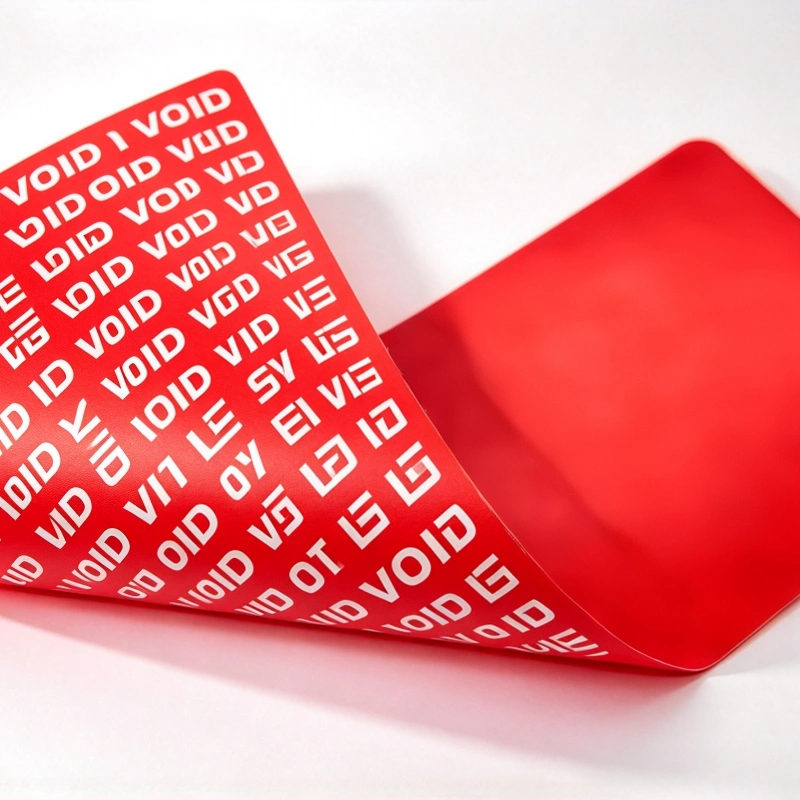
4. Destructible Security Tape
Destructible security tape uses a material construction intended to break apart or become visibly damaged when removal is attempted.
Instead of relying exclusively on a transferred VOID message, the material itself may provide the tamper indication.
This type can be considered when intact removal and reapplication would be undesirable. However, destructible security tape should not be confused with every type of destructible security label; the formats and application methods may differ.
5. Custom-Printed Security Tape
Some security tape products can incorporate printed text, logos, colors, sequential identifiers, or other design elements, depending on the manufacturer’s capabilities.
Custom printing can support brand identification, package handling instructions, or internal security procedures. It may also make unauthorized substitution easier to notice when the printed design is part of a broader inspection process.
Printed graphics alone do not make ordinary tape tamper evident. If a security effect is required, the underlying tape construction must provide the intended tamper indication.
What Is Tamper Evident Tape Used For?
Tamper evident tape is used in applications where package integrity needs to be checked during storage, handling, distribution, or delivery. The most suitable product depends on the packaging design, the type of interference being considered, and the level of visible evidence required.
1. Shipping and Logistics
During transportation, packages may pass through multiple facilities, vehicles, and handling stages. Tamper evident tape can provide a visible indication if a sealed closure has been disturbed.
Common applications include shipping cartons, distribution packaging, and selected warehouse operations.
For logistics applications, buyers should consider carton material, surface coatings, storage conditions, and the way packages are sealed. A sample test on the actual carton can help determine whether the security message appears as intended.
2. E-Commerce Packaging
Online retailers and fulfillment operations need packaging that remains identifiable and easy to inspect throughout delivery.
Tamper evident tape may help reveal signs of attempted opening on compatible packages. Custom printing may also support brand recognition or package identification.
However, the tape should be considered part of a broader packaging strategy. It does not independently guarantee that a shipment has not been opened or that its contents have remained unchanged.
3. Electronics and Equipment Packaging
Electronic products, accessories, and equipment may require security seals on packaging or selected components.
Depending on the product design, tamper evident tape or a smaller security label may be suitable for indicating attempted access.
When selecting a solution, consider the surface material, enclosure geometry, product value, inspection requirements, and whether residue could affect the product’s appearance or subsequent use.
4. Documents, Envelopes, and Security Bags
Certain documents, envelopes, and security bags require a closure that provides visible evidence of opening.
A suitable security sealing tape can help recipients identify possible interference at the closure point. The tape must be compatible with the envelope or bag material and the intended sealing process.
For applications involving confidential information or regulated materials, the packaging design and inspection procedure should be evaluated together rather than relying on tape alone.
5. Warehousing and Asset Protection
In some warehouse and industrial settings, tamper evident tape can support inspection procedures for sealed containers, stored components, and selected equipment packaging.
It may help staff identify packages that need further inspection, especially when combined with documented sealing and receiving procedures.
For high-risk applications, buyers should evaluate whether additional controls, such as unique identifiers, serialized labels, or access-control measures, are necessary.
Tamper Evident Tape vs. Regular Packing Tape
The main difference between tamper evident tape and regular packing tape is their intended function. Regular packing tape primarily seals packages, while tamper evident tape is designed to reveal visible signs of attempted removal or interference.
| Feature | Tamper Evident Tape | Regular Packing Tape |
|---|---|---|
| Primary purpose | Sealing with a visible tamper indication | General package sealing |
| Removal evidence | May reveal a message, transfer pattern, or material damage | Usually has no dedicated tamper-indicating mechanism |
| Security functionality | Designed to support inspection for possible interference | Primarily provides closure and handling support |
| Customization | May include security messages and specialized constructions | Often available with standard or custom printing |
| Surface behavior | Depends on the specific tamper-evident mechanism | Depends on the adhesive and tape material |
| Typical selection factors | Security effect, substrate, residue, and application conditions | Sealing strength, dimensions, cost, and packaging requirements |
For example, a carton sealed with ordinary packing tape may be reopened and resealed without a dedicated security message appearing. Tamper evident tape is designed to make certain removal attempts more apparent.
However, neither the presence nor absence of visible damage provides absolute proof that a package has or has not been tampered with. Product design, application conditions, and inspection procedures all influence the evidence available.
Tamper Evident Tape vs. Tamper Evident Labels
Tamper evident tape and tamper evident labels serve related purposes, but they are not interchangeable in every application.
Tape is often considered for sealing a longer opening or closure. Labels are often used on smaller areas, product housings, access points, or specific sealing locations.
| Comparison Factor | Tamper Evident Tape | Tamper Evident Labels |
|---|---|---|
| Format | Usually supplied in tape rolls | Often supplied as individual labels or rolls of die-cut labels |
| Application area | Longer package seams and closure areas | Defined areas, product surfaces, and selected openings |
| Size and shape | Typically available in specified tape widths and lengths | Can often be customized into different shapes and sizes |
| Printing and branding | Depends on the tape supplier and product construction | May support custom graphics, logos, text, and specialized label finishes |
| Typical use | Package sealing and selected security closures | Product protection, warranty seals, equipment identification, and other localized applications |
| Key selection concern | Closure geometry, substrate, and sealing process | Application area, surface compatibility, label construction, and required tamper indication |
When Should You Choose Tamper Evident Tape?
Consider tamper evident tape when you need to seal a package closure or a longer seam and want a visible indication of attempted removal.
It may be appropriate for cartons, envelopes, and selected packaging formats, provided the tape is compatible with the surface and sealing process.
When Should You Choose Tamper Evident Labels?
Consider tamper evident labels when the security feature needs to be positioned on a defined area, such as a product housing, access point, warranty location, or component package.
Depending on the construction, options may include VOID labels, destructible labels, and other specialized security labels. Custom sizes, shapes, printed information, and selected finishing techniques may also be available.
For manufacturers, brand owners, and packaging companies, the right choice depends on the product design and the required security effect. In some projects, a combination of security tape and labels may provide a more suitable approach than either product alone.
How to Choose the Right Tamper Evident Tape
Selecting tamper evident tape requires evaluating the application as a whole. A tape that works well on one carton or surface may behave differently on another.
The following factors can help buyers define their requirements before requesting samples or quotations.
1. Identify the Application Surface
Start by identifying the exact surface to which the tape will be applied.
Common substrates include corrugated cardboard, coated paperboard, plastic, metal, and glass. Their surface energy, texture, coatings, and cleanliness can influence adhesion and tamper indication.
For example, a coated carton may behave differently from an uncoated corrugated carton. A smooth metal surface may also require a different adhesive approach from a textured packaging material.
Whenever possible, provide the supplier with the actual packaging material or a representative sample.
2. Define the Required Tamper Indication
Determine where the tamper evidence should appear and what the recipient needs to observe.
Questions to consider include:
- Should a VOID message appear on the package surface?
- Should the message appear mainly on the tape?
- Is visible material damage an acceptable indication?
- Is permanent marking acceptable?
- Does the package require custom text or a recognizable security pattern?
These requirements help narrow the choice between transfer, non-transfer, and destructible constructions.
3. Evaluate Adhesive Performance
The adhesive must work with the intended substrate and application process.
Important considerations include initial adhesion, the time allowed for the adhesive to bond, storage conditions, and performance under the expected operating environment.
Temperature, humidity, dust, surface coatings, and application pressure can all influence results. The adhesive should be evaluated under conditions representative of actual use.
Do not assume that stronger adhesion always means better tamper evidence. The complete security mechanism, rather than adhesive strength alone, determines the intended removal behavior.
4. Consider Environmental Conditions
Packages may experience temperature changes, humidity, long storage periods, or demanding transportation conditions.
If the tape will be used in a cold warehouse, hot distribution environment, or humid location, confirm the manufacturer’s applicable performance specifications.
Where conditions are demanding, test samples under representative storage and application conditions before committing to a large production order.
5. Confirm Dimensions and Application Method
Tape width, roll length, core dimensions, and dispensing method may influence production efficiency and ease of application.
For manual sealing, operators may have different handling requirements from automated packaging lines. The selected format should match the available equipment and packaging workflow.
For customized products, confirm the dimensions, winding direction, roll specifications, and other relevant production details with the supplier.
6. Evaluate Custom Printing Requirements
Custom printing can help identify packages, display handling instructions, or support brand consistency.
Depending on the product, customization may include logos, colors, warning messages, or other printed information. Specialized security features should be assessed separately from decorative printing.
If custom printing is required, confirm that the design is compatible with the tape construction and that the final product remains suitable for its intended application.
7. Test Before Bulk Production
Sample testing is an important step when introducing a new security sealing material.
A practical evaluation should include:
- Apply the tape to the intended packaging surface using the expected procedure.
- Allow the adhesive to bond according to the manufacturer’s instructions.
- Evaluate the appearance and adhesion under representative conditions.
- Attempt removal and inspect the resulting tamper indication.
- Check for unacceptable residue, surface damage, or other unintended effects.
- Confirm that operators can apply and inspect the tape consistently.
Record the results and agree on acceptance criteria before moving to bulk production.
This process helps reduce the risk of selecting a product that performs differently from what the application requires.
Can Tamper Evident Tape Prevent All Tampering?
No. Tamper evident tape is designed to reveal certain signs of opening or removal, but it cannot guarantee that every attempt at interference will be detected.
Its effectiveness depends on the security construction, packaging material, application quality, environmental conditions, and the way the package is inspected.
Some products provide a clear visible message when removed correctly, while others may show different results depending on the substrate or removal conditions. Deliberate manipulation, unsuitable surfaces, or incorrect application may affect the evidence produced.
For this reason, tamper evident tape should be viewed as one part of a security process rather than a complete anti-theft or anti-counterfeiting solution.
Depending on the application, additional measures may include:
- Unique serial numbers or identification codes
- Specialized tamper evident labels
- Documented package sealing and receiving procedures
- Access controls and inspection records
- Suitable packaging structures and other security features
The appropriate combination depends on the product’s value, distribution process, risk level, and inspection requirements.
Custom Tamper Evident Labels and Security Solutions from Perfect Label
For projects that require localized tamper indication, specialized materials, or customized label designs, tamper evident labels may be an appropriate alternative or complement to security tape.
Qingdao Perfect Printing and Packaging Co., Ltd. (Perfect Label) is a custom label manufacturer based in Qingdao, China, serving brands, packaging companies, and industrial manufacturers across international markets.
With 16 years of experience in the label printing industry, Perfect Label provides customized label solutions supported by an in-house technical team and advanced printing and converting equipment.
Our product portfolio includes security and anti-counterfeit labels, special-material labels, RFID/NFC smart labels, functional labels, and decorative labels. Depending on the application and product specifications, we help customers evaluate suitable label materials, printing requirements, shapes, and finishing options.
Customized Labels for Different Applications
Security and anti-counterfeit labels
For applications requiring product identification or visible signs of interference, an appropriate security label construction can help support inspection and product protection procedures.
Different surfaces and operating environments may require specialized label materials. Material selection should consider the substrate, adhesive compatibility, application method, and intended service conditions.
Custom printing and finishing
Depending on the selected product, customization may include brand graphics, text, colors, die-cut shapes, and compatible finishing techniques. The available options should be confirmed for each label construction.
Manufacturing and Quality Management
Perfect Label operates a 5,000-square-meter intelligent manufacturing workshop equipped with printing, die-cutting, hot-stamping, embossing, and other converting equipment. Our in-house technical team supports customized label projects, while our ISO 9001:2015 quality management system provides a framework for production quality control.
We offer a 24-hour rapid sample-making service for applicable projects, with mass-production orders potentially completed within 3–7 working days depending on product specifications and order requirements.
For customers evaluating a security label project, sample development can help verify material compatibility, printing quality, dimensions, and the intended application performance before bulk production.
Discuss Your Custom Security Label Requirements
If you are comparing tamper evident tape with security labels, the most suitable solution depends on where the seal will be applied, what evidence needs to appear after removal, and which materials are compatible with your product.
Contact Perfect Label to discuss your application, packaging surface, label dimensions, customization requirements, and estimated order quantity. Our team can help evaluate the relevant custom label options based on your project specifications.
Frequently Asked Questions About Tamper Evident Tape
Is tamper evident tape reusable?
Many tamper evident tapes are designed to show visible changes when removal is attempted. Once the security mechanism has been activated, the tape may not be suitable for reuse without visible evidence. Actual behavior depends on the product construction.
Does tamper evident tape leave residue?
It depends on the tape and the applied surface. Some products are designed to transfer a VOID message or pattern to the substrate, while others primarily reveal information on the tape itself. Adhesive residue and surface marking should be evaluated using the actual product and packaging material.
Can tamper evident tape be customized?
Some manufacturers offer customization options such as dimensions, colors, printed messages, logos, and security patterns. The available options depend on the tape construction and production capabilities. Buyers should confirm the specifications with their supplier.
What is the difference between tamper evident and tamper proof?
Tamper evident means that a product is designed to provide visible evidence of certain opening or interference attempts. Tamper proof suggests that tampering cannot occur. Tamper evident tape generally supports detection rather than guaranteeing that unauthorized access is impossible.
Is tamper evident tape suitable for plastic packaging?
Some tamper evident tapes may be suitable for particular plastic surfaces, but compatibility cannot be assumed for all plastics. Surface energy, coatings, texture, adhesive formulation, and application conditions can affect performance. Testing on the actual packaging material is recommended.
Is tamper evident tape the same as security tape?
The terms overlap in commercial usage, but not every product marketed as security tape necessarily has the same tamper-indicating mechanism. Buyers should verify whether a particular tape reveals a message, transfers a pattern, breaks apart, or simply provides a printed security design.
Should I choose security tape or a security label?
Security tape may be suitable for sealing longer package closures, while security labels may be more appropriate for smaller areas, product housings, warranty locations, or defined access points. The best choice depends on the package design, surface material, and required security effect.
What information should I provide when requesting a custom security label quotation?
Provide the application, surface material, desired tamper indication, label dimensions, printing requirements, estimated order quantity, and any relevant environmental conditions. Sharing a sample or photograph of the application can also help the manufacturer evaluate the project more accurately.
Conclusion
Tamper evident tape is designed to help reveal signs of opening, removal, or interference through visible messages, transfer patterns, or material damage. It is used in shipping, logistics, e-commerce packaging, equipment packaging, and other applications where package integrity needs to be inspected.
Choosing the right product requires evaluating the tamper-indicating mechanism, packaging surface, adhesive performance, environmental conditions, dimensions, and customization requirements. Testing the selected product on the actual packaging material is an important step before bulk purchasing.
For applications involving smaller sealing areas, product housings, warranty locations, or specialized identification requirements, custom tamper evident labels may provide a more suitable solution.
Perfect Label supports customized label projects with specialized printing and converting capabilities, an in-house technical team, and an established quality management system. If you are evaluating security labels for your product or packaging, contact our team to discuss your application and explore suitable customization options.