
Custom Stickers for Small Business: A Complete Guide
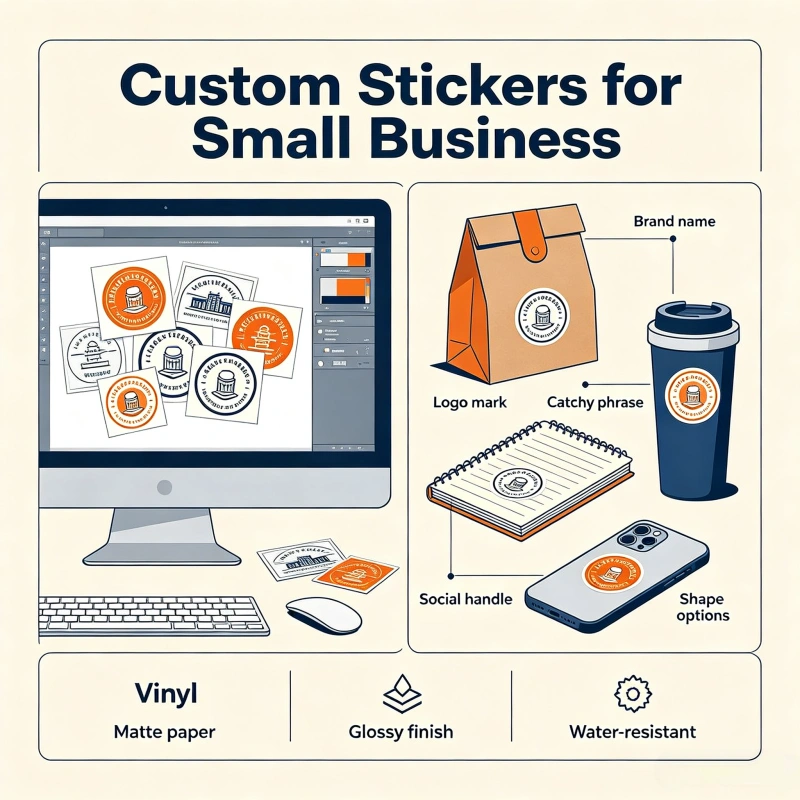
For a small business, branding does not always require expensive custom packaging, professional retail displays, or large advertising budgets. Custom stickers for small businesses offer a simpler way to put your brand name, logo, product information, or marketing message directly onto packaging, products, mailers, shopping bags, and promotional materials.
The challenge is choosing the right sticker.
A handmade candle company has different requirements from a coffee shop. An Etsy seller may need attractive logo stickers, while a cosmetics brand may need waterproof product labels. A local bakery may care more about food packaging and moisture resistance, while an online retailer may need stickers for shipping boxes and customer orders.
This guide explains how small businesses can choose the right custom stickers, control costs, prepare artwork, select materials, decide quantities, and build a practical sticker program that can grow with the business.
Content Details Navigation
Why Do Small Businesses Need Custom Stickers?
What Are the Best Custom Stickers for a Small Business?
Custom Stickers for Product Packaging
Custom Logo Stickers for Small Business
Custom Stickers for E-Commerce Businesses
Custom Stickers for Handmade Businesses
Custom Stickers for Food and Beverage Businesses
Custom Stickers for Beauty and Cosmetics Brands
Custom Stickers for Small Business Marketing
Custom QR Code Stickers for Small Business
How Much Do Custom Stickers Cost for a Small Business?
Should a Small Business Order 100, 500 or 1,000 Stickers?
How to Choose the Right Sticker Material
What Sticker Finish Should a Small Business Choose?
How to Design Custom Stickers for a Small Business
Custom Die-Cut Stickers vs. Standard Shapes
A Practical Sticker Strategy for a New Small Business
Example: A Small Cosmetics Brand
How to Order Custom Stickers for Your Small Business
How to Avoid Common Small Business Sticker Mistakes
Factory-Direct Custom Stickers for Small Business
Why Do Small Businesses Need Custom Stickers?
Custom stickers give small businesses a flexible way to add branding without redesigning all of their packaging.
For example, a company using standard kraft boxes can add a branded logo sticker and immediately create a more consistent presentation. A plain mailer bag can become recognizable with a custom sticker. A product jar can use a printed label instead of requiring expensive custom-printed containers.
Current small-business sticker guides commonly identify packaging, product labeling, giveaways, events, customer orders, and promotional campaigns as major applications.
The biggest advantage is flexibility.
A small business can order stickers separately from its packaging and change designs more easily when:
- A logo changes
- A product is redesigned
- A seasonal campaign starts
- A new product is launched
- A promotion is introduced
- Different languages are required
- A new market is entered
This makes stickers particularly useful for growing brands that do not yet want to commit to large quantities of fully printed packaging.
What Are the Best Custom Stickers for a Small Business?
No single “best” sticker fits every small business.
The right option depends on what you want the sticker to do.
| Business Need | Recommended Sticker |
|---|---|
| Logo branding | Die-cut or round stickers |
| Product packaging | Product labels |
| Box sealing | Logo seal stickers |
| E-commerce orders | Logo + thank-you stickers |
| Outdoor branding | Waterproof vinyl stickers |
| Food packaging | PP/BOPP or suitable food-packaging label |
| Bottles and jars | Waterproof adhesive labels |
| Premium products | Clear, metallic, foil or decorative labels |
| Events | Promotional die-cut stickers |
| QR code marketing | QR code stickers |
| Multiple languages | Multi-layer/booklet labels |
| Inventory tracking | RFID labels |
For most new businesses, it is better to start with one or two practical sticker formats than to order ten different designs.
Custom Stickers for Product Packaging
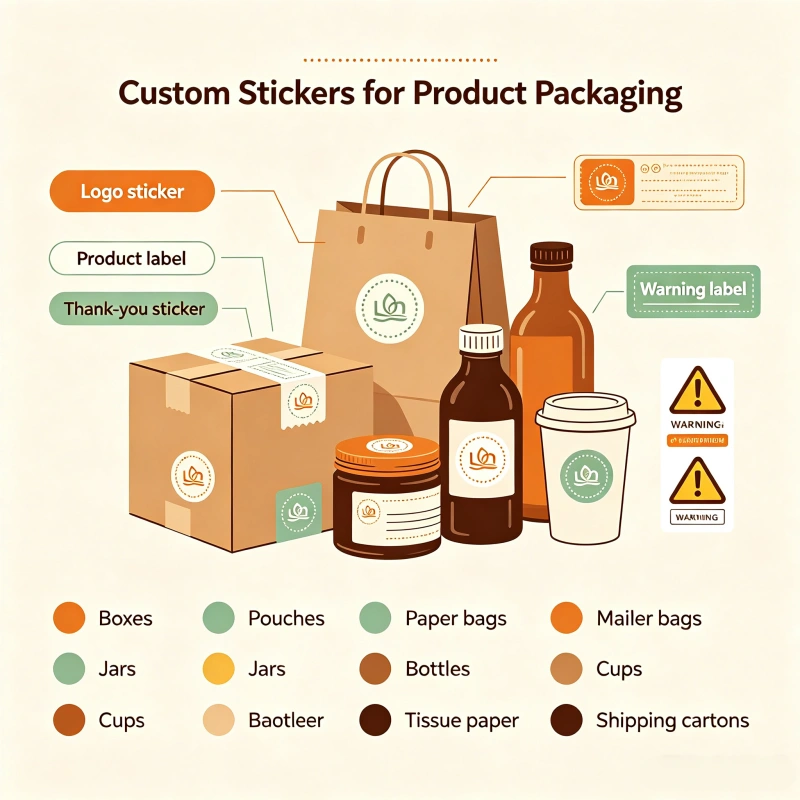
Packaging is one of the most practical uses for small business stickers.
A custom sticker can turn standard packaging into branded packaging without requiring the business to purchase custom-printed boxes, bags, or containers.
Common applications include:
- Boxes
- Pouches
- Paper bags
- Mailer bags
- Jars
- Bottles
- Cups
- Tissue paper
- Shipping cartons
- Product containers
For example, an online candle brand could use:
Logo sticker + product label + warning label + thank-you sticker
Instead of printing everything directly onto the box, the business can use stickers to keep packaging flexible.
This is especially useful when a company has multiple products but relatively low sales volume for each SKU.
Custom Logo Stickers for Small Business
A custom logo sticker is one of the easiest places to start.
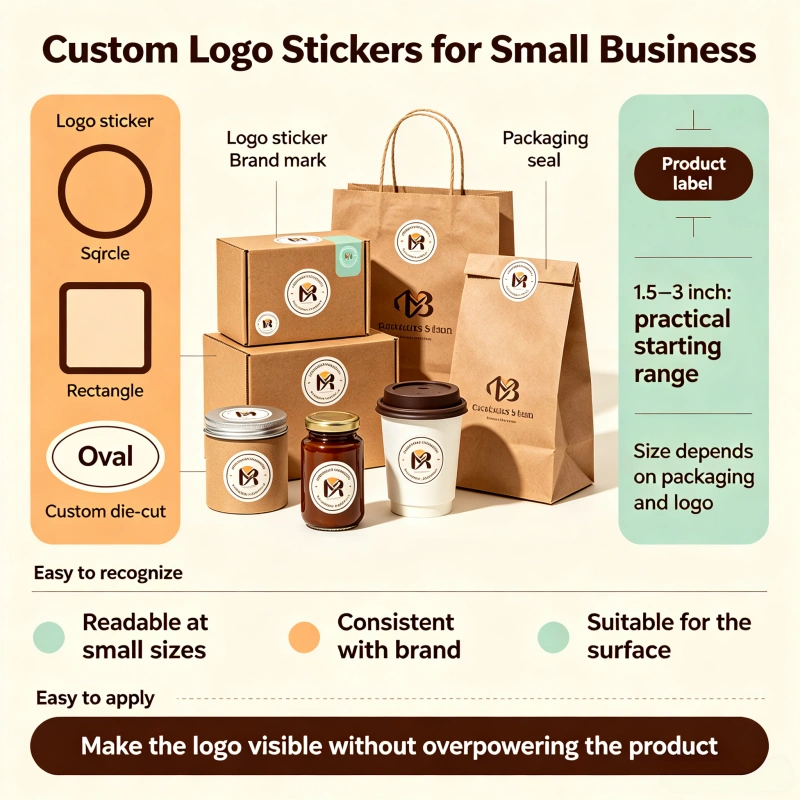
A good logo sticker should be:
- Easy to recognize
- Simple enough to read at small sizes
- Consistent with the brand identity
- Suitable for the intended surface
- Easy to apply
Common shapes include:
- Circle
- Square
- Rectangle
- Oval
- Custom die-cut
For packaging, a 1.5–3 inch sticker is often a practical starting range, although the ideal size depends on the packaging dimensions and logo design.
The goal is not to make the sticker as large as possible.
The goal is to make the logo visible without overpowering the product.
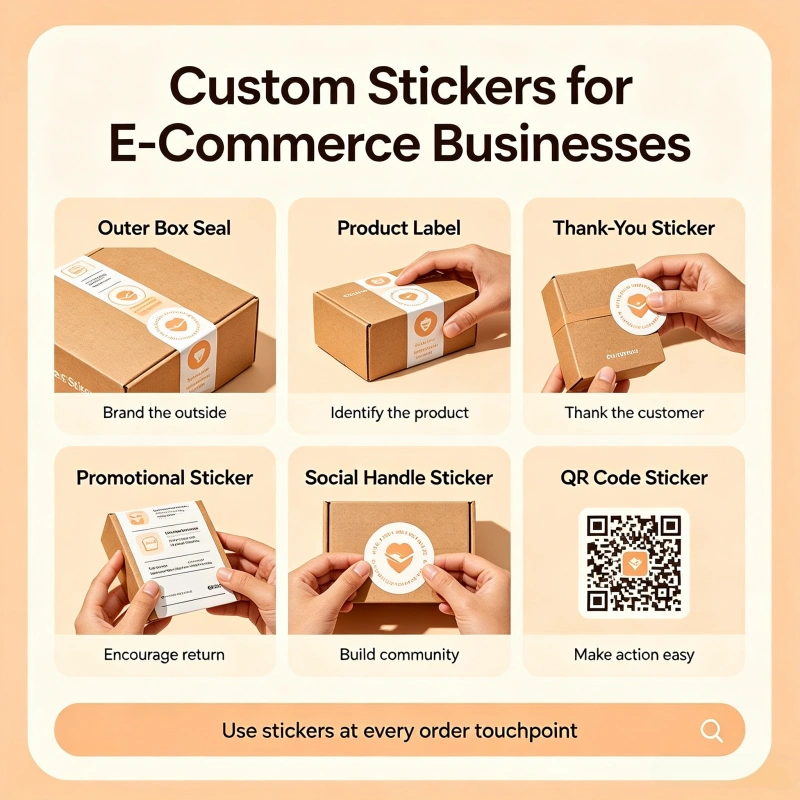
Custom Stickers for E-Commerce Businesses
Small online stores can use stickers throughout the order process.
A single shipment might include:
Outer box → logo seal → product label → thank-you sticker → promotional sticker
For example, an Etsy or Shopify seller could include one small branded sticker with every order.
The sticker can contain:
- Logo
- Website
- Social media handle
- QR code
- Thank-you message
- Discount code
- Brand slogan
Current small-business sticker guides specifically identify e-commerce packaging, inserts, thank-you stickers, product labels, and promotional stickers as common applications.
This creates multiple brand touchpoints without requiring expensive packaging changes.
Custom Stickers for Handmade Businesses
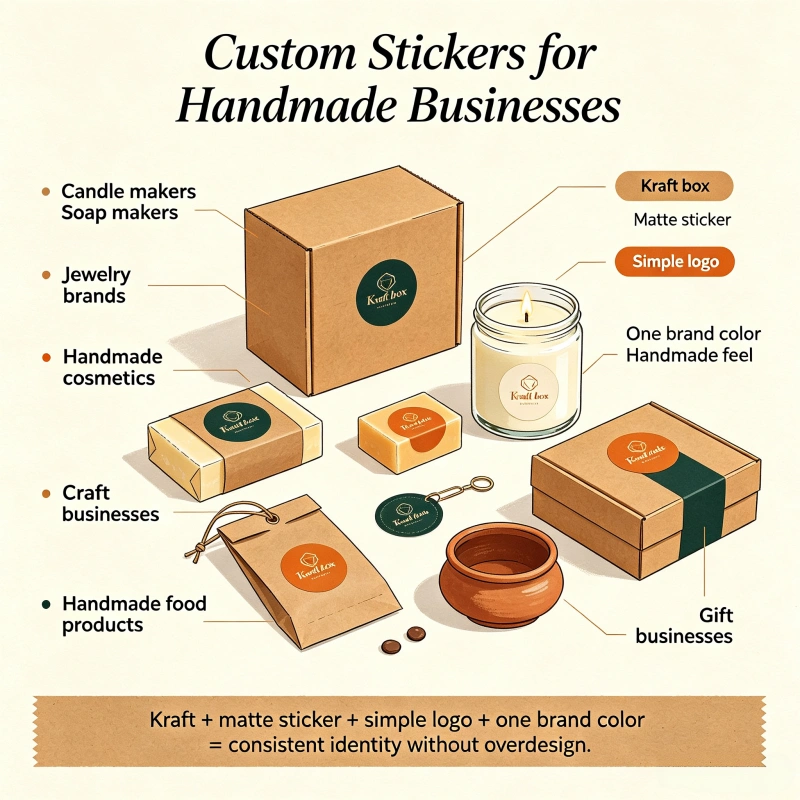
Handmade businesses are particularly well suited to custom stickers.
Examples include:
- Candle makers
- Soap makers
- Jewelry brands
- Handmade cosmetics
- Pottery businesses
- Craft businesses
- Handmade food products
- Gift businesses
For these companies, packaging often needs to feel personal, not mass-produced.
A kraft box plus a high-quality custom sticker can create a very different impression from a completely generic package.
For handmade brands, consider:
Kraft + matte sticker + simple logo + one brand color
This can create a consistent visual identity without making the packaging look overdesigned.
Custom Stickers for Food and Beverage Businesses
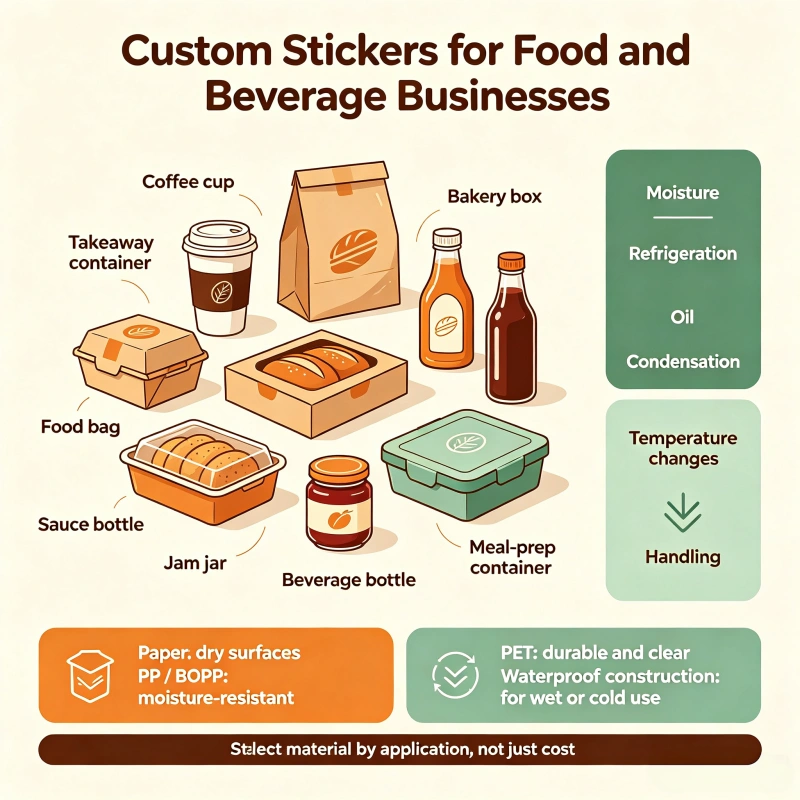
Food businesses should consider the environment where the sticker will be used.
Common applications include:
- Coffee cups
- Takeaway containers
- Bakery boxes
- Food bags
- Sauce bottles
- Jam jars
- Beverage bottles
- Meal-preparation containers
The sticker may encounter:
- Moisture
- Refrigeration
- Oil
- Condensation
- Temperature changes
- Handling
Therefore, paper stickers may not always be appropriate.
For moisture-exposed packaging, synthetic materials such as PP/BOPP, PET, or suitable waterproof constructions may be more practical.
Select the material based on the actual application rather than simply choosing the cheapest sticker.
Custom Stickers for Beauty and Cosmetics Brands
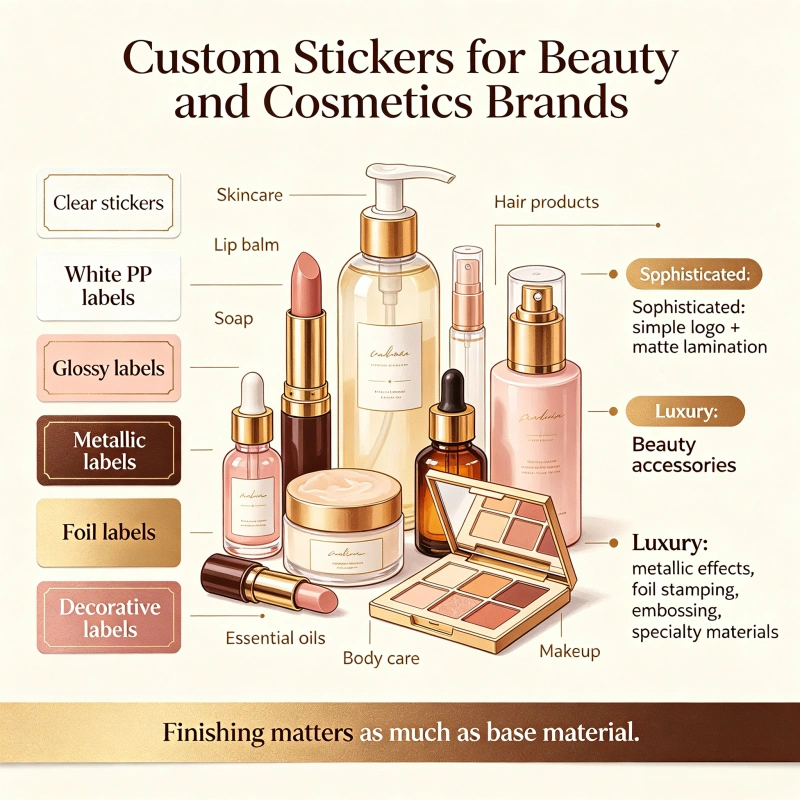
Small cosmetics brands often need packaging that looks premium.
Typical products include:
- Skincare
- Lip balm
- Soap
- Hair products
- Essential oils
- Body care
- Makeup
- Beauty accessories
Possible sticker options include:
- Clear stickers
- White PP labels
- Matte labels
- Glossy labels
- Metallic labels
- Foil labels
- Decorative labels
For premium products, finishing can be as important as the base material.
A simple logo with matte lamination may create a sophisticated appearance without the cost of highly complex finishing.
For luxury positioning, consider metallic effects, foil stamping, embossing, or specialty materials.
Custom Stickers for Small Business Marketing
Stickers should not be limited to packaging.
They can also become a low-cost promotional product.
Businesses can distribute them at:
- Markets
- Trade shows
- Pop-up stores
- Events
- Coffee shops
- Conferences
- Product launches
- Local community events
A good promotional sticker should give people a reason to keep it.
Instead of putting only a logo on the sticker, consider:
- A memorable slogan
- A mascot
- A product illustration
- A useful QR code
- A limited-edition design
- A humorous message
Shopify’s 2026 guide also highlights stickers as a flexible marketing tool that can go in packaging, be distributed at events, or be sold as merchandise.
Custom QR Code Stickers for Small Business
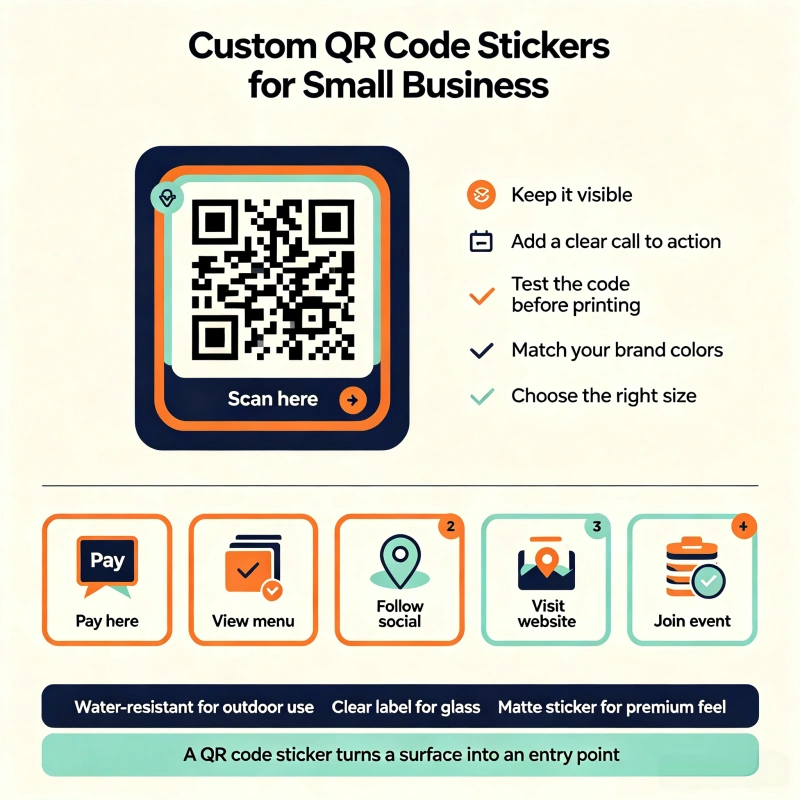
QR code stickers are particularly useful for small businesses because one small physical label can connect customers to a digital destination.
A QR code could link to:
- Website
- Product page
- Online menu
- TikTok
- Review page
- Warranty registration
- Instruction manual
- Discount page
However, do not make the QR code too small.
The code needs enough clear space around it and should be tested with several smartphones before mass production.
For packaging, the QR code should support the customer journey rather than simply exist because QR codes are fashionable.
For example:
Product → Scan QR → Usage instructions
is more useful than:
Product → Scan QR → Homepage
How Much Do Custom Stickers Cost for a Small Business?
The cost of custom stickers depends mainly on material, size, quantity, printing, finishing, and production method.
For small businesses, low-volume orders normally have a higher unit cost, while larger orders reduce the average cost per sticker.
A recent 2026 industry guide gives a broad reference range of approximately $0.05–$0.50 per sticker, depending on size, material, quantity, and printing method.
However, B2B factory pricing can be substantially different from retail or small online-printing prices.
For example, actual factory reference pricing for customized label products can fall into the following ranges:
| Product | Factory Reference Price |
|---|---|
| Security Labels | $0.015–$0.030/pc |
| Dome Labels | $0.030–$0.074/pc |
| RFID Tags | $0.060–$0.119/pc |
| Wine & Beverage Labels | $0.089–$0.179/pc |
| Multi-Layer Booklet Labels | $0.119–$0.223/pc |
| Decorative Labels | $0.179–$0.298/pc |
These are reference factory ranges, not fixed prices.
The final custom sticker price depends on the exact specification.
Should a Small Business Order 100, 500 or 1,000 Stickers?
This is one of the most practical purchasing decisions.
If you are testing a new design, starting with 100–200 pieces can reduce the risk of committing too much money to an unproven design. Some current small-business sticker guides recommend a small test run, then increasing volume after confirming customer response.
A practical approach is:
100–200 Pieces
Best for:
- New businesses
- New logos
- Product testing
- Seasonal campaigns
- New packaging
500 Pieces
Good for:
- Established packaging
- Regular e-commerce orders
- Local events
- Small product launches
1,000+ Pieces
Better for:
- Regular product sales
- High-volume packaging
- Popular designs
- Wholesale orders
5,000+ Pieces
Suitable when:
- The design is stable
- The sticker is used on every order
- The product has predictable demand
- Lower unit cost is important
The key principle is:
Don’t buy 10,000 stickers just because the unit price is lower if you will only use 500.
Inventory that sits in a warehouse is not savings.
How to Choose the Right Sticker Material
Select material based on the application.
Paper Stickers
Best for:
- Indoor packaging
- Short-term promotions
- Kraft packaging
- Low-cost branding
Advantages:
- Low cost
- Easy to print
- Natural appearance
- Suitable for many indoor uses
Vinyl Stickers
Best for:
- Outdoor promotion
- Promotional giveaways
- Bottles
- Equipment
- Long-term branding
Vinyl is commonly chosen when durability and moisture resistance matter.
PP/BOPP Stickers
Best for:
- Food packaging
- Cosmetics
- Bottles
- Moisture-exposed products
They offer a practical combination of durability, printability, and moisture resistance.
PET Stickers
Best for:
- Industrial applications
- Durable product labels
- Electronics
- Harsh environments
Clear Stickers
Best for:
- Premium packaging
- Glass bottles
- Transparent containers
- “No-label-look” designs
Always test the correct material on the actual product surface before large-scale production.
What Sticker Finish Should a Small Business Choose?
The finish changes both appearance and performance.
Matte
Good for:
- Premium packaging
- Minimalist brands
- Cosmetics
- Handmade products
Glossy
Good for:
- Bright colors
- Promotional stickers
- Product images
- Retail packaging
Holographic
Good for:
- Youth brands
- Artists
- Collectibles
- Promotional products
Metallic
Good for:
- Premium products
- Cosmetics
- Wine
- Luxury packaging
Lamination
Useful when you need extra protection against moisture, abrasion, or handling.
A small business does not need the most expensive finish.
Choose the finish that supports the brand positioning and actual use.
How to Design Custom Stickers for a Small Business
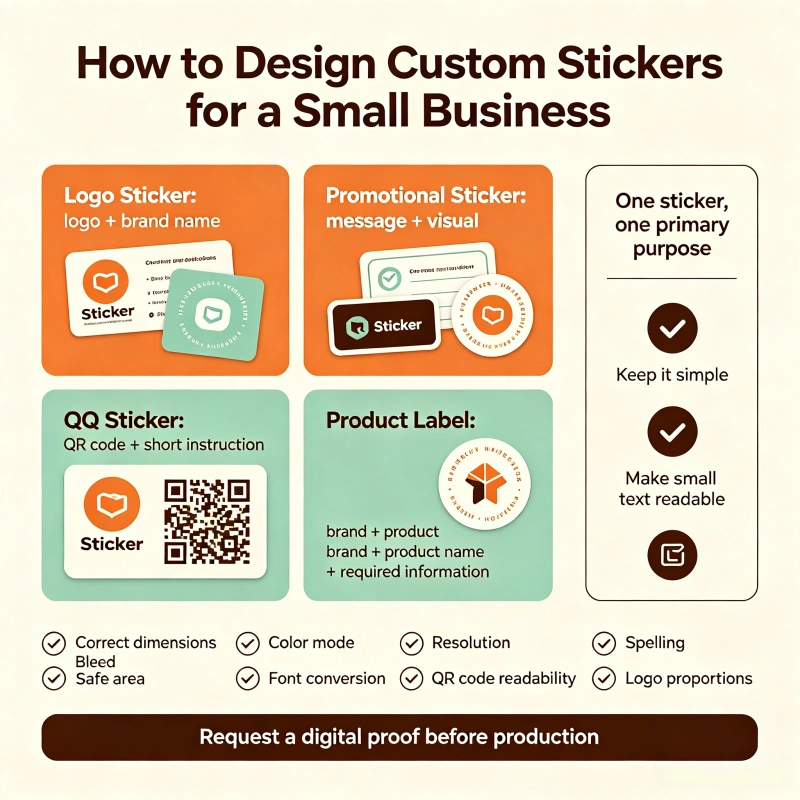
A common mistake is putting too much information on one sticker.
A small sticker usually works better when it has one primary purpose.
For a logo sticker:
Logo + brand name
For a promotional sticker:
Message + visual
For a QR sticker:
QR code + short instruction
For a product label:
Brand + product name + required information
Before sending artwork to the manufacturer, check:
- Correct dimensions
- Bleed
- Safe area
- Color mode
- Resolution
- Font conversion
- QR code readability
- Spelling
- Logo proportions
If possible, request a digital proof before production.
Custom Die-Cut Stickers vs. Standard Shapes
Small businesses can choose between standard shapes and custom die-cut stickers.
Standard Shapes
Examples:
- Circle
- Square
- Rectangle
- Oval
Advantages:
- Simple
- Easy to design
- Efficient production
- Often cost-effective
Die-Cut Stickers
The sticker follows the shape of the artwork or logo.
Advantages:
- More distinctive
- Stronger visual identity
- Better for illustrations
- Suitable for promotional merchandise
Die-cut stickers are especially popular among artists, creators, and brands selling merchandise.
If the sticker will mainly be used as a packaging seal, a standard circle or rectangle may provide better value.
A Practical Sticker Strategy for a New Small Business
If you are launching a business and have never purchased custom stickers before, do not start with six different products.
Use a simple three-stage system.
Stage 1: Build the Brand
Order:
Logo sticker
Use it on:
- Boxes
- Bags
- Mailers
- Thank-you cards
Recommended starting quantity:
100–500 pieces
Stage 2: Improve Packaging
Add:
Product label + packaging seal
The sticker system now serves both branding and product-information functions.
Stage 3: Add Marketing
Introduce:
Promotional / QR / giveaway stickers
Include these with orders or distribute them at events.
This approach lets the sticker program grow with the business instead of creating unnecessary inventory.
Example: A Small Candle Business
Imagine a small candle company selling handmade soy candles online.
The company uses plain kraft boxes.
Instead of ordering expensive printed boxes, it could use:
1. Logo sticker
Placed on the outside of the box.
2. Product label
Applied to the candle jar.
3. Safety label
Placed underneath the candle.
4. Thank-you sticker
Added inside the package.
5. QR code sticker
Links to candle-care instructions.
The company can create a complete branded packaging experience while still using standard packaging materials.
This is one of the strongest reasons custom stickers for small businesses remain practical: the business can change one component without replacing its entire packaging system.
Example: A Small Cosmetics Brand
A skincare startup may have only three products:
- Face serum
- Moisturizer
- Cleanser
Instead of ordering three types of custom bottles, it can use standard containers combined with customized PP or PET labels.
Each product can share:
- Brand logo
- Typography
- Brand colors
while changing:
- Product name
- Ingredients
- Usage
- Volume
- Batch information
This creates a consistent product family while maintaining production flexibility.
How to Order Custom Stickers for Your Small Business
A practical ordering process should look like this:
Step 1: Define the Application
Ask:
Where will the sticker be used?
Packaging, outdoor promotion, bottles, shipping boxes, or products?
Step 2: Choose the Material
Match the material to:
- Surface
- Moisture
- Temperature
- Handling
- Expected lifespan
Step 3: Select the Size
Measure the actual application surface.
Don’t design the sticker first and then discover it doesn’t fit the package.
Step 4: Select the Shape
Choose:
- Circle
- Rectangle
- Square
- Oval
- Custom die-cut
Step 5: Choose the Finish
Select matte, glossy, laminate, metallic, holographic, or another finish according to the desired result.
Step 6: Prepare the Artwork
Provide:
- Logo
- Artwork
- Text
- QR code
- Product information
Step 7: Request a Sample or Proof
Before ordering thousands of pieces, verify:
- Color
- Size
- Adhesion
- Material
- Surface appearance
Step 8: Compare Quantity Pricing
Ask for quotations at multiple volumes.
For example:
500 / 1,000 / 5,000 / 10,000 pcs
Step 9: Start Production
Once the proof is approved, proceed with the production order.
Step 10: Evaluate and Reorder
After using the stickers for several weeks, evaluate:
- Adhesion
- Customer response
- Appearance
- Durability
- Consumption rate
Then adjust the next order. The most important step is partnering with an experienced manufacturer that can provide solutions for a wide range of product labels.
How to Avoid Common Small Business Sticker Mistakes
Mistake 1: Ordering Too Many
A new company may order 10,000 stickers because the unit price looks attractive.
If the design changes six months later, the remaining inventory becomes waste.
Mistake 2: Choosing Material Only by Price
A cheap paper sticker may fail on a refrigerated bottle.
Mistake 3: Ignoring Adhesion
Different surfaces require different adhesives.
Mistake 4: Making the Sticker Too Small
A beautiful logo becomes useless if customers cannot read it.
Mistake 5: Adding Too Much Information
A sticker is not a website.
Keep the main message clear.
Mistake 6: Skipping a Sample
A digital design cannot fully show:
- Material texture
- Adhesive performance
- Actual color
- Gloss level
- Thickness
Always test important applications before a large production run.
Factory-Direct Custom Stickers for Small Business
Small businesses often begin with online printing services because they need relatively small quantities.
As the business grows, direct manufacturing can become more attractive, particularly when monthly sticker consumption increases.
A factory can provide customization across:
- Material
- Size
- Shape
- Adhesive
- Printing
- Finishing
- Packaging
- Variable data
- RFID
- Security features
- Multi-layer construction
For a small business, factory-direct sourcing is not necessarily about buying the largest possible quantity.
It is about creating a sticker specification that matches the actual product and purchasing volume.
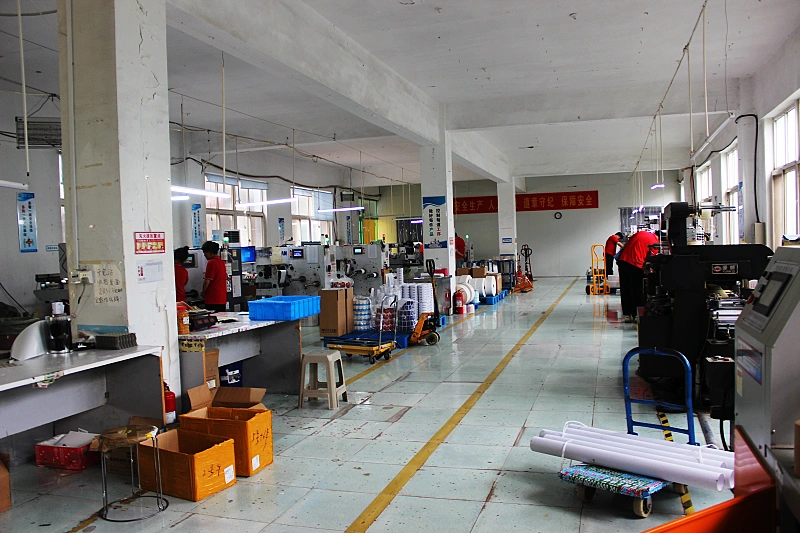
Perfect Label provides custom label and sticker manufacturing for brands, product manufacturers, distributors, and other B2B buyers. Depending on the application, solutions can include standard stickers, waterproof labels, security labels, RFID tags, dome labels, beverage labels, multi-layer booklet labels, and decorative labels.
The most cost-effective solution is not always the sticker with the lowest unit price.
It is the sticker that provides the required appearance, adhesion, durability, functionality, and cost for the actual application.
FAQ About Custom Stickers for Small Business
What are the best custom stickers for a small business?
For many new businesses, a simple custom logo sticker is a good starting point. Vinyl works well when moisture or outdoor durability matters, while paper suits many indoor packaging applications.
How many custom stickers should a small business order?
Start with around 100–500 pieces when testing a new design. Once the design and application are proven, larger quantities can reduce the unit cost.
Are custom stickers good for product packaging?
Yes. You can use them on boxes, bags, jars, bottles, mailers, tissue paper, and other packaging surfaces. They allow businesses to add branding without ordering fully custom-printed packaging.
What is the best material for waterproof business stickers?
Vinyl, PP/BOPP, PET, and other synthetic constructions can suit moisture-resistant applications. The best choice depends on the surface, temperature, exposure, and required lifespan.
Can I put my logo on custom stickers?
Yes. You can print a logo as a standard circle, rectangle, square, or custom die-cut shape.
Are custom stickers expensive for small businesses?
They do not have to be. Simple stickers can be produced at relatively low unit costs, particularly as order quantities increase. The biggest cost drivers are usually size, material, quantity, printing, and finishing.
Can small businesses use QR code stickers?
Yes. QR stickers can connect physical products or packaging to websites, menus, social media, instructions, reviews, promotions, or other digital content.
Should I buy stickers directly from a manufacturer?
If your volume is increasing or you require specific materials, adhesives, finishes, or custom constructions, buying directly from a manufacturer can be worth evaluating. It allows you to compare factory pricing and communicate specifications directly with the production team.
A Simple Implementation Plan for Your Small Business
To put this guide into practice, use the following checklist.
Week 1 — Define the purpose
Choose one primary application:
Packaging / Product Label / Logo / Promotion / QR Code
Week 1 — Select specifications
Determine:
- Size
- Shape
- Material
- Adhesive
- Finish
- Quantity
Week 2 — Prepare artwork
Create one primary design and one alternative version.
Week 2 — Request samples
Test the sticker on the actual packaging or product.
Week 3 — Evaluate
Check:
- Appearance
- Adhesion
- Durability
- Customer response
- Cost per unit
Week 3 — Place the first production order
Choose a quantity based on your actual monthly consumption.
After 1–3 months — Optimize
Review how quickly you use the stickers and whether the material and design work as expected.
Then negotiate larger-volume pricing if demand is stable.
Final Thoughts
Custom stickers for small businesses work best when treated as part of a practical branding and packaging system, not just promotional decoration.
Start with the application.
Then choose the material, size, adhesive, finish, and quantity.
For a new business, a sensible starting point might be:
Logo sticker → Product label → Packaging seal → QR/promotional sticker
As sales grow, the sticker program can become more sophisticated with waterproof materials, premium finishes, security features, RFID, multi-layer labels, or other customized constructions.
The key is to scale your sticker purchasing as fast as your business.
You do not need 10,000 stickers to look professional.
You need the right 100, 500, or 1,000 stickers for the job—and a supplier that can scale with you when those numbers start getting bigger.

Jgs is a custom labeling professional with 15 years of industry experience in labeling solutions.


Leave a Reply
Want to join the discussion?Feel free to contribute!