
Types of Packaging Labels: A Complete Guide
Packaging labels do much more than display a brand name. They identify products, communicate essential information, support traceability, protect product authenticity, and create a visual connection between a product and its customers.
But with so many options available—including pressure-sensitive labels, shrink sleeve labels, paper labels, BOPP labels, security labels, and smart labels—choosing the right type of packaging label can be challenging.
The best packaging label depends on several factors, including the packaging material, product environment, application method, information requirements, branding objectives, and functional needs.
In this guide, we explain the main types of packaging labels, their materials, applications, and how to choose the right solution for your product.
What Are Packaging Labels?
Packaging labels are printed or functional labels applied to product packaging to provide identification, information, branding, decoration, tracking, security, or other functions.
They can be applied to bottles, jars, cartons, boxes, pouches, cans, tubes, and many other packaging formats.
Depending on the product and application, a packaging label may contain:
- Brand name and logo
- Product name
- Ingredients and nutritional information
- Instructions for use
- Barcodes and QR codes
- Batch and lot numbers
- Manufacturing and expiration dates
- Regulatory information
- Warning information
- Security or authentication features
- Promotional messages
Packaging labels can therefore be classified in several ways, including by application method, function, material, and industry.
Types of Packaging Labels at a Glance
| Label Type | Best For | Main Benefit |
|---|---|---|
| Pressure-Sensitive Labels | Bottles, jars, boxes, pouches | Versatile and easy to apply |
| Shrink Sleeve Labels | Complex-shaped containers | 360-degree coverage |
| Wrap-Around Labels | Bottles and cans | Large printable area |
| Paper Labels | Dry products and cartons | Cost-effective and highly printable |
| BOPP Labels | Food, beverage, cosmetics | Moisture resistance and durability |
| PET Labels | Industrial and demanding applications | Excellent durability |
| Clear Labels | Glass and transparent containers | No-label-look appearance |
| Security Labels | Sensitive or premium products | Anti-counterfeiting protection |
| Smart Labels | Tracking and authentication | RFID, NFC, or digital functionality |
| Booklet Labels | Small products with extensive information | More content in limited space |
| Tamper-Evident Labels | Sealed products | Evidence of opening |
Types of Packaging Labels by Application Method
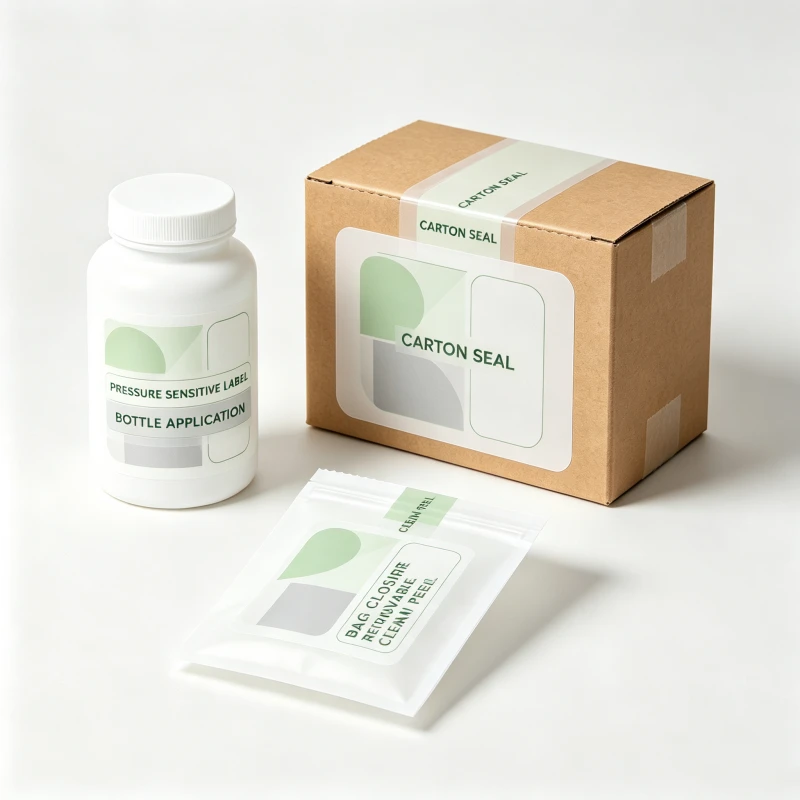
1. Pressure-Sensitive Labels
Pressure-sensitive labels, also called self-adhesive labels, are one of the most widely used packaging label formats.
They consist of a printable face material, adhesive, and usually a release liner. The label can be applied by hand or through an automated labeling machine.
Pressure-sensitive labels are suitable for:
- Glass bottles
- Plastic bottles
- Jars
- Cartons
- Boxes
- Pouches
- Tubes
- Cans
They are available in many materials, shapes, sizes, adhesives, finishes, and printing options.
For general-purpose product packaging, pressure-sensitive labels are often a highly versatile choice.
2. Shrink Sleeve Labels
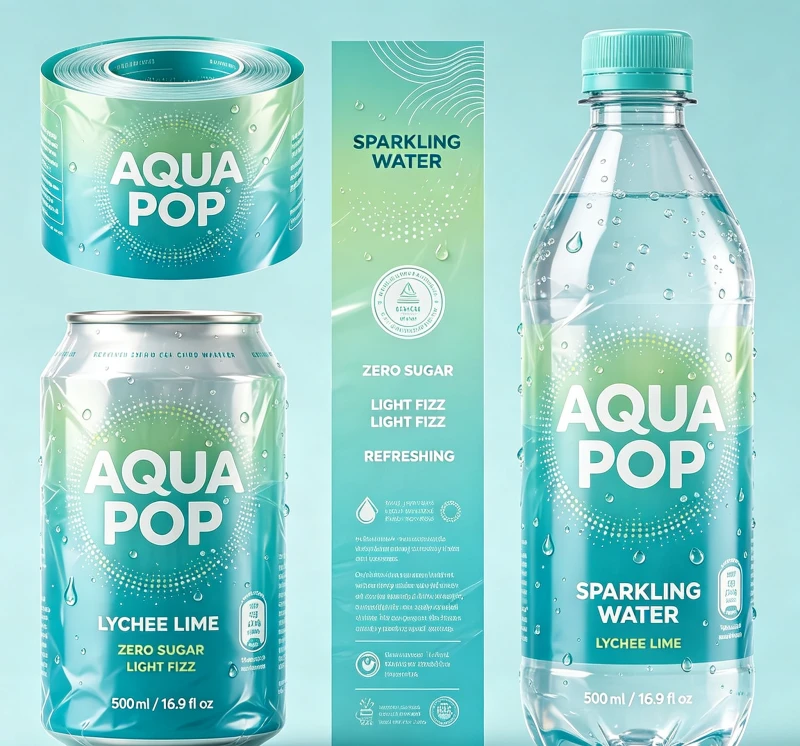
Shrink sleeve labels are made from flexible film that is applied around a container and then shrunk using controlled heat.
Unlike a conventional front or back label, a shrink sleeve can provide extensive coverage around the package.
They are particularly suitable for:
- Beverages
- Cosmetics
- Personal care products
- Promotional packaging
- Unusually shaped containers
The major advantage of shrink sleeves is their ability to provide strong 360-degree graphics while conforming to complex container shapes.
3. Wrap-Around Labels
Wrap-around labels extend around part or all of a cylindrical package.
They are commonly used for bottles, cans, and other round containers.
Wrap-around labels can provide a large printable area while maintaining an efficient packaging format. Depending on the application, they can be produced using different materials and adhesive technologies.
4. Heat-Transfer Labels
Heat-transfer labeling uses heat and pressure to transfer a printed design onto a container or product surface.
This method can create a clean, integrated appearance and is useful for selected plastic containers and other packaging applications.
The appropriate process depends on the packaging substrate, container geometry, production equipment, and required durability.
5. In-Mold Labels
In-mold labeling integrates the label into a container during the molding process rather than applying a conventional adhesive label afterward.
This approach is used in selected high-volume packaging applications where the label and container are designed to work together as part of the manufacturing process.
Types of Packaging Labels by Function
Packaging labels are not only differentiated by how they are applied. They can also be classified according to what they are designed to do.
1. Brand and Decorative Labels
Brand labels are designed primarily to communicate brand identity and create visual differentiation.
They may include:
- Logos
- Brand colors
- Product names
- Decorative graphics
- Metallic effects
- Embossing
- Special coatings
- Textured finishes
Premium decorative labels are widely used for cosmetics, beverages, food products, personal care products, and other consumer goods where shelf appearance is important.
2. Product Information Labels
Information labels communicate essential product details to customers and other stakeholders.
Depending on the product, information may include:
- Product specifications
- Ingredients
- Nutritional information
- Directions
- Manufacturer information
- Product quantity
- Storage instructions
- Warnings
The required information varies by product category and market, so packaging labels should be designed with the relevant regulatory requirements in mind.
3. Barcode and Variable Data Labels
Variable-data labels are used when each label needs unique or changing information.
Examples include:
- Barcodes
- QR codes
- Serial numbers
- Batch numbers
- Lot numbers
- Manufacturing dates
- Expiration dates
These labels are important for inventory management, traceability, logistics, authentication, and product identification.
4. Security and Anti-Counterfeit Labels
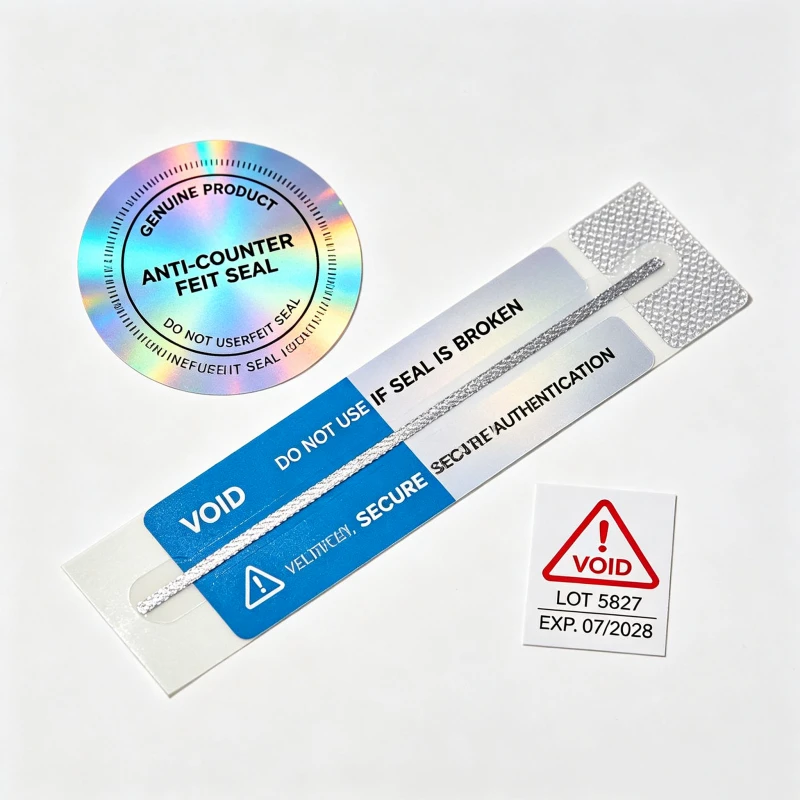
Security labels help brands protect products against unauthorized duplication, tampering, or counterfeiting.
Possible security features include:
- Tamper-evident constructions
- Destructible materials
- Void effects
- Holographic elements
- Specialized printing
- Serialized codes
- Authentication technologies
Security labels can be particularly valuable for pharmaceuticals, electronics, premium consumer goods, cosmetics, and other products where authenticity is important.
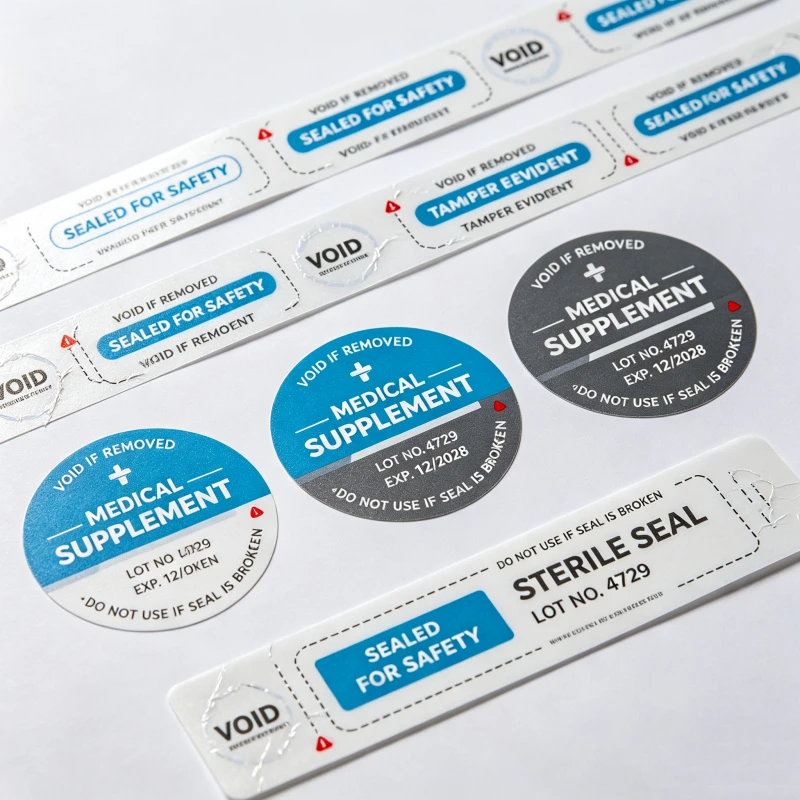
5. Tamper-Evident Labels
Tamper-evident labels are designed to provide visible evidence if a package has been opened or interfered with.
They can be used on:
- Bottles
- Cartons
- Boxes
- Jars
- Healthcare packaging
- Cosmetic packaging
- Food packaging
The appropriate construction depends on the package design and the level of tamper evidence required.
6. Booklet and Extended-Content Labels
Booklet labels provide more information than a conventional single-layer label while maintaining a relatively compact footprint.
They are useful when packaging needs to communicate:
- Multiple languages
- Detailed instructions
- Ingredients
- Safety information
- Regulatory information
- Usage instructions
- Promotional content
They are especially useful for small packages where the available labeling area is limited.
7. Smart Labels
Smart labels combine conventional labeling with technologies such as RFID, NFC, or digitally connected codes.
Depending on the solution, smart labels can support:
- Product authentication
- Inventory tracking
- Supply-chain visibility
- Product identification
- Consumer engagement
- Digital product information
For businesses that need both physical packaging communication and digital functionality, smart labels can provide capabilities beyond conventional printed labels.
Types of Packaging Labels by Material
The material used for a packaging label has a major impact on its appearance, durability, print quality, and performance.
Paper Labels
Paper is a popular label material because it offers excellent printability and can be a cost-effective solution for many applications.
Paper labels are commonly used for:
- Dry food products
- Cartons
- Boxes
- General retail products
- Artisan products
- Promotional packaging
However, standard paper labels may not be the best choice for products exposed to high moisture, condensation, chemicals, or heavy abrasion.
BOPP Labels
BOPP, or biaxially oriented polypropylene, is a popular synthetic label material for packaging.
BOPP labels offer a combination of:
- Moisture resistance
- Good printability
- Durability
- Flexible appearance options
- Clear or white constructions
They are widely used in food, beverage, cosmetics, personal care, and other applications where resistance to moisture is important.
PET Labels
PET labels are designed for demanding applications where durability is a major requirement.
They can provide good resistance to:
- Abrasion
- Chemicals
- Heat
- Moisture
PET and other durable synthetic materials are commonly considered for industrial products, electronics, healthcare applications, and demanding packaging environments.
PVC and Vinyl Labels
PVC or vinyl materials can offer flexibility, water resistance, and durability.
They may be used for selected packaging and industrial applications where the label needs to withstand moisture or environmental exposure.
However, material selection should consider the complete packaging system, including disposal and recycling requirements.
Specialty and Sustainable Label Materials
Brands can also choose specialty materials to achieve specific sustainability, appearance, or performance objectives.
Options may include selected recycled papers, specialty films, and other material constructions.
The right sustainable label should be evaluated as part of the entire packaging system rather than based only on the face material.
Types of Packaging Labels for Different Industries
Food and Beverage Packaging Labels
Food and beverage labels may need to withstand:
- Moisture
- Condensation
- Refrigeration
- Oil
- Handling and transportation
Common solutions include pressure-sensitive labels, BOPP labels, shrink sleeves, and other specialty constructions.
Cosmetic and Personal Care Labels
Cosmetic packaging often places a strong emphasis on both performance and appearance.
Common requirements include:
- Premium printing
- Metallic effects
- Embossing
- Transparent labels
- Water resistance
- Chemical resistance
- High-quality finishes
For premium beauty products, the label can become an important part of the overall brand experience.
Pharmaceutical and Healthcare Labels
Healthcare and pharmaceutical applications may require labels with high information density, reliable adhesion, variable data, security features, and strong traceability.
Small-format and extended-content labels can be particularly useful when a large amount of information must fit onto a limited package surface.
Electronics Labels
Electronic products often require durable identification labels containing:
- Serial numbers
- Barcodes
- QR codes
- Product specifications
- Traceability information
The label material and adhesive should be selected according to the product’s operating environment.
Industrial Labels
Industrial products may expose labels to chemicals, abrasion, temperature changes, moisture, or outdoor conditions.
For these applications, durable synthetic materials and specialized adhesives may be more appropriate than standard paper labels.
How to Choose the Right Packaging Label
There is no single best packaging label for every product. The right choice depends on the complete application.
1. Consider the Packaging Material
First determine what surface the label will be applied to.
Common substrates include:
- Glass
- Plastic
- Metal
- Cardboard
- Paper
- Flexible packaging
Different surfaces can require different adhesive and label constructions.
2. Consider the Package Shape
Is the container:
- Flat?
- Cylindrical?
- Curved?
- Irregularly shaped?
- Flexible?
For complex shapes, shrink sleeves or specially designed pressure-sensitive labels may provide better coverage than conventional labels.
3. Consider Environmental Conditions
Think about what the label will experience during its life cycle.
Will it be exposed to:
- Water?
- Condensation?
- Oil?
- Chemicals?
- Heat?
- Cold?
- UV exposure?
- Abrasion?
Environmental conditions can significantly affect the choice of face material, adhesive, coating, and printing process.
4. Consider the Labeling Process
Will the labels be applied manually or automatically?
For automated production, label dimensions, roll specifications, liner construction, adhesive behavior, and dispensing performance all need to be compatible with the labeling equipment.
5. Consider Information Requirements
If the package only needs a brand logo and product name, a conventional label may be sufficient.
If the package needs extensive instructions, multiple languages, variable data, or regulatory information, consider extended-content or booklet labels.
6. Consider Brand Appearance
For consumer products, appearance can be just as important as functionality.
Depending on the desired result, you can consider:
- Matte finishes
- Gloss finishes
- Transparent labels
- Metallic effects
- Hot stamping
- Embossing
- Specialty coatings
- Custom shapes
7. Consider Security and Smart Functions
If your product requires authentication, traceability, anti-counterfeiting, or digital interaction, conventional printed labels may not be enough.
Security features, QR codes, NFC, RFID, or other smart label technologies can be incorporated into a customized labeling solution.
Which Packaging Label Is Best for Your Product?
The answer depends on your priorities.
| Your Requirement | Possible Label Solution |
|---|---|
| General-purpose packaging | Pressure-sensitive labels |
| 360-degree branding | Shrink sleeve labels |
| Cylindrical containers | Wrap-around or pressure-sensitive labels |
| Dry indoor products | Paper labels |
| Moisture exposure | BOPP or suitable synthetic labels |
| High durability | PET or specialty synthetic labels |
| Transparent packaging | Clear labels |
| Premium appearance | Decorative specialty labels |
| Anti-counterfeiting | Security labels |
| Evidence of package opening | Tamper-evident labels |
| Extensive information on small packaging | Booklet labels |
| Product tracking or authentication | RFID/NFC smart labels |
The final selection should be based on the actual package, product, production process, and required performance rather than simply choosing the most popular label type.
Custom Packaging Labels from Perfect Label
At Perfect Label, we understand that packaging labels need to balance appearance, functionality, durability, and production efficiency.
Qingdao Perfect Printing and Packaging Co., Ltd. is an original manufacturer of custom labels based in Qingdao, China, with more than 16 years of experience in the label printing industry.
Our capabilities cover a wide range of customized packaging label solutions, including:
- Pressure-sensitive labels
- Security and anti-counterfeit labels
- RFID and NFC smart labels
- Specialty-material labels
- Structural and functional labels
- Decorative craft labels
- Industry-specific labels
Our production capabilities include a 12-color satellite rotary printing press, automated RFID smart label production lines, and more than 100 sets of printing and post-press equipment.
Our 5,000 m² intelligent manufacturing workshop supports both high-volume production and flexible customization.
For customers with urgent development schedules, we provide rapid sample-making services, with samples available in as little as 24 hours for suitable projects. Mass-production orders can be completed in approximately 3–7 working days depending on project requirements.
Our quality management system follows ISO 9001:2015, with full-process inspection throughout production.
Whether you need premium decorative labels for cosmetics, moisture-resistant labels for beverages, security labels for authentication, or RFID smart labels for traceability, our technical team can help develop a label construction based on your packaging and application requirements.
Frequently Asked Questions
What are the most common types of packaging labels?
The most common types include pressure-sensitive labels, shrink sleeve labels, wrap-around labels, paper labels, synthetic labels, security labels, tamper-evident labels, booklet labels, and smart labels.
What is the difference between pressure-sensitive labels and shrink sleeve labels?
Pressure-sensitive labels use adhesive to attach to the packaging surface, while shrink sleeve labels are formed around the container using heat. Pressure-sensitive labels are highly versatile, while shrink sleeves are particularly useful for 360-degree coverage and complex container shapes.
What material is best for packaging labels?
There is no universal best material. Paper may be suitable for dry applications, while BOPP or other synthetic materials may be better for moisture exposure. PET and specialty materials can be considered when higher durability is required.
What type of label is best for bottles?
The best choice depends on the bottle material, shape, environment, labeling equipment, and desired appearance. Pressure-sensitive labels are a versatile option for many bottles, while shrink sleeves can be useful for complex shapes or full-body graphics.
What type of label is best for cosmetic packaging?
Cosmetic packaging often uses pressure-sensitive labels, clear labels, specialty films, and decorative labels with finishes such as embossing or hot stamping. The final choice depends on the container material and the product environment.
What are smart packaging labels?
Smart packaging labels incorporate technologies such as RFID, NFC, or connected QR codes to add functions such as tracking, authentication, inventory management, or consumer engagement.
How do I choose the right packaging label?
Start with the packaging substrate, shape, environmental conditions, labeling process, information requirements, appearance, and functional requirements. A professional label manufacturer can then help determine the appropriate material, adhesive, printing process, and construction.
Conclusion
Packaging labels can be classified by application method, function, material, and industry. Understanding these categories makes it easier to select a label that performs reliably while supporting your brand and packaging objectives.
For general packaging, pressure-sensitive labels offer excellent versatility. Shrink sleeves are useful for full-body graphics and complex shapes. Paper and BOPP labels can serve different environmental and visual requirements, while PET and specialty materials can provide enhanced durability. Security, tamper-evident, RFID, NFC, and booklet labels add specialized functions for products with more demanding requirements.
The most important point is that the right packaging label should be selected according to the complete application—not simply based on appearance or price.
If you are developing a new product or looking for a reliable supplier for custom packaging labels, working with an experienced label manufacturer can help you optimize material selection, printing, finishing, functionality, and production efficiency. Welcome to contact us.



Leave a Reply
Want to join the discussion?Feel free to contribute!