
What Are NFC Stickers?
NFC stickers are small self-adhesive labels embedded with a Near Field Communication (NFC) chip and antenna. When a compatible smartphone or NFC reader is brought close to the sticker, it can read stored information or trigger an action, such as opening a website, displaying product details, verifying a product’s identity, or connecting to a digital service.
For brands, importers, packaging companies, electronics manufacturers, and promotional product distributors, custom NFC stickers offer a practical way to connect physical products with digital experiences. You can integrate them into product packaging, promotional materials, equipment labels, business cards, and select anti-counterfeit applications.
However, not every NFC sticker suits every project. Chip memory, antenna size, surface material, adhesive performance, smartphone compatibility, and data security all influence the result.
As a custom label manufacturer, we recommend selecting NFC stickers according to the intended application and testing the complete label on the actual product before placing a bulk order.
What Are NFC Stickers and How Do They Work?
NFC stands for Near Field Communication, a short-range wireless communication technology that enables compatible devices to exchange information when brought close together.
According to the NFC Forum, NFC operates at a base frequency of 13.56 MHz and is designed for short-range interactions, typically within a few centimeters. NFC tags can operate without their own battery by drawing energy from the reader’s electromagnetic field.
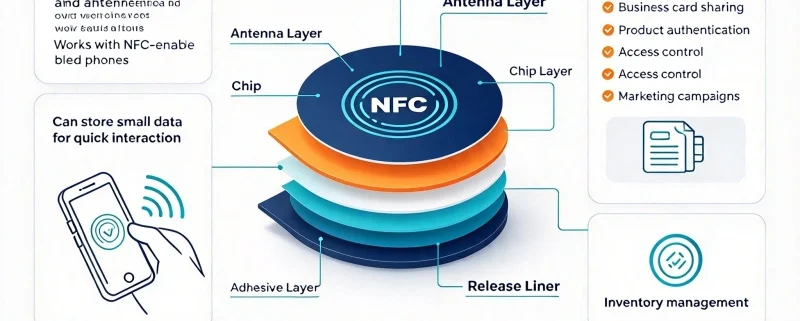
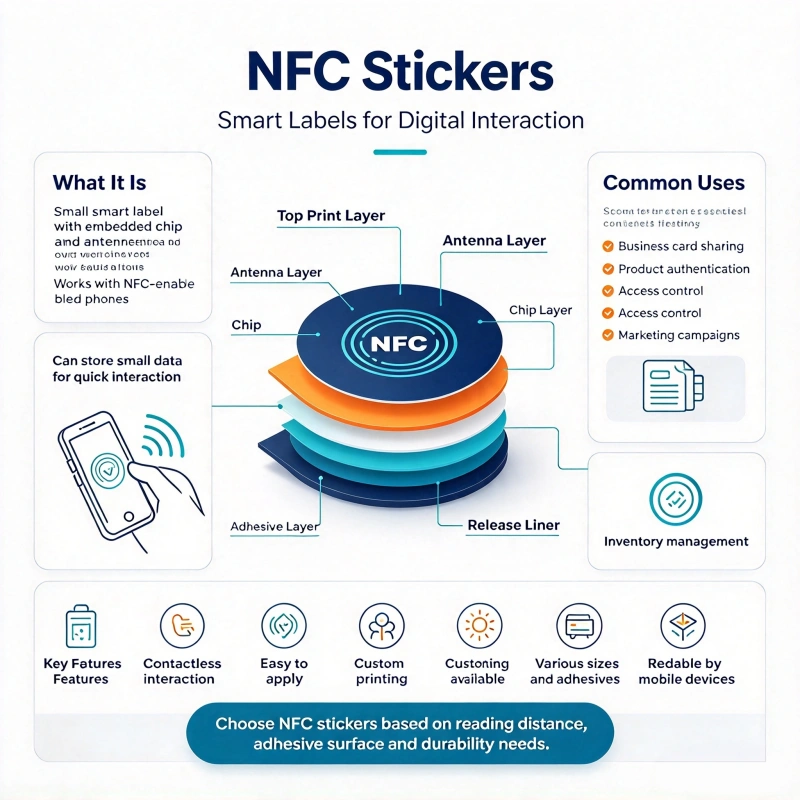
A typical NFC sticker contains three main elements:
- NFC chip: Stores data or provides a unique identifier and other chip-specific functions.
- Antenna: Receives the reader’s electromagnetic field and enables communication.
- Adhesive label structure: Protects and supports the chip and antenna while allowing the sticker to be attached to a product or package.
The finished sticker may use paper, PP film, PET film, or another suitable face material. For applications involving metal, a specially designed on-metal construction may be required.
How Does an NFC Sticker Work?
The process is straightforward:
- A manufacturer programs the NFC chip with a URL, text, contact details, or another supported data format.
- Attach the sticker to a product, package, display, or other surface.
- A compatible smartphone or NFC reader approaches the sticker.
- The reader powers the passive tag and reads the available information.
- The phone may display a notification or open a supported action, depending on the device, operating system, tag content, and application configuration.
For example, a cosmetics brand could place an NFC sticker on a product box. When a customer taps the sticker with a compatible phone, the phone can open a product page containing usage instructions, ingredient information, or a product registration form.
The sticker itself does not automatically create that online experience. The brand must provide the destination page, digital content, or connected application.
What Can NFC Stickers Be Used For?
NFC stickers are useful when a business wants customers, employees, or service technicians to access digital information with a simple tap.
| Application | How NFC stickers are used | Business value |
|---|---|---|
| Product packaging | Open product details, instructions, or registration pages | Connect physical products with digital content |
| Brand authentication | Direct customers to a verification service | Support product authentication workflows |
| Marketing campaigns | Open promotions, videos, landing pages, or loyalty pages | Reduce the steps required to access a campaign |
| Business cards | Share contact information or a digital profile | Simplify professional networking |
| Industrial equipment | Open maintenance instructions or service records | Help technicians access relevant documentation |
| Asset identification | Link equipment to a digital asset record | Support inventory and maintenance processes |
| Retail displays | Connect products to product specifications or demonstrations | Provide additional information at the point of sale |
| Event materials | Open registration, event information, or digital resources | Simplify access to event-related content |
NXP Semiconductors identifies applications for its NTAG213, NTAG215, and NTAG216 chips that include product authentication, NFC shelf labels, smart advertising, mobile companion tags, and business cards.
The best design depends on the business objective. A marketing sticker that opens a website has different requirements from a security label intended to support product authentication.
NFC Sticker Specifications: What Should B2B Buyers Check?
Before ordering custom NFC stickers, buyers should evaluate the chip, memory, antenna, dimensions, materials, and programming requirements.
1. NFC Chip and Memory Capacity
Different NFC chips offer different memory capacities and functions. The correct chip depends on how much data must be stored directly on the tag and whether additional security or application features are required.
A widely used chip family is NXP’s NTAG21x series.
| Specification | NTAG213 | NTAG215 | NTAG216 |
|---|---|---|---|
| User memory | 144 bytes | 504 bytes | 888 bytes |
| Operating frequency | 13.56 MHz | 13.56 MHz | 13.56 MHz |
| NFC standard | NFC Forum Type 2 Tag | NFC Forum Type 2 Tag | NFC Forum Type 2 Tag |
| Typical consideration | Basic URL and small data records | Applications requiring more stored data | Applications requiring the most user memory in this family |
Source: NXP Semiconductors, NTAG213/215/216 product specifications.
These memory figures refer to user memory, not the full physical storage capacity of the chip. The space available for an actual application can also depend on the data format and record structure.
For many marketing projects, storing a URL is sufficient. The website can then provide extensive product information without storing the entire content on the chip.
Our recommendation: If the sticker only needs to open a web page, start by evaluating a suitable entry-level NFC chip such as NTAG213. If your project needs more information stored directly on the tag or has specialized requirements, compare higher-memory or application-specific chips before finalizing the specification.
2. NFC Frequency and Reading Distance
The NFC Forum identifies 13.56 MHz as the technology’s base operating frequency. NFC is designed for close-range communication rather than long-distance tracking.
Actual reading performance depends on factors such as:
- Chip and antenna design
- Antenna dimensions and geometry
- Smartphone or reader capability
- Position and orientation of the phone
- The material behind the sticker
- Nearby metal or electromagnetic interference
NXP lists an operating distance of up to 100 mm for the NTAG21x chip family under specified conditions, depending on factors including field strength and antenna geometry. This is a technical capability, not a guaranteed reading distance for every finished sticker.
In practical consumer applications, users generally tap or bring the phone within a few centimeters of the label.
For procurement projects, specify the required reading behavior and test the complete sticker with the intended phones or readers. Do not select a product based solely on a supplier’s maximum-distance claim.
3. Sticker Size and Antenna Design
NFC stickers can be produced in different shapes and dimensions, including circular, rectangular, square, and custom-cut formats.
However, the printed label size is not the only dimension that matters. The antenna needs enough space to achieve suitable performance for the chosen chip and application.
A smaller sticker may be visually attractive for premium packaging, but reducing the antenna size can affect reading performance. A larger antenna may offer design advantages in some applications, although the actual result depends on the overall construction.
Before ordering, confirm:
- Finished label dimensions
- Chip model
- Antenna dimensions and design
- Required reading performance
- Available installation space
- Distance from metal components or other potential sources of interference
If your project requires an unusually small NFC sticker, request a prototype and test it on the intended product rather than assuming that every chip can perform equally well in every size.
Which Materials Are Suitable for Custom NFC Stickers?
Material selection affects print quality, appearance, durability, adhesion, and NFC performance.
| Material or construction | Main advantages | Suitable applications | Important considerations |
|---|---|---|---|
| Coated paper | Economical and suitable for printed graphics | Promotions, paper packaging, disposable campaigns | Limited resistance to moisture and abrasion unless protected |
| PP film | Lightweight and suitable for many consumer packaging designs | Cosmetics, retail products, everyday product labels | Adhesive and label stiffness must match the substrate |
| PET film | Useful for durable labels requiring dimensional stability | Electronics, equipment labels, technical applications | Confirm flexibility, finishing, and adhesive compatibility |
| Transparent film | Allows a discreet label appearance | Premium packaging, glass containers, selected product surfaces | Antenna and chip visibility, printing contrast, and surface conditions need testing |
| On-metal NFC construction | Designed to reduce the effects of nearby metal | Metal equipment, tools, selected metal packaging | Requires a suitable isolation or shielding structure and performance validation |
| Protective laminate | Can improve surface protection when properly selected | Labels exposed to frequent handling | Must not interfere with the antenna or intended application |
A paper NFC sticker may be sufficient for a short-term promotional campaign, while a PET or specialized construction may be more appropriate for industrial use.
The correct material cannot be determined from appearance alone. Buyers should consider where the label will be installed, how long it must last, and whether it will be exposed to water, oils, cleaning agents, sunlight, or repeated handling.
Can NFC Stickers Work on Metal?
Standard NFC stickers may experience reduced reading performance when attached directly to metal because the metal can interfere with the antenna’s electromagnetic field.
For these applications, buyers should consider an on-metal NFC sticker designed with an appropriate isolation or shielding structure.
Examples include labels for:
- Metal equipment housings
- Industrial tools
- Machinery identification
- Metal product packaging
- Selected reusable containers
However, not all on-metal stickers perform identically. Reading performance depends on the antenna design, isolation layer, metal surface, and reader.
Practical solution: Test the finished label on the exact metal product, not just on a sample sheet. Confirm reading performance with the target smartphone or reader and under the intended installation conditions.
NFC Stickers vs. QR Code Stickers vs. RFID Labels
B2B buyers often compare NFC stickers with QR codes and RFID labels because all three can connect physical items with digital information. Their operating methods and ideal applications differ.
| Feature | NFC stickers | QR code stickers | RFID labels |
|---|---|---|---|
| Reading method | Tap or bring a compatible device close to the tag | Scan the printed code using a camera or scanner | Use a compatible RFID reader |
| Physical contact | Not required, but very close proximity is typical | Not required; the code must be visible to the scanner | Depends on the RFID frequency and system |
| Smartphone interaction | Supported by compatible NFC-enabled phones | Supported by phones with suitable camera or scanning software | Usually requires compatible RFID hardware; phone support depends on the technology |
| Information access | Can store small data records or point to online content | Usually encodes a URL or other data in a visual pattern | Depends on tag type, chip, memory, and system |
| Visual appearance | Can be hidden or integrated into a printed label | Requires a visible, scannable code | May be integrated into a label or tag |
| Common uses | Tap-to-open content, smart packaging, selected authentication systems | Product pages, manuals, menus, campaigns | Inventory, logistics, asset tracking, and other identification systems |
| Main consideration | Antenna design, chip compatibility, and nearby materials | Code readability, contrast, and visibility | Reader compatibility, frequency, range, and system design |
NFC Forum describes NFC as a short-range technology for close-proximity communication. NXP’s NTAG21x family supports consumer-facing applications such as smart advertising and product authentication. These sources illustrate why NFC is especially useful when the desired interaction is a simple tap.
Which Technology Should You Choose?
Choose NFC stickers when the project benefits from tap-based interaction, a compact label design, or a digital experience that users can access by bringing their phones close to the product.
Choose QR code stickers when low-cost visual access is the priority and the user can scan a visible code.
Consider RFID labels when the project requires an identification system built around compatible RFID readers, such as inventory or logistics workflows. The appropriate RFID technology depends on the required range, frequency, reader infrastructure, and environment.
Some projects use both NFC and QR codes. For example, a product label can provide NFC access for customers who prefer tapping while retaining a QR code as a visible alternative.
Are NFC Stickers Secure? Can They Prevent Counterfeiting?
NFC stickers can support product authentication, but an NFC chip alone does not guarantee that a product is genuine.
A basic NFC sticker may contain a URL or text record that can be read or copied. If every label is programmed with the same static URL, copying the URL may be enough to reproduce the basic digital interaction.
For a stronger authentication workflow, brands should evaluate the complete system rather than relying only on the presence of an NFC chip.
Recommended Security Solutions
1. Use unique identifiers.
Assign each product or label a unique identifier and link it to a backend database. This helps distinguish individual items and can support detection of repeated or suspicious scans.
2. Consider cryptographic authentication.
For higher-risk applications, evaluate NFC chips designed to support cryptographic functions or authenticity checks. Confirm the specific security features in the chip’s technical documentation.
3. Validate information on a server.
The brand’s backend can check a product identifier or authentication response and return an appropriate result. Security depends on the implementation, including how identifiers and cryptographic data are generated, stored, and validated.
4. Monitor repeated scans and unusual activity.
A backend system can flag unexpected scan patterns, repeated use of the same identifier, or activity inconsistent with the product’s expected distribution. These signals may indicate suspicious behavior, although a repeated scan alone does not prove counterfeiting.
5. Protect the physical label.
Depending on the application, tamper-evident materials, destructible labels, or security printing can make unauthorized transfer more difficult.
NXP’s NTAG21x documentation describes features including a chip originality signature and configurable password protection. These features have specific capabilities and limitations; they should not be treated as a substitute for a complete authentication architecture.
For anti-counterfeit projects, we recommend defining the threat model first: What is being protected, what information can an attacker copy, and what evidence must the system return to a customer or brand owner?
How to Program NFC Stickers for Business Use
For a simple NFC sticker that opens a website, the programming workflow can be relatively straightforward.
- Select a compatible NFC sticker and reader or smartphone.
- Prepare the destination URL or required data record.
- Use a compatible NFC writing application or programming system to write the data.
- Scan the tag with another compatible device to verify the result.
- Confirm that the destination page works and displays the intended content.
- If the application requires read-only behavior, configure the supported locking functions after testing and approval.
The exact process depends on the chip and software. Once a tag is locked using an irreversible locking function, its data may no longer be rewritable through ordinary methods.
For large B2B orders, treat programming as part of the production specification. Buyers should decide whether the supplier will deliver blank tags, tags preprogrammed with a common URL, or individually serialized labels.
Should You Use a Static URL or a Dynamic URL?
A static URL is written directly to the NFC tag. It is suitable when the destination is unlikely to change and the project does not need per-item identification.
A dynamic URL strategy directs users through a web service or redirect system that lets you update destination content without rewriting every tag, as long as the stored URL remains under the brand’s control.
For product authentication, unique per-item identifiers and backend validation may be more appropriate than a single shared URL.
For long-term product packaging, we recommend using a destination domain that the brand controls. This reduces the risk of losing access if an external service is discontinued.
NFC Stickers and Smartphone Compatibility
Most consumer NFC sticker projects are designed around compatible smartphones, but the user experience can vary by device and operating system.
Apple’s official Core NFC documentation states that iPhone XS and later support background tag reading under supported conditions. Apple also notes that background reading has limitations, and developers should provide an in-app scanning option for devices or situations that do not support background reading.
This matters for B2B projects because a tag that works on one phone may not deliver the same experience on every device.
Before bulk production, test:
- The intended iPhone and Android models
- The required operating-system versions
- Whether the user must open an app first
- Whether a notification or direct action is expected
- The phone’s reading position relative to the sticker
- Whether the destination page works on mobile browsers
If the target audience uses a wide range of phones, consider adding a QR code or a clearly visible web address as a fallback.
How Are Custom NFC Stickers Manufactured?
Custom NFC sticker manufacturing combines electronic components with label printing and converting. A good production process must protect the inlay while maintaining the required appearance, adhesion, and reading performance.
Step 1: Confirm the Application and Technical Requirements
The buyer should provide the intended use, target surface, label dimensions, required chip, data format, expected lifetime, environmental conditions, and order quantity.
If the sticker will be attached to metal, a curved container, or an electronic housing, state this before material selection.
Step 2: Select the Chip and Antenna
The manufacturer and buyer determine the chip type, memory capacity, antenna design, and required reading performance.
For projects involving unique identifiers or authentication, the data structure and programming requirements should be agreed upon at this stage.
Step 3: Choose the Label Materials
Select the face material, adhesive, protective layer, and liner based on the product surface and environment.
For on-metal applications, the construction must account for how the metal surface affects NFC performance.
Step 4: Design and Print the Artwork
Artwork may include branding, instructions, a QR code, serial numbers, or other printed information.
The design must preserve the intended antenna area and avoid any finishing process that could damage the chip or compromise performance.
Step 5: Convert and Finish the Labels
Depending on the construction, the production process may include lamination, die-cutting, slitting, and roll or sheet packaging.
Finished dimensions, die-cut accuracy, and label orientation should match the customer’s application and labeling equipment.
Step 6: Program and Inspect the Finished Stickers
If programming is included, the production process should define how data is written, verified, and recorded.
Quality checks may include:
- Visual inspection and print quality
- Label dimensions and die-cut accuracy
- NFC read performance
- Chip and data verification
- Adhesion to the intended surface
- Programming accuracy for serialized tags
- Verification of QR codes or printed serial numbers, where applicable
For projects requiring security features, the buyer should define the authentication tests and acceptance criteria separately from basic NFC readability.
Step 7: Approve Samples Before Mass Production
We recommend testing samples on the actual product or packaging before approving the full order.
A sample should be evaluated for both physical performance and digital behavior. A sticker that looks good but cannot be read reliably on the intended product is not ready for production.
Common NFC Sticker Problems and Their Solutions
| Problem | Possible cause | Recommended solution |
|---|---|---|
| Smartphone cannot read the sticker | Incompatible phone, poor antenna performance, or incorrect positioning | Confirm device compatibility and test the finished tag with the intended phones |
| Reading performance is weak on metal | Standard antenna construction is unsuitable for the metal surface | Evaluate a purpose-designed on-metal NFC sticker |
| Sticker opens the wrong webpage | Incorrectly programmed URL or outdated destination | Verify the encoded URL and test the complete user journey |
| Some labels contain incorrect data | Programming or serialization errors | Use controlled programming, data records, and verification checks |
| Printed QR code does not scan | Low contrast, poor print quality, or unsuitable code size | Validate the printed code with suitable scanning devices |
| Sticker peels off the package | Adhesive is incompatible with the surface or application conditions | Test the adhesive on the actual substrate |
| Authentication system is easy to copy | The solution relies only on a shared static URL or copied data | Consider unique identifiers, backend validation, and suitable cryptographic features |
| Users cannot access the digital content | The destination page is unavailable, mobile-unfriendly, or blocked | Test the landing page on target devices and maintain the destination service |
These problems are easier to address during sampling than after labels have been applied to finished products and distributed to customers.
How Much Do Custom NFC Stickers Cost?
NFC sticker prices depend on the chip, antenna, dimensions, label materials, printing, programming, security requirements, order quantity, and packaging.
A basic NFC sticker with a common chip and a simple printed design will generally have a different cost structure from a specialized on-metal label or a serialized authentication label.
| Cost factor | Effect on the quotation |
|---|---|
| Chip model | Memory capacity and supported functions affect component selection |
| Antenna design | Dimensions and performance requirements affect the inlay construction |
| Label size | Larger labels may require more material and different converting arrangements |
| Face material | Paper, PP, PET, and specialized materials have different costs |
| Printing and finishing | Color printing, laminates, custom shapes, and protective finishes affect cost |
| Programming | Writing and verifying data may add production steps |
| Serialization | Individual data records require controlled data handling and verification |
| Security requirements | Authentication systems may require specialized chips, software, and backend integration |
| Order quantity | Setup and production costs are distributed differently across order sizes |
| Packaging and delivery | Roll format, protective packing, freight, and delivery terms affect total cost |
For an accurate quotation, buyers should provide the chip preference, dimensions, material, artwork, programming requirements, order quantity, intended application, and delivery destination.
When comparing suppliers, ensure that all quotations cover the same chip, construction, programming method, testing requirements, and packaging. Comparing only the unit price may conceal important differences in the finished product.
How to Choose a Reliable NFC Sticker Manufacturer
A reliable NFC sticker supplier should understand both label manufacturing and the functional requirements of NFC technology.
Use the following checklist when evaluating potential suppliers.
1. Chip and material expertise
Ask whether the supplier can recommend suitable chip models, label materials, and antenna constructions for your application.
2. Sample development
Confirm that the supplier can provide samples for testing on your actual product surface.
3. Programming capability
If tags require preprogrammed URLs or unique identifiers, ask how the supplier writes, verifies, and records the data.
4. Quality control
Confirm the available checks for label appearance, dimensions, NFC readability, and programming accuracy.
5. Security requirements
For authentication applications, confirm whether the supplier provides only the physical sticker or also supports chip configuration and the connected digital system.
6. Production consistency
Discuss repeat-order controls, material traceability, artwork approval, and acceptance criteria.
7. Transparent quotation
Request a quotation that clearly identifies the chip, materials, printing, programming, testing, quantity, and delivery requirements.
A capable supplier should help you identify potential issues before production instead of simply manufacturing the design exactly as submitted.
Custom NFC Stickers for Wholesale, OEM, and Private-Label Projects
For brands, importers, packaging companies, and industrial manufacturers, the best NFC sticker specifications start with the intended business function.
If the goal is to open a product webpage, the project may require only a suitable NFC chip, a compatible antenna, a printable label, and a reliable destination URL.
If the goal is product authentication, the specification may also need unique identifiers, backend verification, security features, and a defined response to suspicious scans.
If the label will be attached to metal, the construction must be evaluated for reading performance on that surface.
Before requesting a quotation, prepare the following information:
- Application and target industry
- Label dimensions and shape
- Preferred chip model, if known
- Material and adhesive requirements
- Product surface, including whether it is metal
- Printing artwork and finishing requirements
- Data to be written to the chip
- Common URL or unique serialized data
- Reading-performance requirements
- Order quantity and delivery destination
With these details, a manufacturer can recommend a suitable construction, prepare samples, and quote the project based on its actual technical requirements.
Planning a custom NFC sticker project? Start by defining what should happen when a customer or employee taps the label. Then select the chip, materials, programming method, and quality tests around that use case. Testing a production-representative sample before mass production helps reduce avoidable costs and improves the likelihood of a successful rollout.
Frequently Asked Questions About NFC Stickers
1. Do NFC stickers need a battery?
Most conventional passive NFC stickers do not need a battery. They receive energy from the electromagnetic field generated by a compatible reader during communication.
2. Can NFC stickers work with iPhones?
Compatible iPhones can read supported NFC tags, but the exact experience depends on the device, operating system, tag content, and scanning method. Apple documents background tag reading on iPhone XS and later under supported conditions.
3. How much information can an NFC sticker store?
It depends on the chip. For example, NXP’s NTAG213, NTAG215, and NTAG216 provide 144, 504, and 888 bytes of user memory, respectively. These are user-memory figures, and the usable space for a specific application depends on the data format.
4. Can NFC stickers open a website?
Yes. A compatible NFC sticker can store a website URL that a compatible phone can read. The resulting action depends on the device and operating system, and the website must remain available for the experience to work as intended.
5. Can NFC stickers be rewritten?
Many NFC tags support rewriting before their data is locked, but the capability depends on the chip and its configuration. Irreversible locking may prevent subsequent changes, so test the programming workflow before locking tags for a bulk order.
6. Are NFC stickers waterproof?
Some NFC stickers can be designed for moisture-resistant or waterproof applications. Performance depends on the face material, adhesive, chip protection, construction, and exposure conditions. Request samples and test the complete label under the intended conditions.
7. Can NFC stickers be used for anti-counterfeiting?
They can support product authentication, but a basic NFC sticker does not automatically prevent copying. Stronger solutions may combine unique identifiers, server-side validation, and appropriate chip security features.
8. Can NFC stickers be attached to metal products?
Yes, with a suitable on-metal construction. Standard NFC stickers may perform poorly when attached directly to metal, so the finished design should be tested on the actual surface.
9. What is the difference between NFC stickers and RFID labels?
NFC is a short-range technology within the broader RFID technology family. NFC stickers are commonly used for tap-based interactions with compatible phones, while other RFID systems may be designed for different reading ranges, frequencies, and identification workflows.
10. What should I provide when ordering NFC stickers in bulk?
Provide the intended application, label size, chip preference, material, artwork, target surface, data-programming requirements, quantity, and delivery destination. For metal applications or authentication projects, include the required reading and security performance from the beginning.
References and Authoritative Sources
1. NFC Forum — NFC Technology Official technical overview of NFC, including its 13.56 MHz operating frequency, short-range communication, and passive operation. Read the official source
2. NFC Forum — What NFC Does Explains common NFC use cases and the technology’s suitability for short-range interactions. Read the official source
3. NXP Semiconductors — NTAG213/215/216 Manufacturer specifications for user memory, operating frequency, reading-distance conditions, and supported NFC applications. Read the official source
4. Apple Developer Documentation — Adding Support for Background Tag Reading Official information about supported iPhone models, background tag reading, and relevant operating conditions. Read the official source
5. Apple — Human Interface Guidelines: NFC Guidance on NFC tag reading, background reading limitations, and providing an in-app reading option. Read the official source

Jgs is a custom labeling professional with 15 years of industry experience in labeling solutions.

Leave a Reply
Want to join the discussion?Feel free to contribute!