
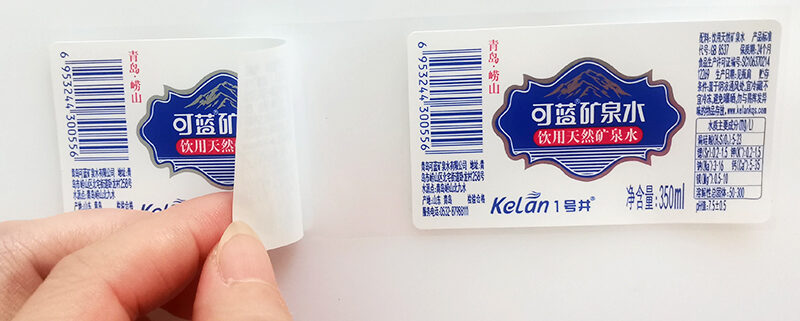
Self Adhesive Labels: Materials, Applications and Benefits.
Self Adhesive Labels are one of the most versatile labeling solutions for modern product packaging, retail, logistics, industrial identification, and promotional applications. Unlike labels that require water, heat, or a separate bonding process, self-adhesive labels use a pressure-sensitive adhesive that bonds when pressure is applied.
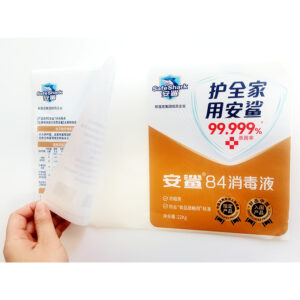
For buyers, however, choosing the right label is not as simple as selecting a color or ordering a “standard sticker.” The performance of a self-adhesive label depends on the face material, adhesive, liner, printing method, application surface, temperature, moisture, chemicals, and expected service life.
This is particularly important when selecting white self adhesive labels, red self adhesive labels, or yellow self adhesive labels. Color affects visibility and branding, but it does not determine whether a label will survive refrigeration, outdoor exposure, abrasion, or chemical contact.
This guide explains what Self Adhesive Labels are, how they are constructed, which materials are available, where different types are used, and how to select the right solution for your products.
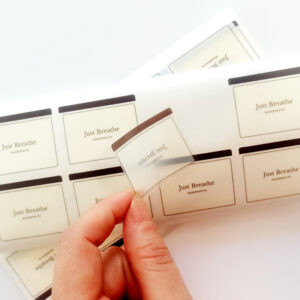
What Are Self Adhesive Labels?
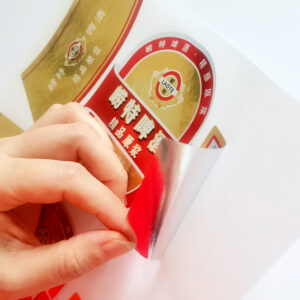
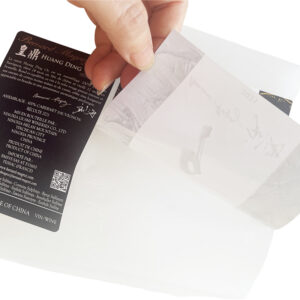
Self Adhesive Labels are labels with a pressure-sensitive adhesive layer on the reverse side. The adhesive is protected by a release liner until the label is ready to be applied.
A typical construction contains three primary functional components:
- Face stock – the printable top layer
- Pressure-sensitive adhesive – the bonding layer
- Release liner – the backing that protects the adhesive before application
Some constructions also include printable coatings, varnishes, laminates, or other functional layers.
The application process is straightforward:
Peel → Position → Apply Pressure → Bond
No water, heat, or solvent activation is normally required. This makes Self Adhesive Labels particularly suitable for automated and manual labeling processes.
The apparent simplicity of the product can be misleading. A label intended for a dry cardboard box may require a completely different construction from a label applied to a refrigerated beverage bottle or an outdoor machine.
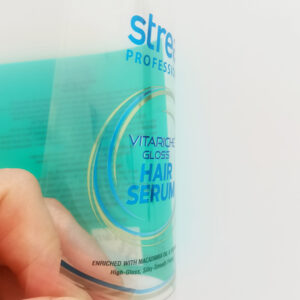
How Do Self Adhesive Labels Work?
The adhesive used in Self Adhesive Labels is designed to remain tacky under normal conditions.
When the label is pressed onto a surface, the adhesive flows into microscopic irregularities in the substrate and creates contact between the label and the surface.
The actual bonding result depends on several factors:
- Surface material
- Surface cleanliness
- Surface energy
- Adhesive formulation
- Application pressure
- Temperature
- Label flexibility
- Contact area
- Storage conditions
For example, glass and stainless steel generally provide relatively favorable surfaces for adhesive bonding, while low-surface-energy plastics such as polyethylene and polypropylene can require specially selected adhesives.
This is why simply requesting a “strong adhesive” is not always the correct solution. The right adhesive is one that matches the surface and operating environment.
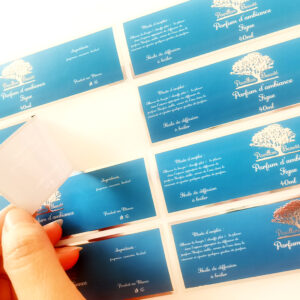
Main Materials Used for Self Adhesive Labels
Material selection is one of the most important decisions when sourcing Self Adhesive Labels.
1. Paper Self Adhesive Labels
Paper remains one of the most widely used label face materials because it provides good printability at a relatively low cost. It is suitable for many indoor and dry applications.
Common paper options include:
- Semi-gloss paper
- Gloss paper
- Matte paper
- Coated paper
- Kraft paper
- Textured paper
- Thermal paper
- Specialty art paper
Best applications
Paper Self Adhesive Labels are commonly used for:
- Retail packaging
- Food products
- Cartons
- Promotional products
- Product identification
- Shipping and logistics
- Price labels
- Wine and specialty packaging
The main limitation is moisture. Ordinary paper can absorb water and may become damaged or lose appearance when exposed to prolonged moisture.
For dry indoor products, however, paper can offer an excellent balance of cost, print quality, and appearance.
2. BOPP / PP Self Adhesive Labels
Polypropylene film is widely used when a label needs greater resistance to moisture and tearing than ordinary paper.
PP/BOPP labels can be produced in:
- White
- Clear
- Metallic
- Gloss
- Matte
They are suitable for:
- Beverages
- Food packaging
- Cosmetics
- Personal care
- Household products
- Refrigerated products
- Retail packaging
A major advantage is that polypropylene is resistant to water and offers good flexibility. Current label-material guidance identifies PP as a common durable face material for applications where moisture resistance and flexibility are required.
3. PET Self Adhesive Labels
PET is a strong synthetic film commonly selected for demanding applications.
Compared with ordinary paper, PET can offer improved:
- Tear resistance
- Dimensional stability
- Chemical resistance
- Abrasion resistance
- Temperature resistance
- Moisture resistance
PET Self Adhesive Labels are particularly useful for:
- Electronics
- Automotive components
- Industrial equipment
- Electrical products
- Laboratory containers
- Outdoor identification
- Chemical packaging
For long-life industrial labels, PET is often a better starting point than conventional paper.
4. PE Self Adhesive Labels
Polyethylene is a flexible film that can be useful when labels need to conform to squeezable or flexible packaging.
Potential applications include:
- Personal-care containers
- Flexible bottles
- Household products
- Specialty packaging
The key advantage is flexibility. However, PE is a relatively low-surface-energy substrate, so the adhesive construction must be selected carefully when PE itself is the application surface.
5. Synthetic Paper
Synthetic paper combines a paper-like appearance with improved resistance to moisture and tearing.
It can be considered for:
- Outdoor tags
- Logistics labels
- Retail labels
- Industrial identification
- Product packaging
For products that need a paper appearance but require greater durability, synthetic paper can be a useful middle-ground option.
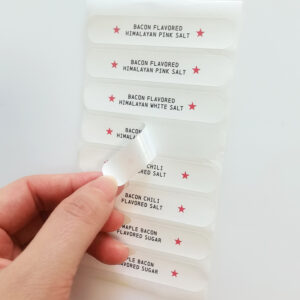
White Self Adhesive Labels
White self adhesive labels are the most versatile option for general-purpose branding and identification.
White provides a neutral background that allows:
- Black text
- Full-color graphics
- Product photographs
- Barcodes
- QR codes
- Logos
- Regulatory information
to remain easy to read.
White labels can be produced using both paper and synthetic materials.
Common applications
White self adhesive labels are widely suitable for:
- Food packaging
- Cosmetics
- Electronics
- Logistics
- Retail products
- Pharmaceutical packaging
- Industrial identification
- Shipping cartons
For a standard indoor product, white coated paper may be sufficient.
For refrigerated, wet, or outdoor applications, a white PP, BOPP, or PET construction can provide greater durability.
The important point is that “white” describes the appearance, not the technical performance.
A white paper label and a white PET label can look similar on a computer screen while performing very differently in the real world.
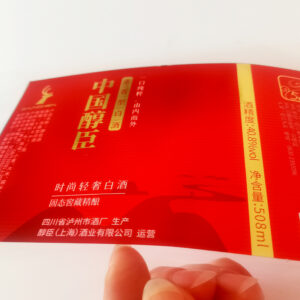
Red Self Adhesive Labels
Red self adhesive labels are often selected when visibility and visual attention are priorities.
Red has strong visual impact and can be used to highlight:
- Promotions
- Warnings
- Discounts
- Special offers
- Product variations
- Priority information
- Brand identity
Typical applications
Red Self Adhesive Labels can be used for:
- Retail promotions
- Clearance products
- Warning identification
- Food packaging
- Warehouse marking
- Industrial identification
- Event products
For example, a retailer may use a red label to make promotional pricing immediately visible.
An industrial manufacturer may use red labels to differentiate a specific component or identification category.
However, color alone should not be relied upon to communicate safety information. Where labels are used for regulated hazard communication, the applicable standard determines the required label elements, not simply the buyer’s preferred color.
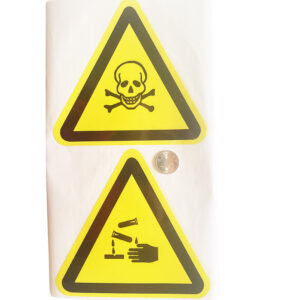
Yellow Self Adhesive Labels
Yellow self adhesive labels are commonly selected for high visibility and quick visual recognition.
Yellow can be particularly effective when labels need to stand out against:
- Black
- White
- Gray
- Metallic
- Dark-colored surfaces
Potential applications include:
- Warehouse identification
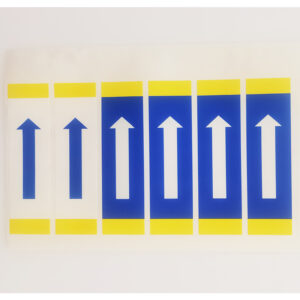
- Industrial marking
- Warning labels
- Inventory management
- Promotional packaging
- Product classification
- Temporary identification
Yellow labels can also be combined with black printing for strong contrast.
For industrial environments, however, the final design should follow the relevant safety or regulatory requirements rather than using yellow simply because it is highly visible.
White vs. Red vs. Yellow Self Adhesive Labels
The best color depends on what the label needs to accomplish.
| Label Color | Main Advantage | Typical Applications |
|---|---|---|
| White | Versatile, clean appearance | Product packaging, barcodes, branding |
| Red | Strong visual attention | Promotions, warnings, special identification |
| Yellow | High visibility | Industrial marking, inventory, warnings |
| Clear | No-label appearance | Glass, cosmetics, premium packaging |
| Silver | Metallic appearance | Electronics, automotive, premium products |
Color should be treated as part of the communication and branding strategy, while material and adhesive should be selected according to performance requirements.
Choosing the Right Adhesive for Self Adhesive Labels
The adhesive is just as important as the face material.
Permanent Adhesive
Permanent adhesives are designed for long-term attachment.
Suitable applications include:
- Product packaging
- Industrial equipment
- Electronics
- Automotive components
- Asset identification
Removable Adhesive
Removable adhesives are designed for applications where the label needs to be removed with minimal residue.
Suitable for:
- Temporary promotions
- Retail displays
- Temporary identification
- Reusable packaging
Repositionable Adhesive
Repositionable adhesives allow the label to be adjusted during application.
This can be helpful when:
- Labels are manually applied
- Accurate positioning is critical
- Operators need additional adjustment time
Freezer Adhesive
Products exposed to refrigeration or freezing may require a specialized adhesive designed to maintain bonding performance at low temperatures.
Examples include:
- Frozen food
- Cold-chain products
- Laboratory samples
- Refrigerated beverages
High-Temperature Adhesive
Industrial products exposed to elevated temperatures may require specialized adhesive systems.
Examples include:
- Automotive components
- Electronics
- Industrial machinery
- Manufacturing processes
Adhesive selection should always consider the actual substrate and environment. A permanent adhesive that works well on glass may not provide the same result on polyethylene or polypropylene.
Self Adhesive Labels for Different Applications
Food & Beverage
Food and beverage labels need to combine attractive graphics with reliable adhesion.
Typical applications include:
- Bottles
- Jars
- Sauces
- Coffee
- Snacks
- Frozen food
- Beverages
For refrigerated products, condensation is a major consideration.
A conventional paper label may not be the best choice if the package repeatedly moves between cold storage and room temperature.
In these cases, BOPP, PP, PET, or other moisture-resistant constructions can be considered.
Cosmetics & Beauty
Cosmetic packaging is highly visual.
Labels need to support both branding and functional information.
Common products include:
- Shampoo
- Skincare
- Serum
- Lotion
- Perfume
- Hair-care products
- Makeup
Popular materials and finishes include:
- White BOPP
- Clear PET
- Specialty paper
- Gold foil
- Silver foil
- Matte coating
- Soft-touch coating
- Embossing
- Spot UV
For premium cosmetics, the tactile experience of the label can be almost as important as the printed design.
Wine & Liquor
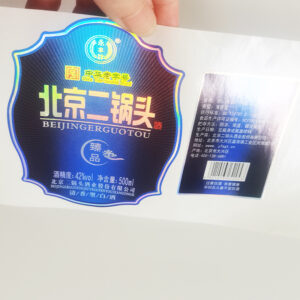
Wine and liquor labels often prioritize premium appearance.
Popular materials include:
- Textured paper
- Cotton paper
- Pearl paper
- Kraft paper
- Clear film
- Metallic paper
Decorative processes can include:
- Hot stamping
- Embossing
- Debossing
- Spot UV
- Metallic printing
Bottle curvature should also be considered before selecting label dimensions.
A material that performs well on a flat carton may not be appropriate for a curved wine bottle.
Pharmaceutical & Healthcare
Pharmaceutical and healthcare labels require accurate information and reliable identification.
Applications include:
- Medicine bottles
- Medical devices
- Laboratory containers
- Healthcare packaging
- Diagnostic products
Depending on the market and application, labels may require:
- Barcodes
- QR codes
- Lot numbers
- Expiration dates
- Serial numbers
- Variable data
- Tamper-evident features
For regulated products, the label specification should be developed around approved artwork and applicable market requirements.
Electronics & Industrial Equipment
Industrial labels often need durability rather than decorative effects.
They may be exposed to:
- Heat
- Cold
- Oil
- Chemicals
- Moisture
- Abrasion
- UV exposure
PET, polyester, and other synthetic constructions can be considered for demanding environments. Polyester is widely used where resistance to solvents, abrasion, and elevated temperatures is required.
Typical applications include:
- Serial-number labels
- Equipment identification
- Rating plates
- Control panels
- Electrical products
- Automotive components
Benefits of Self Adhesive Labels
1. Easy Application
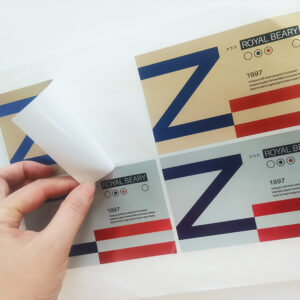
Self Adhesive Labels require only pressure to bond, eliminating the need for water, heat, or separate glue activation.
2. Flexible Customization
Labels can be customized in:
- Size
- Shape
- Material
- Color
- Adhesive
- Printing
- Finish
3. Suitable for Automation
Self-adhesive labels are available in roll formats compatible with many automated labeling systems.
This makes them suitable for high-volume manufacturing.
4. Excellent Branding Potential
The same basic label format can support:
- Full-color graphics
- Metallic effects
- Textures
- Embossing
- QR codes
- Variable information
5. Wide Material Selection
Paper, PP, PE, PET, synthetic paper, transparent films, foil, and specialty materials allow labels to be matched to different environments.
6. Cost Efficiency
For many packaging applications, self-adhesive labels provide an efficient combination of printing quality, application speed, customization, and production scalability.
Common Self Adhesive Label Problems and Solutions
| Problem | Possible Cause | Recommended Direction |
|---|---|---|
| Label peeling | Wrong adhesive/surface | Match adhesive to substrate |
| Wrinkling | Curved surface or rigid face material | Use more conformable material |
| Water damage | Paper face stock | Consider PP/BOPP/PET |
| Ink fading | UV exposure | Use suitable inks/protection |
| Barcode failure | Poor print quality or contrast | Optimize artwork and printing |
| Edge lifting | Small diameter or difficult surface | Use flexible construction |
| Residue after removal | Permanent adhesive | Use removable adhesive |
| Poor cold adhesion | Unsuitable adhesive | Use freezer-grade construction |
| Chemical damage | Incompatible face material | Consider PET or specialized material |
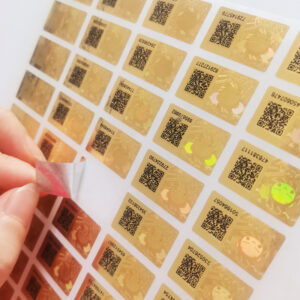
The important lesson is that label failure is rarely solved by changing only one component. Face material, adhesive, surface, and environment work as a system.
How to Choose the Right Self Adhesive Labels
A practical selection process can be reduced to eight questions.
1. What surface are you labeling?
Glass, cardboard, PET, PP, PE, metal, wood, or another substrate?
2. What environment will the label experience?
Indoor, outdoor, refrigerated, frozen, humid, or chemically aggressive?
3. How long must the label last?
Hours, months, one year, or several years?
4. Is the label permanent or removable?
This determines the adhesive direction.
5. Does the label need to resist water?
If yes, consider synthetic materials such as PP or PET.
6. Does the label need to resist heat or chemicals?
If yes, a durable synthetic construction may be more appropriate than ordinary paper.
7. What information must be printed?
Consider:
- Logo
- Product name
- Barcode
- QR code
- Variable data
- Regulatory information
8. What visual effect does the brand require?
Choose among:
- Matte
- Gloss
- Transparent
- Metallic
- Textured
- Embossed
- Foil
This process is much more reliable than choosing a label solely by color or price.
Custom Self Adhesive Labels from Perfect Label
Perfect Label provides custom Self Adhesive Labels manufacturing and OEM/ODM solutions for brands, manufacturers, distributors, retailers, and packaging companies.
Custom options can include:
- White self adhesive labels
- Red self adhesive labels
- Yellow self adhesive labels
- Clear labels
- Metallic labels
- Paper labels
- PP/BOPP labels
- PET labels
- Synthetic paper labels
- Permanent adhesive labels
- Removable labels
- Repositionable labels
- Freezer labels
- High-temperature labels
Perfect Label can also customize:
Size + Shape + Material + Adhesive + Printing + Finishing + Packaging
For demanding projects, the recommended workflow is:
Application analysis → Material selection → Adhesive selection → Artwork → Sample → Application testing → Mass production
This approach allows the label construction to be evaluated under actual conditions before a large production order is placed.
Self Adhesive Labels vs. Traditional Labels
One reason Self Adhesive Labels are so widely used is their simplicity.
Traditional wet-glue labeling may require a separate adhesive application process. Heat-activated systems require thermal activation. Self Adhesive Labels arrive with the adhesive already integrated into the label construction.
This can simplify:
- Manual application
- Automated labeling
- Product changeovers
- Short production runs
- Packaging customization
The exact production advantages depend on the labeling equipment and application process, but the fundamental benefit remains the same: the label is ready to bond when the liner is removed and pressure is applied.
FAQ About Self Adhesive Labels
What are Self Adhesive Labels?
Self Adhesive Labels are labels with a pressure-sensitive adhesive that bonds to a surface when pressure is applied. They generally consist of a face material, adhesive, and release liner.
What are the main materials for Self Adhesive Labels?
Common materials include paper, PP/BOPP, PE, PET, synthetic paper, foil, and specialty films. The best choice depends on the application environment and required durability.
What are white self adhesive labels used for?
White self adhesive labels are suitable for general product identification, packaging, barcodes, retail products, food, cosmetics, logistics, and industrial applications. They provide a neutral background for text and graphics.
What are red self adhesive labels used for?
Red self adhesive labels are commonly used for promotions, visual identification, special product markings, and applications where high visual impact is required.
What are yellow self adhesive labels used for?
Yellow self adhesive labels are useful when high visibility is important, including inventory identification, warehouse marking, industrial applications, and promotional labeling.
Are Self Adhesive Labels waterproof?
Not all Self Adhesive Labels are waterproof. Standard paper labels can be affected by moisture, while PP/BOPP, PET, and other synthetic constructions generally provide better water resistance.
Can Self Adhesive Labels be removed?
Yes, if they are manufactured with a removable adhesive. Permanent and removable adhesives are designed for different applications, so the adhesive should be specified before production.
Can Self Adhesive Labels be customized?
Yes. Perfect Label can customize the material, adhesive, color, size, shape, printing, barcode, QR code, and finishing according to the application.
Final Thoughts
The best Self Adhesive Labels are not simply the labels with the strongest adhesive or the lowest unit price. They are labels engineered around the actual product and its environment.
White self adhesive labels are a versatile choice for general packaging and identification. Red self adhesive labels can provide strong visual emphasis for promotions and product identification. Yellow self adhesive labels are useful when visibility and quick recognition are important.
But color is only one part of the specification.
For reliable performance, consider the complete system:
Surface → Environment → Face Material → Adhesive → Printing → Finish → Application → Service Life
Paper may be ideal for a dry retail carton. BOPP can be more suitable for a wet beverage environment. PET may be better for industrial equipment exposed to abrasion, chemicals, or temperature changes.
The right specification can reduce peeling, wrinkling, fading, residue, and re-labeling costs while improving both product presentation and operational efficiency.
For brands and manufacturers sourcing Self Adhesive Labels in bulk, the most effective approach is to provide the label manufacturer with the product surface, environmental conditions, required service life, label dimensions, quantity, artwork, and performance requirements before production. That gives the supplier enough information to recommend a construction based on actual performance rather than simply selecting a label from a color chart.

International Trade Sales professional with 10+ years of experience in the label printing and packaging industry. Specializing in export sales, global market development, and client relationship management, with expertise in custom labeling solutions across paper and film substrates (PP, PE, PET). Serving global clients across FMCG, pharmaceutical, and personal care sectors. Committed to delivering quality, consistency, and trust in every shipment.


Leave a Reply
Want to join the discussion?Feel free to contribute!