
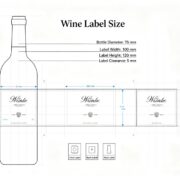
Wine Label Size Guide: Standard Dimensions
/0 Comments/in blog /by JgsChoosing the right wine label size is more complicated than simply selecting a standard template. A 750ml Bordeaux bottle, a Burgundy bottle, a Champagne bottle, and a tall Alsace-style bottle may all hold the same volume but have very different usable labeling surfaces.
For most 750ml still-wine bottles, a practical starting point for a front label is around 90–100 mm wide × 90–120 mm high (3.5–4 × 3.5–4.7 inches). However, this is a starting range, not a universal standard. Current commercial label guides, for example, list approximately 90 × 120 mm for a Bordeaux 750ml front label and 90 × 115 mm for a Burgundy 750ml label, while Champagne bottles commonly use a shorter label around 90 × 80 mm.
The most important rule is simple: measure the actual bottle before finalizing the wine label dimensions. Bottle capacity tells you how much wine is inside; it does not tell you exactly how much flat surface is available for your label.
What Is the Standard Wine Label Size?
No single wine label size is globally mandated. Label dimensions are determined primarily by bottle geometry, design requirements, information content, material, application method, and the market in which the wine will be sold.
For a conventional 750ml wine bottle, the following dimensions are useful starting points:
| Bottle / Label Type | Common Starting Size |
|---|---|
| Bordeaux 750ml front label | 90 × 120 mm |
| Bordeaux 750ml back label | 80 × 105 mm |
| Burgundy 750ml front label | 90 × 115 mm |
| Champagne / sparkling wine | 90 × 80 mm |
| 375ml half bottle | 70 × 90 mm |
| 1.5L Magnum | 110 × 140 mm |
These dimensions are examples, not mandatory industry standards. Bottle manufacturers can use different glass dimensions, so a label that fits one 750ml bottle may not fit another 750ml bottle perfectly. One current label-size guide specifically recommends measuring the actual container before production because manufacturers vary.
Another useful commercial reference for 750ml bottles places many front labels around 3.5–4 inches wide × 3.5–4 inches high, while back labels are often approximately 3–4 inches wide × 3.5–4.5 inches high.
So, if you are creating a new wine brand and do not yet have a final label specification, 90 × 120 mm is a reasonable size to test on a Bordeaux-style 750ml bottle. But don’t send that dimension to production until you’ve checked the physical bottle.
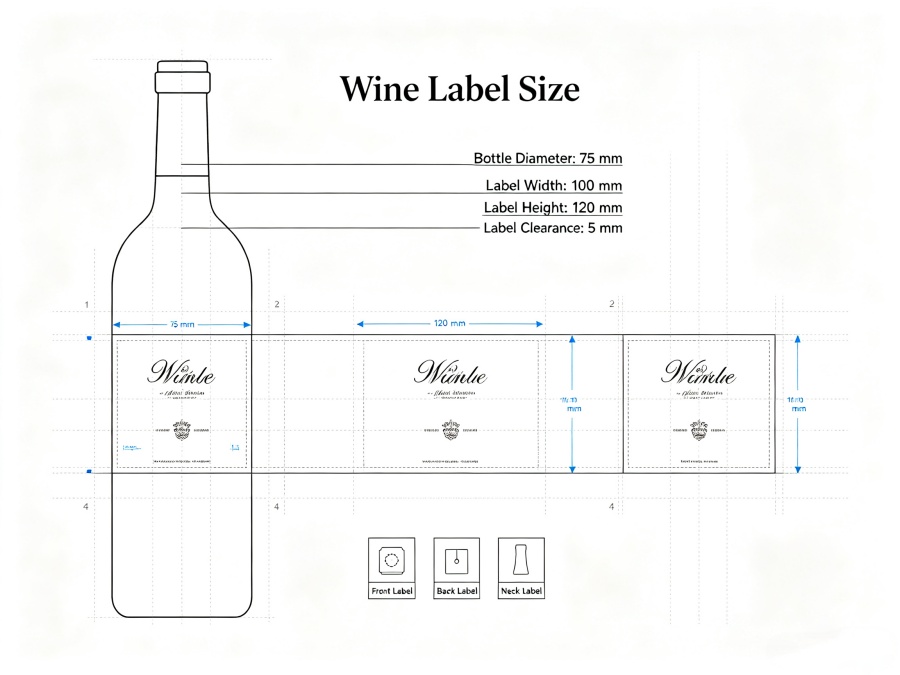
750ml Wine Bottle Label Size
The 750ml wine bottle is the most important format for many wine brands, so it deserves special attention.
A typical 750ml bottle may be roughly 290–305 mm tall and 75–81 mm in diameter, although dimensions vary considerably by bottle design. A recent packaging reference gives approximately 11.5–12 inches in height and 3–3.2 inches in diameter for a typical 750ml Bordeaux-style bottle. Burgundy bottles can be wider, while sparkling wine bottles are often wider and heavier.
This variation explains why 750ml is a capacity specification, not a label-size specification.
Recommended starting dimensions for a 750ml bottle
For a traditional Bordeaux-style bottle:
- Front label: around 90 × 120 mm
- Back label: around 80 × 105 mm
- Alternative front label: approximately 100 × 90 mm
- Neck label: commonly much smaller and highly dependent on bottle shape
- Full-wrap label: must be calculated from the bottle circumference and usable height
A front label of approximately 4 × 3.5 inches (102 × 89 mm) can also be a useful starting point for brands wanting a wider, shorter presentation. Commercial guides cite this general range as a practical option for common 750ml bottles.
The correct choice depends on your design.
A wine brand with a large central logo may prefer a wider horizontal label. A traditional European wine design with a crest, vintage, appellation, and producer information may work better with a taller rectangular label.
Front Wine Label Size vs. Back Wine Label Size
The front and back labels do not have to be identical.
In fact, making them different sizes can make the packaging more practical.
Front Wine Label
The front label is primarily a branding element. It may contain:
- Brand name
- Wine name
- Vintage
- Grape variety
- Region or appellation
- Winery logo
- Product style
- Decorative graphics
Because its primary purpose is visual presentation, the front label can be designed around the bottle’s appearance.
A starting size of 90 × 120 mm or 100 × 90 mm is often practical for a standard Bordeaux-style 750ml bottle.
Back Wine Label
The back label normally has less visual emphasis but may need considerably more information.
Depending on the market, it can include:
- Product information
- Alcohol content
- Net contents
- Producer or bottler information
- Origin information
- Barcode
- QR code
- Sulfite declaration
- Warning information
- Ingredients or nutrition information where applicable
- Tasting notes
- Brand story
For US-market wines, the TTB identifies mandatory information including brand name, class/type designation, and certain appellation information on the brand label, while alcohol content, net contents, name and address, health warning, sulfite declaration, and certain other information may appear on any label.
This is why a back label often needs enough vertical space for small but readable text.
For a 750ml bottle, 80 × 105 mm is one practical starting point for a back label, although the final size should be determined by the amount of information and the bottle’s available surface.
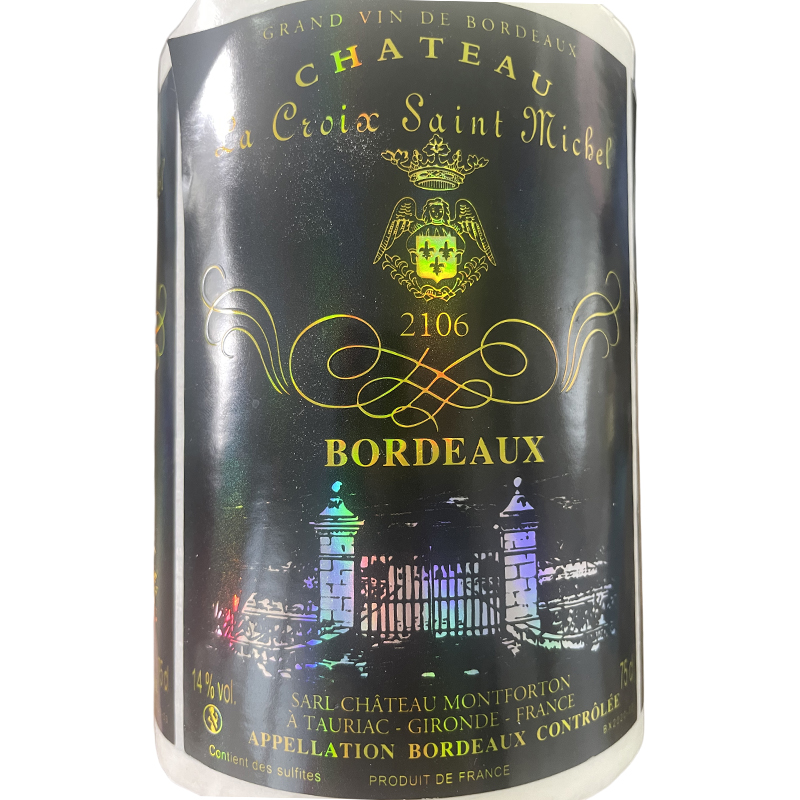
Wine Label Size by Bottle Type
The bottle shape is one of the biggest factors influencing label dimensions.
Bordeaux Wine Bottle Label Size
Bordeaux-style bottles have relatively straight sides and are among the easiest bottles to label.
A useful starting point for a 750ml Bordeaux bottle is:
90 × 120 mm front label
or approximately:
3.5 × 4.7 inches
A back label around 80 × 105 mm is another commonly used starting point.
Because the bottle has a relatively straight central body, rectangular labels generally work well.
Burgundy Wine Bottle Label Size
Burgundy-style bottles typically have broader shoulders and a more curved transition from the body to the neck.
A 750ml Burgundy bottle may use a front label around:
90 × 115 mm
This is close to the Bordeaux format, but the slightly different bottle geometry means the same label cannot automatically be transferred between bottle types.
When using textured paper, thick specialty paper, or rigid metallic materials, test the curvature carefully.
Champagne and Sparkling Wine Label Size
Champagne and sparkling wine bottles are different again.
A typical commercial starting point is around:
90 × 80 mm
for the main label.
Sparkling wine bottles need to withstand internal pressure, so their shape and glass construction differ from many still-wine bottles. A shorter label can create a better visual balance on the wider bottle.
375ml Half-Bottle Label Size
Half bottles commonly hold 375ml, exactly half the volume of a 750ml bottle.
However, the label should not simply be scaled to 50% of a 750ml label.
A commercial starting point is approximately:
70 × 90 mm
for a 375ml bottle.
The bottle’s actual diameter and straight-sided area still need to be checked.
1.5L Magnum Wine Label Size
A Magnum contains 1.5 liters, or twice the wine volume of a standard 750ml bottle.
A practical starting point is approximately:
110 × 140 mm
for the front label.
However, the design should not simply enlarge every element by the same percentage. Reconsider typography, logo proportions, decorative elements, and white space for the larger bottle.
How to Measure a Wine Bottle for a Custom Label
Before ordering custom wine labels, measure the actual bottle rather than relying only on the stated capacity.
Step 1: Measure the bottle diameter
Use a ruler or caliper to measure the diameter of the straight section where the label will be placed.
Step 2: Measure the usable height
Measure from the lower point of the label area to the point where the bottle begins to curve toward the shoulder.
This is the usable labeling height, not the total bottle height.
Step 3: Measure the circumference
For a wrap-around label, measure the circumference of the actual labeling area.
The circumference can be estimated from diameter:
Circumference = π × Diameter
For example, if a cylindrical section has a diameter of 78 mm:
78 × 3.1416 ≈ 245 mm
That gives approximately 245 mm around the bottle before accounting for the specific design and application requirements.
Step 4: Check the curvature
This is particularly important for Burgundy, Champagne, and unusual bottle shapes.
A label can technically have the correct width but still wrinkle if it extends too far into a curved shoulder.
Step 5: Create a paper mockup
This is one of the simplest and most useful tests.
Print the proposed label at 100% actual size, cut it out, and place it on the real bottle.
Check:
- Width
- Height
- Curvature
- Position
- Logo visibility
- Barcode placement
- Text readability
- Distance from bottle edges
Only after this physical test should you confirm the final wine label dimensions.
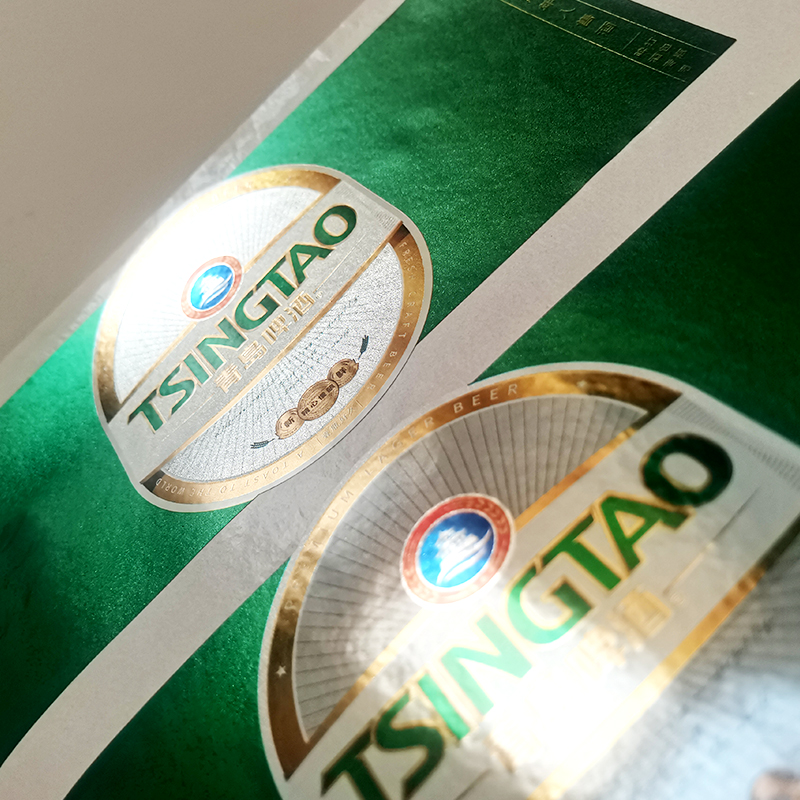
Wine Label Dimensions in Inches and Millimeters
International wine brands frequently work between inches and millimeters.
Here are some useful conversions:
| Inches | Approx. Millimeters |
|---|---|
| 2 × 3 in | 51 × 76 mm |
| 2.5 × 3.5 in | 64 × 89 mm |
| 3 × 4 in | 76 × 102 mm |
| 3 × 4.5 in | 76 × 114 mm |
| 3.5 × 4 in | 89 × 102 mm |
| 3.5 × 4.7 in | 89 × 120 mm |
| 4 × 3.5 in | 102 × 89 mm |
| 4 × 5 in | 102 × 127 mm |
For B2B wine label production, it is usually best to provide the manufacturer with dimensions in millimeters, especially when the label will be die-cut or produced according to a technical drawing.
For example:
Instead of saying:
“Make the label about 3.5 × 4.5 inches.”
provide:
89 × 114 mm finished size
This reduces ambiguity during artwork preparation and production.
What Size Should a Custom Wine Label Be?
There is no single “best” wine label size.
The correct size is a combination of:
- Bottle capacity
- Bottle diameter
- Bottle shape
- Usable straight surface
- Label position
- Amount of information
- Artwork proportions
- Material
- Adhesive
- Application method
For example, a premium 750ml Burgundy wine with a textured cotton-paper label may need a different construction from a mass-market Bordeaux wine using standard coated paper.
Similarly, a transparent PET label can look very different from a heavily embossed paper label, even if both have the same dimensions.
This is why professional wine label manufacturing should begin with the bottle, not the label template.
Wine Label Size and Artwork Requirements
The finished label size is not necessarily the same as the artwork file size.
Suppose the finished label is:
90 × 120 mm
The printer may require additional bleed outside the trim line.
A commercial label guide may use a 2 mm bleed zone and 3 mm safe zone, for example, but these specifications are not universal and should be confirmed with the actual label manufacturer.
Finished Size
This is the final physical size of the label after cutting.
Bleed
Bleed extends background colors or graphics beyond the cutting line to prevent unwanted white edges caused by minor cutting variation.
Safe Area
Important text and logos should remain inside the safe area rather than being positioned too close to the trim.
Die-Cut Line
For custom-shaped wine labels, the die-cut path defines the final shape.
For example, a wine brand may request:
- Oval label
- Shield label
- Arch-top label
- Circular label
- Custom winery logo shape
- Irregular artistic shape
The manufacturer should receive the final dimensions and cutting requirements before production.
Does Wine Label Material Affect Label Size?
Yes.
Wine labels are strongly associated with material texture and finishing quality, especially in premium wine packaging.
Coated Paper
Coated paper is economical and suitable for high-volume wine production.
It works well for:
- Entry-level wine
- Private-label wine
- Promotional products
- Large production runs
Specialty Art Paper
Premium wines often use:
- Cotton paper
- Pearl paper
- Kraft paper
- Textured paper
- Embossed paper
- Soft-touch paper
These materials can give the bottle a more sophisticated appearance.
Clear PET
Transparent PET is suitable for minimalist wine packaging.
The bottle or wine color can become part of the visual design.
Foil and Metallic Materials
Gold, silver, copper, and other metallic effects can be used for premium wine and spirits.
Finishing options can include:
- Hot stamping
- Embossing
- Debossing
- Spot UV
- Metallic printing
- Holographic effects
Select the material based on the bottle shape and label size. A rigid material may behave differently around a curved surface than a flexible synthetic film.
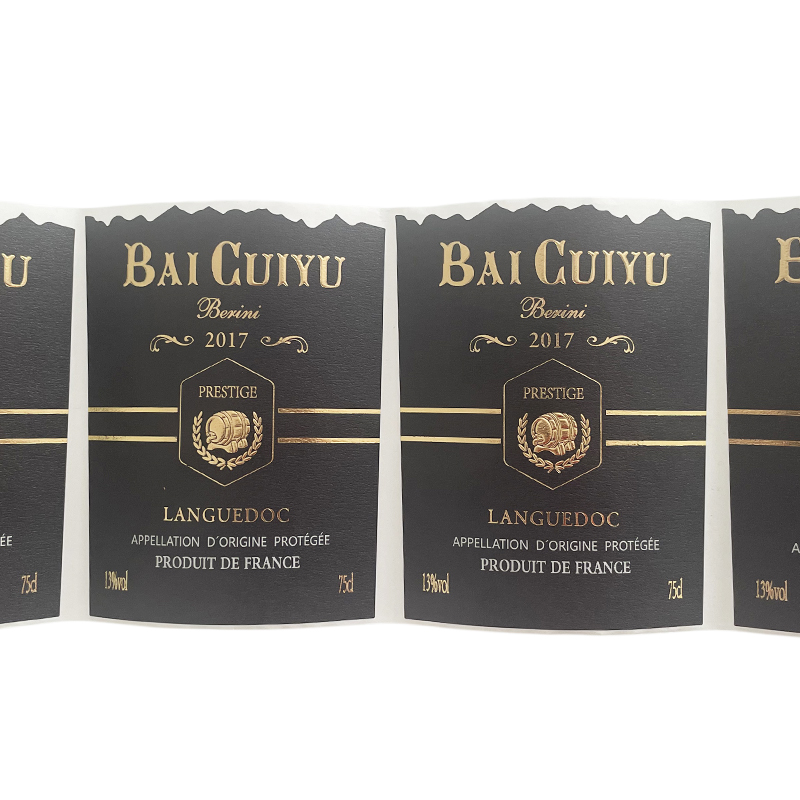
Common Wine Label Size Mistakes
Mistake 1: Assuming Every 750ml Bottle Uses the Same Label
A 750ml Bordeaux bottle and a 750ml Champagne bottle are not the same shape.
Capacity does not determine the usable label area.
Mistake 2: Measuring the Whole Bottle
You only need to measure the usable labeling area, not the entire bottle height.
Mistake 3: Ignoring Bottle Curvature
A label may look fine on a computer but wrinkle when applied to a curved shoulder.
Mistake 4: Making the Back Label Too Small
Regulatory and product information can quickly consume available space.
For US wine products, TTB guidance identifies multiple mandatory statements, including alcohol content, net contents, name and address, health warning information, and sulfite declarations, depending on the product and circumstances.
Mistake 5: Designing Before Confirming the Bottle
The correct workflow is:
Bottle → measurements → label structure → artwork → sample → mass production
not:
Artwork → find a bottle later
Mistake 6: Forgetting Barcode and QR Code Space
A back label may look attractive until the barcode, QR code, legal information, and producer details are added.
Leave enough space for all required information before finalizing the design.
How to Choose the Right Wine Label Size
A practical decision process looks like this:
For a standard 750ml Bordeaux bottle
Start by testing:
90 × 120 mm front label
and approximately:
80 × 105 mm back label
For a Burgundy bottle
Test:
90 × 115 mm
and check the shoulder curvature carefully.
For Champagne or sparkling wine
Test a shorter format such as:
90 × 80 mm
For a 375ml bottle
Start around:
70 × 90 mm
For a 1.5L Magnum
A starting point around:
110 × 140 mm
can be considered.
These figures should be treated as starting dimensions, not fixed standards. Actual bottles vary, and the final specification should be confirmed using the physical bottle or technical bottle drawing.
Custom Wine Labels from Perfect Label
Perfect Label provides custom wine label manufacturing and OEM/ODM label solutions for wineries, wine brands, private-label producers, importers, distributors, and packaging companies.
Rather than forcing every project into a standard template, labels can be customized to match the bottle and branding requirements.
Customization can include:
- Label dimensions
- Custom shapes
- Front and back labels
- Neck labels
- Wrap-around labels
- Paper materials
- Specialty art papers
- Clear PET
- Metallic materials
- Waterproof materials
- Custom adhesives
- Gold and silver foil
- Embossing
- Debossing
- Spot UV
- Matte or glossy finishes
- Variable data
- Barcode and QR code printing
- Custom die-cutting
For premium wine brands, material selection is particularly important. A textured paper with embossing can create a completely different perception from a standard coated-paper label, even when both use exactly the same dimensions.
Perfect Label can also work from the actual bottle dimensions, bottle sample, artwork, or packaging requirements to develop a suitable label construction before bulk production.
For international wine projects, review regulatory requirements for the destination market before approving the final artwork. For example, the US TTB states that wine sold in the US must comply with applicable wine-labeling requirements, and its current guidance identifies mandatory information and approval requirements depending on the product.
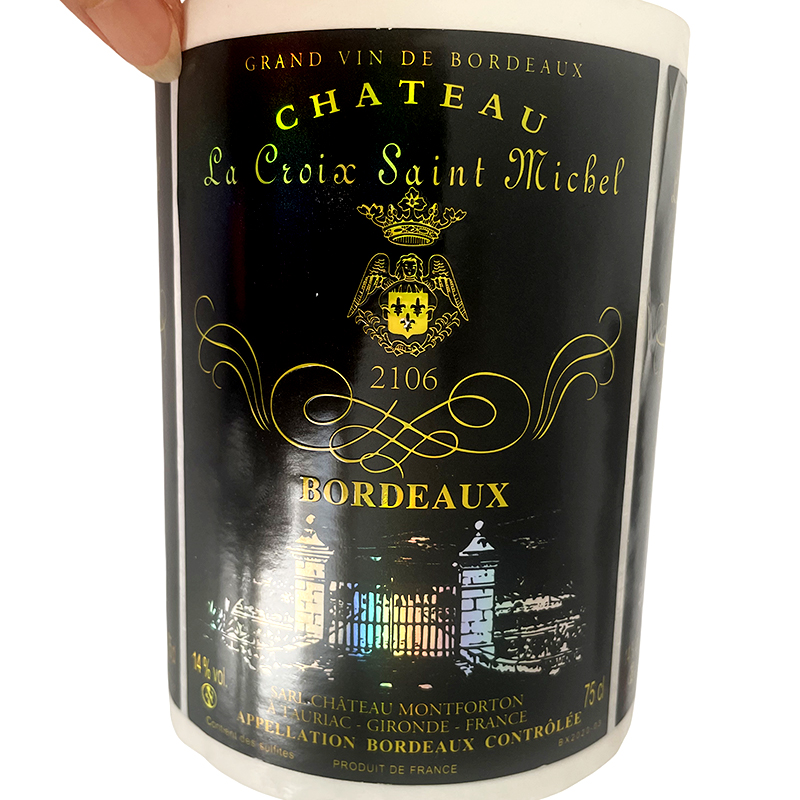
Wine Label Size FAQ
What is the standard wine label size for a 750ml bottle?
There is no universal standard. A practical starting point for a Bordeaux-style 750ml bottle is around 90 × 120 mm for the front label. Other common designs use approximately 90–100 mm widths with different heights depending on the bottle and artwork.
What size should a 750ml wine back label be?
A practical starting size is around 80 × 105 mm, although the required size depends on the amount of mandatory and optional information and the bottle’s available surface.
What size is a Champagne wine label?
A commonly used starting point for a 750ml Champagne or sparkling wine bottle is approximately 90 × 80 mm. Check the actual dimensions against the bottle before production.
Can I use the same wine label size on different bottles?
Not necessarily. Two bottles may both contain 750ml but have different diameters, shoulder shapes, and usable labeling areas. Always test the label on the actual bottle.
How do I measure a wine bottle for a label?
Measure the diameter, circumference, and usable vertical height of the straight labeling area. Then create a full-size paper mockup and test it on the actual bottle before production.
What is the best wine label size for a premium wine?
There is no single premium size. Premium wine labels are often selected based on bottle shape, brand positioning, information requirements, material, and finishing. A smaller textured label can sometimes look more premium than an oversized label.
Does the label material affect the recommended size?
Yes. Paper, PET, foil, textured stock, and other materials have different flexibility and surface characteristics. Bottle curvature and adhesive performance should be considered together with the material.
Do wine labels need bleed?
Most professionally printed labels require some bleed when artwork extends to the edge, but the exact specification varies by manufacturer and printing process. Confirm the bleed and safe-area requirements with your label supplier before preparing final artwork.
Can Perfect Label make custom-size wine labels?
Yes. Perfect Label provides customized wine labels in different sizes, shapes, materials, adhesives, printing methods, and decorative finishes. Custom specifications can be developed according to the actual wine bottle and packaging requirements.
Final Guide: Start With the Bottle, Not the Template
If you need a quick answer, 90 × 120 mm is a useful starting point for a front label on a conventional 750ml Bordeaux-style wine bottle, while approximately 80 × 105 mm can be considered for the back label. Burgundy, Champagne, 375ml, Magnum, and unusual bottle formats require different starting dimensions.
But the most important principle is:
There is no one-size-fits-all wine label size.
The best label dimensions are determined by the actual bottle’s diameter, circumference, usable surface, curvature, information requirements, material, and application method.
For wine brands preparing a new label, the safest workflow is to measure the bottle → select a starting size → create a full-size mockup → test the label physically → finalize artwork → approve a production sample → begin bulk production.
That approach reduces the risk of wrinkles, poor positioning, insufficient information space, and expensive reprints—and gives the final wine bottle a much more professional appearance.

Jgs is a custom labeling professional with 15 years of industry experience in labeling solutions.