RFID Tags for Inventory: Complete Guide
/0 Comments/in blog /by JgsManaging inventory becomes increasingly difficult as the number of products, warehouses, SKUs, and supply-chain movements grows. Traditional barcode systems remain useful, but they normally require the scanner to see the barcode and are often used for item-by-item identification. RFID Tags for Inventory offer another approach: products can be identified through radio-frequency communication, allowing businesses to automate more inventory data capture and improve visibility across warehouses, manufacturing facilities, distribution centers, and retail operations.
For companies evaluating RFID, the important question is not simply “What is RFID?” It is “Will RFID solve our inventory problem, and which RFID tag should we choose?”
This guide explains how RFID inventory tags work, their advantages and limitations, RFID versus barcode, UHF RFID selection, materials, read range, customization, implementation, and the key factors procurement teams should consider before ordering.
What Are RFID Tags for Inventory?
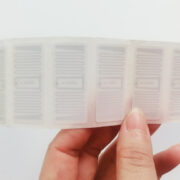
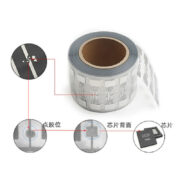
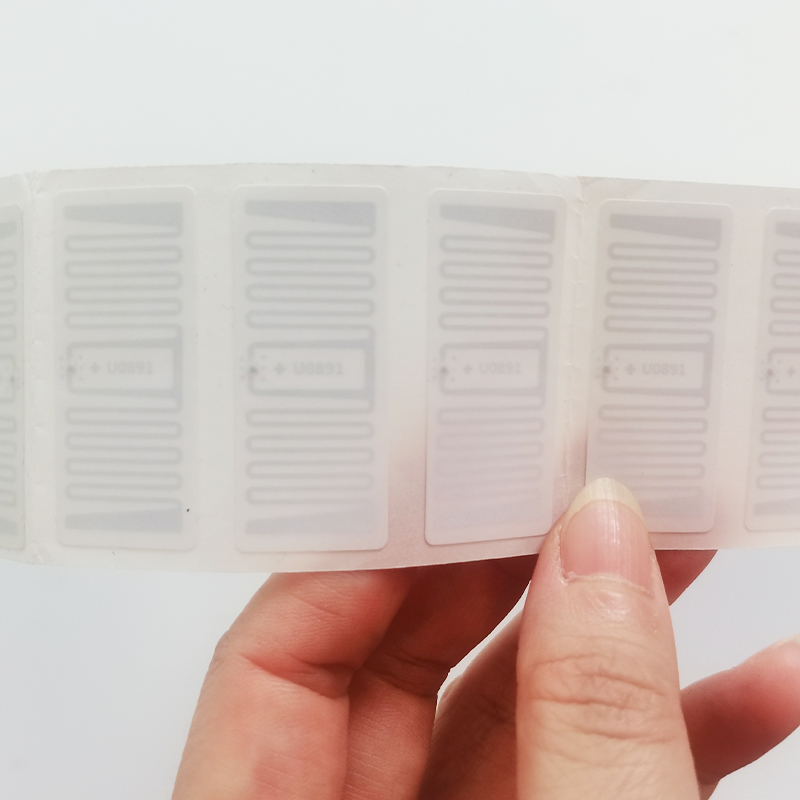
RFID Tags for Inventory are electronic identification tags attached to products, cartons, pallets, containers, or assets so that their identity can be captured using RFID readers.
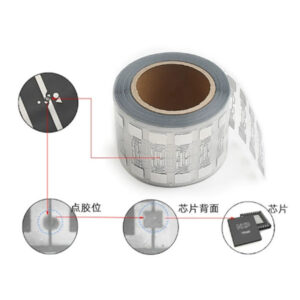
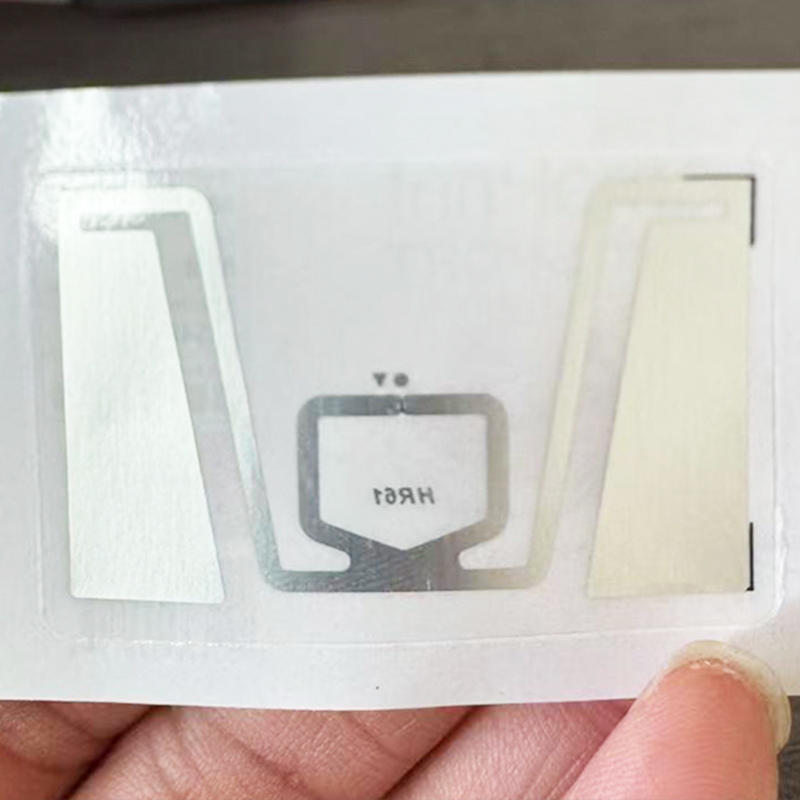
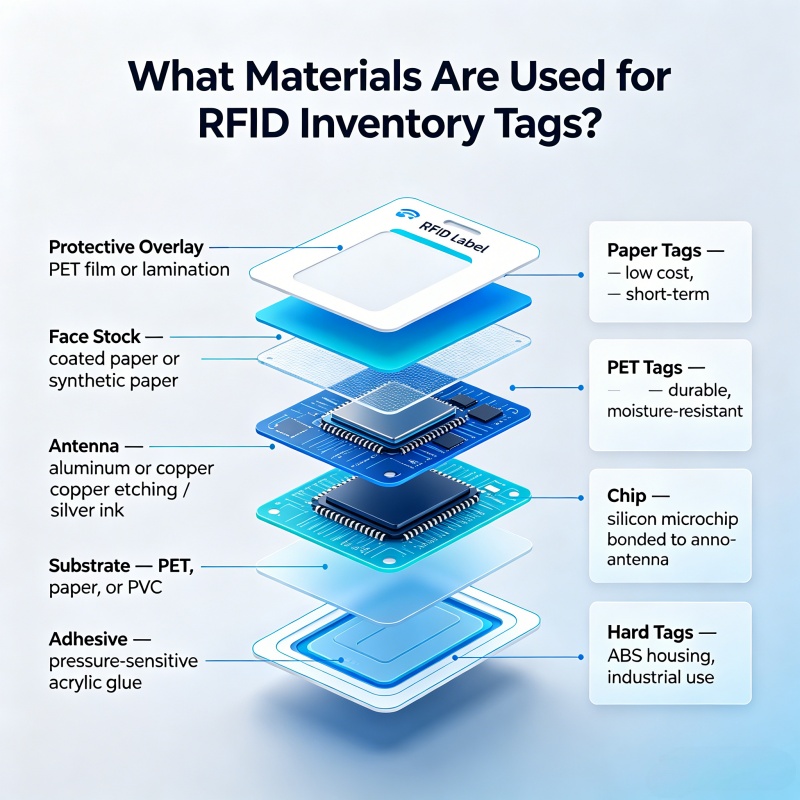
A typical passive RFID tag consists of:
- RFID chip
- Antenna
- Inlay
- Substrate
- Adhesive
- Protective layer, depending on the application
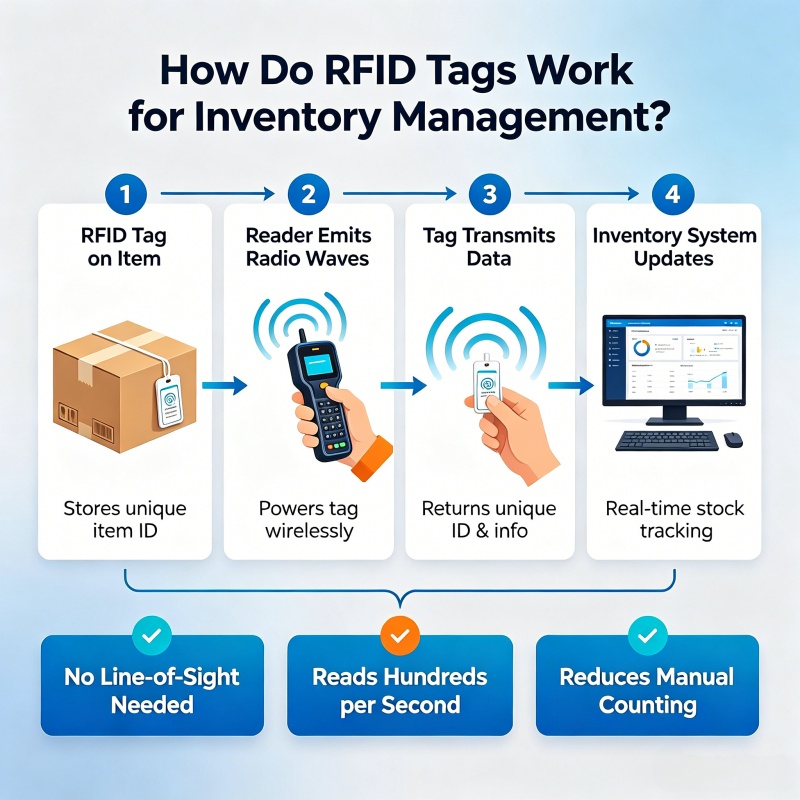
In a typical passive RFID system, the reader sends a radio signal that provides operating energy to the tag. The tag responds by backscattering information to the reader. GS1 describes this reader-and-tag architecture as the foundation of passive UHF RFID deployments.
The information associated with a tag may include a unique identifier such as an EPC, which can then be linked to product information in an inventory, warehouse management, ERP, or other business system.
This means an RFID tag does not necessarily need to store the entire product database. Instead, its unique identification can act as the bridge between the physical product and digital inventory record.
How Do RFID Tags Work for Inventory Management?
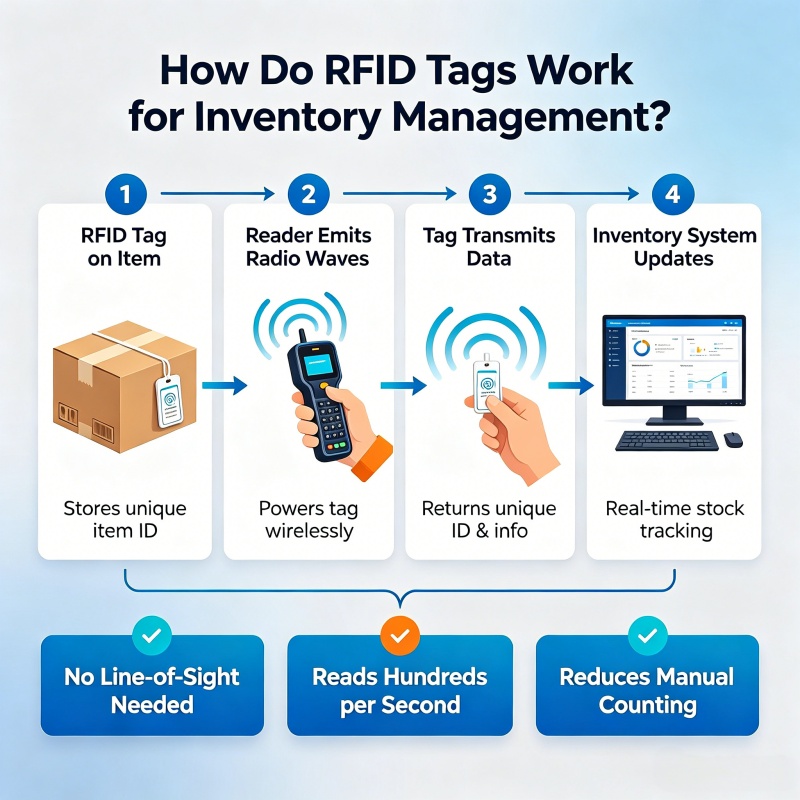
A basic RFID inventory workflow looks like this:
RFID Tag → RFID Reader → Data Capture → Inventory Software → Inventory Database
Here is how the process works.
Step 1: Attach the RFID Tag
The tag is attached to the:
- Product
- Box
- Carton
- Pallet
- Container
- Equipment
- Asset
Step 2: Assign an Identification Number
Each item can receive a unique identification value.
Depending on the system, this may be associated with information such as:
- SKU
- Product ID
- Serial number
- Batch
- Lot
- Asset number
GS1’s EPC standards provide standardized approaches for encoding identifiers used for physical objects and supply-chain processes.
Step 3: RFID Reader Sends a Signal
A fixed or handheld RFID reader communicates with tags within its reading zone.
Step 4: Tags Respond
Passive tags use energy from the reader’s signal and return their identification information.
Step 5: Software Processes the Data
The captured information can be transferred into an inventory or warehouse system.
This can help businesses monitor:
- What products are in stock
- What products entered a warehouse
- What products left a facility
- Which items require replenishment
- Where tagged assets were last detected
RFID therefore connects physical inventory with digital records rather than simply replacing a printed label.
What Inventory Problems Can RFID Tags Solve?
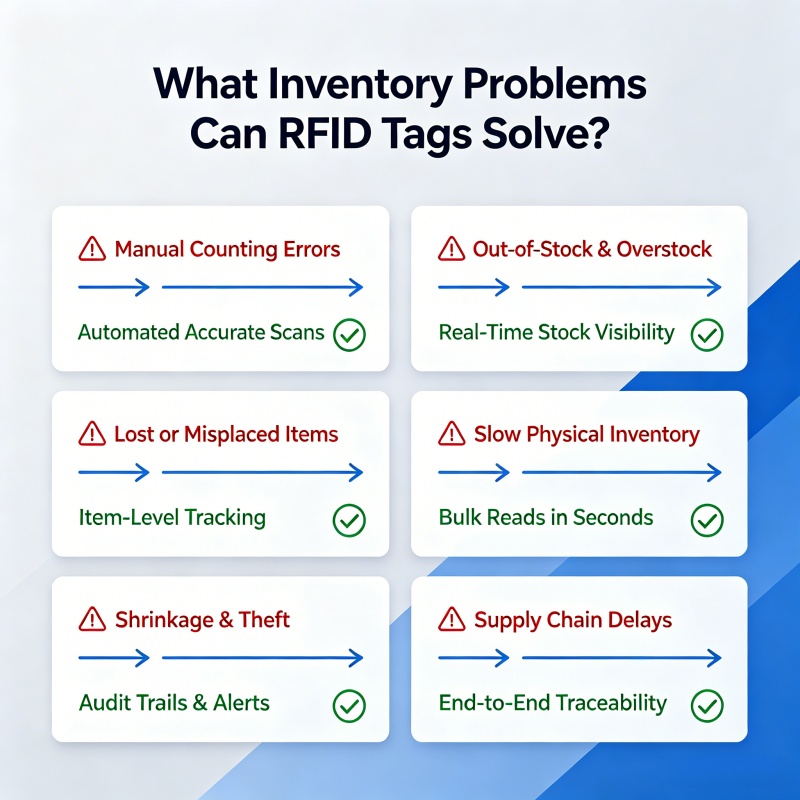
The strongest reason to implement RFID is not the technology itself. It is the operational problem the technology solves.
Manual Inventory Counting
Traditional inventory counting can require employees to scan products individually or manually count stock.
RFID can automate more of the data-capture process and allow multiple nearby tags to be identified during a reading event. GS1 notes that RAIN RFID can capture tags without the direct line of sight required by optical barcode scanning.
Barcode Line-of-Sight Limitations
A barcode scanner generally needs to visually access the barcode.
RFID does not use optical scanning in the same way.
This means a reader can potentially identify tags when they are:
- Inside cartons
- On stacked products
- Moving through a doorway
- Within a pallet
- In storage locations
The actual performance still depends on tag design, reader configuration, product materials, tag orientation, and the environment.
Inventory Accuracy
Manual data entry and scanning processes can introduce errors.
Automated RFID data capture can help reduce some manual handling and improve inventory visibility. GS1 US identifies real-time inventory visibility, improved cycle-count accuracy, and operational efficiency among the potential benefits of RFID inventory management.
Slow Warehouse Processes
RFID can be integrated into processes such as:
- Receiving
- Put-away
- Inventory counting
- Picking
- Packing
- Shipping
Fixed readers can also be positioned at locations such as loading docks or conveyor areas to automatically capture tagged items as they pass through the reading zone.
What Types of RFID Tags Are Used for Inventory?
Not every RFID tag is suitable for every inventory application.
The main categories include passive, active, and semi-passive RFID.
Passive RFID Tags
Passive tags do not contain a battery.
They receive operating energy from the RFID reader and respond to the reader’s signal.
Advantages include:
- Lower tag cost
- Small form factors
- Long service life
- Suitable for high-volume tagging
- Widely used in inventory applications
For many warehouse and supply-chain applications, passive RFID is the starting point.
Active RFID Tags
Active RFID tags contain a battery and can support applications requiring longer-range or more persistent tracking.
They may be considered for:
- High-value equipment
- Large assets
- Returnable transport equipment
- Specialized asset tracking
However, active tags generally involve a different cost and system architecture than passive inventory labels.
Semi-Passive RFID Tags
Semi-passive, or battery-assisted, solutions occupy a middle ground and can be appropriate for specialized applications that require additional functionality.
For high-volume product inventory, passive RFID is often the more practical option.
Why UHF RFID Is Popular for Inventory
When search for RFID Tags for Inventory, UHF RFID is often one of the first technologies they encounter.
UHF passive RFID, also called RAIN RFID, is widely implemented in supply-chain and inventory applications. GS1 identifies UHF passive RFID as one of the most broadly implemented RFID technologies for industry applications.
GS1’s EPC Gen2 air-interface standard covers UHF RFID operation, with implementations in the 860–930 MHz range described by GS1; regional frequency allocations can vary.
UHF RFID is attractive for inventory because it can support:
- Longer reading distances
- Fast tag identification
- Multiple-tag reading
- Automated inventory capture
- Warehouse and distribution applications
However, UHF does not automatically mean better.
The right RFID technology depends on:
- Product material
- Reading distance
- Application environment
- Required tag size
- Reader type
- Data requirements
- Regional requirements
RFID Tags for Inventory vs. Barcodes
One of the most important questions for procurement teams is whether RFID is actually worth adopting when barcode technology already works.
The answer depends on the application.
| Feature | RFID | Barcode |
|---|---|---|
| Direct optical line of sight | Generally not required | Usually required |
| Multiple-item identification | Possible | Usually individual scanning |
| Automated reading | Yes | Usually requires scanning action |
| Printing cost | Higher | Lower |
| Infrastructure cost | Higher | Lower |
| Product-level identification | Excellent | Excellent |
| Harsh-environment options | Available | Available |
| Existing ecosystem | Strong | Very mature |
| Best fit | Automation and high-volume tracking | Simple, cost-sensitive identification |
RFID and barcodes do not have to compete.
In many supply chains, they can complement each other. GS1 specifically notes that barcode and RFID can coexist, allowing businesses to maintain familiar barcode processes while adding automated RFID data capture where it creates value.
When Should You Consider RFID?
RFID becomes particularly interesting when your operation involves:
- Large inventory volumes
- Frequent stock counting
- Labor-intensive scanning
- High inventory accuracy requirements
- Multiple warehouse movements
- Automated receiving or shipping
- Item-level traceability
- Real-time or near-real-time visibility requirements
If you only need to identify a few products occasionally, a barcode may remain the more economical choice.
Where Are RFID Tags for Inventory Used?
RFID inventory tracking is applicable across multiple industries.
Warehouse Inventory
Warehouses can use RFID tags for:
- Receiving
- Storage
- Picking
- Cycle counting
- Shipping
RFID readers can be installed at strategic points or used with handheld devices.
Manufacturing Inventory
Manufacturers can tag:
- Raw materials
- Components
- Work-in-progress
- Finished goods
- Returnable containers
This creates greater visibility as products move through production.
Retail Inventory
Retailers can apply RFID tags to:
- Apparel
- Footwear
- Electronics
- Sporting goods
- General merchandise
RFID can help improve item-level inventory visibility between warehouses and stores.
Automotive Inventory
Automotive manufacturers and suppliers can use RFID to track:
- Components
- Spare parts
- Production materials
- Returnable containers
Healthcare Inventory
Potential applications include:
- Medical supplies
- Equipment
- Consumables
- Inventory cabinets
Select the tag and system based on the application’s specific regulatory and environmental requirements.
Food and Packaging
RFID can also support tracking of cases, cartons, and products where appropriate. GS1 US identifies food products as an RFID inventory application and highlights the potential for tracking information such as batch and expiration data.
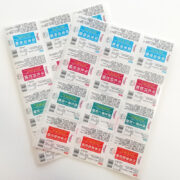
RFID Food Labels
RFID Tags for Pallets, Cartons, and Individual Products
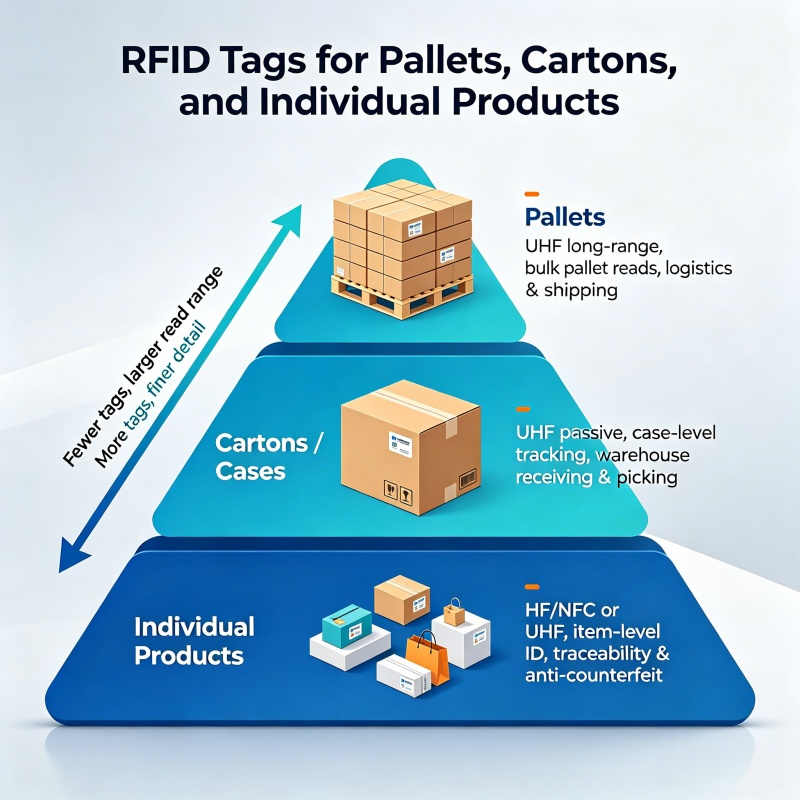
The appropriate RFID tag depends partly on the level at which inventory needs to be tracked.
Item-Level RFID Tags
These are attached to individual products.
They are useful when businesses need detailed item-level visibility.
Carton RFID Tags
A carton tag can identify a shipping or storage unit containing multiple products.
Pallet RFID Tags
Pallet-level tagging can simplify identification of large quantities of goods during:
- Receiving
- Shipping
- Warehouse transfers
- Distribution
A business may use several levels simultaneously.
For example:
Item RFID → Carton RFID → Pallet RFID
This can create a more complete inventory hierarchy when integrated properly with the company’s information systems.
RFID Tags for Inventory on Metal Products
Metal is one of the most important challenges when selecting RFID tags.
A conventional RFID label may not perform as expected when directly attached to metal because the metal surface can affect antenna behavior and RF performance.
For these applications, buyers may need on-metal RFID tags specifically designed for metal surfaces.
Potential applications include:
- Machinery
- Metal components
- Tools
- Industrial equipment
- Automotive parts
- Metal containers
Before placing a large order, test the actual RFID tag on the actual product.
A tag that performs well on a sample sheet of plastic may behave very differently when installed on a steel component.
RFID Tags for Inventory on Plastic Products
Plastic packaging is generally more flexible from an RFID tag-design perspective, but not every plastic product behaves identically.
Factors such as:
- Product geometry
- Plastic type
- Liquid content
- Tag position
- Packaging thickness
can affect performance.
For standard plastic cartons, bottles, containers, and packaging, paper-faced or synthetic RFID labels may be considered depending on durability requirements.
What Materials Are Used for RFID Inventory Tags?
RFID inventory tags can be produced using different face materials and constructions.
Paper RFID Labels
Advantages:
- Cost-effective
- Easy to print
- Suitable for indoor applications
- Appropriate for high-volume tagging
PET RFID Labels
PET offers:
- Better durability
- Moisture resistance
- Dimensional stability
- Suitable performance for demanding environments
PP RFID Labels
PP can provide:
- Flexibility
- Moisture resistance
- Durable surface characteristics
PVC and Specialty Materials
These may be considered for specific industrial applications where the standard paper or synthetic construction does not meet environmental requirements.
Select the right material based on the actual operating environment, rather than simply choosing the most durable material available.
How Far Can RFID Inventory Tags Be Read?
There is no single universal read-range number.
Actual RFID performance depends on:
- RFID frequency
- Reader output
- Reader antenna
- Tag antenna design
- Tag orientation
- Product material
- Metal
- Liquid
- Environmental interference
- Tag placement
GS1 notes that RAIN RFID can achieve reading distances well beyond 10 meters in suitable implementations, but that does not mean every RFID tag will achieve that distance in every application.
For procurement purposes, the better question is:
What read range do I need in my actual operating environment?
A warehouse door, conveyor, shelf, pallet, and handheld inventory count may all require different RFID configurations.
What Information Can RFID Inventory Tags Store?
The exact data structure depends on the chip and system.
An RFID tag may contain or be associated with:
- EPC
- Product ID
- Serial number
- Batch information
- Lot information
- Other application-specific data
GS1 EPC standards provide structured approaches for identifying products and other objects within business processes.
For many inventory applications, the tag does not need to contain every piece of product information.
Instead:
RFID ID → Inventory Database → Complete Product Record
This architecture can make the system more scalable and easier to integrate with existing business software.
RFID Inventory Tag Cost: What Determines the Price?
For standard passive UHF RFID inventory labels, current 2026 market references commonly place high-volume pricing around US$0.05–$0.15 per tag, while printed or customized labels can be around US$0.08–$0.25+. Specialized on-metal or rugged RFID tags can cost significantly more, often US$0.50–$2.00+ per tag depending on construction
There is no universal price for an RFID inventory tag.
The final cost depends on the complete construction.
Important factors include:
- RFID chip
- Memory capacity
- Antenna design
- Tag size
- Face material
- Adhesive
- Printing
- Encoding
- Protective coating
- Waterproofing
- On-metal construction
- Order quantity
- Packaging requirements
For high-volume projects, select the RFID chip and tag construction based on the actual application rather than simply choosing the cheapest available tag.
A slightly higher-cost tag can make more economic sense if it provides significantly better read performance and reduces operational problems.
Custom RFID Tags for Inventory
For manufacturers and warehouse operators, standard RFID tags are not always enough.
A custom RFID inventory tag can be developed around the product, application, and existing inventory system.
Customization may include:
Custom Size
Examples include:
- Small product labels
- Medium carton labels
- Large pallet labels
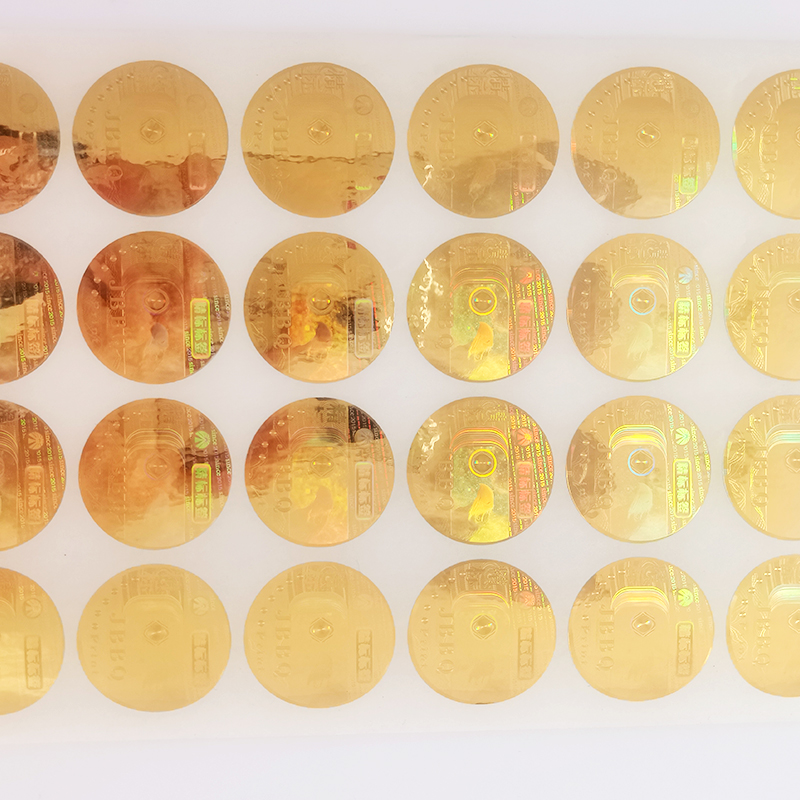
Custom Shape
Options can include:
- Rectangle
- Square
- Circle
- Oval
- Custom die-cut
Custom Material
Possible choices include:
- Paper
- PET
- PP
- PVC
- Specialty industrial materials
Custom Adhesive
The adhesive can be selected for:
- Cardboard
- Plastic
- Glass
- Metal
- Painted surfaces
- Other substrates
Custom Printing
RFID labels can also include:
- Company logo
- Product name
- SKU
- Barcode
- QR code
- Human-readable text
- Serial number
- Variable data
RFID Encoding
Depending on the selected chip and system requirements, tags can be encoded with appropriate identification data before shipment or during deployment.
This can significantly simplify large-scale implementation.
How to Choose the Right RFID Tags for Inventory
Before requesting a quotation, procurement teams should answer the following questions.
1. What Are You Tagging?
Is it:
- Individual products?
- Cartons?
- Pallets?
- Tools?
- Machinery?
- Returnable containers?
2. What Is the Product Material?
Is the surface:
- Cardboard?
- Plastic?
- Glass?
- Metal?
3. What Read Distance Do You Need?
Do you need:
- Short-range identification?
- Handheld inventory counting?
- Conveyor reading?
- Portal reading?
4. What Environment Will the Tag Face?
Consider:
- Water
- Humidity
- Chemicals
- Heat
- Cold
- UV
- Abrasion
5. How Many Tags Will You Purchase?
Quantity can influence the most economical tag construction.
6. Do You Need Printing?
If yes, specify:
- Logo
- Barcode
- QR code
- Text
- Variable information
7. Do You Need Encoding?
If tags must arrive pre-encoded, provide the required data structure.
8. What Software Will Receive the Data?
The RFID system may need to connect with:
- WMS
- ERP
- Inventory software
- Manufacturing software
- Retail systems
This information allows the RFID tag manufacturer to recommend a more appropriate solution.
RFID Tags Are Only One Part of an Inventory System
An RFID tag alone does not create an automated inventory management system.
A complete solution may include:
RFID Tags + Readers + Antennas + Middleware + Inventory Software + Database
Depending on the project, it may also include:
- Handheld readers
- Fixed readers
- Portal readers
- Conveyor readers
- RFID printers/encoders
- WMS integration
- ERP integration
This distinction is important for buyers.
If your goal is automated inventory management, purchasing tags should start the technical evaluation, not end it.
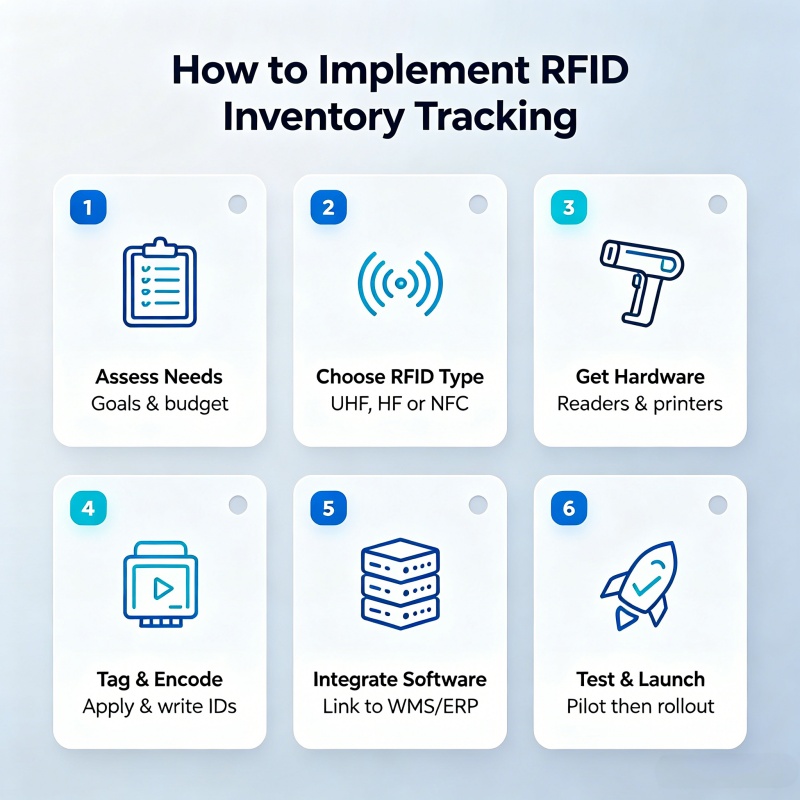
How to Implement RFID Inventory Tracking
A successful RFID project should normally begin with a defined use case.
Step 1: Identify the Inventory Problem
For example:
“Our warehouse requires too much labor for monthly inventory counting.”
Step 2: Define the Target
Possible goals include:
- Faster stock counting
- Better inventory visibility
- Reduced manual scanning
- Improved receiving accuracy
Step 3: Select the RFID Technology
Evaluate:
- Passive vs. active
- UHF vs. HF
- Standard vs. on-metal
Step 4: Select the RFID Tag
Consider:
- Chip
- Antenna
- Size
- Material
- Adhesive
- Printing
Step 5: Test on Actual Products
This is one of the most important steps.
Do not test only the loose RFID label.
Test:
RFID Tag + Actual Product + Actual Reader + Actual Environment
Step 6: Run a Pilot
A limited pilot can help determine:
- Read performance
- Tag placement
- Process changes
- Software integration
- Operational benefits
Step 7: Scale the System
After validating the pilot, expand the system to additional products, warehouses, production lines, or distribution locations.
Common Problems With RFID Inventory Systems
RFID is powerful, but it is not magic.
Tags Are Not Being Read
Possible causes include:
- Incorrect tag design
- Metal interference
- Liquid interference
- Poor tag placement
- Reader configuration
- Antenna positioning
Read Range Is Too Short
Possible causes include:
- Inappropriate antenna design
- Low reader output
- Tag orientation
- Product material
- RF interference
Adhesion Failure
The adhesive may be unsuitable for:
- Plastic
- Metal
- Moisture
- Temperature
- Surface contamination
Duplicate or Missing Reads
These can result from:
- Reader configuration
- Tag placement
- Multiple readers
- RF environment
- Software logic
This is why application testing is more valuable than relying solely on a product datasheet.
Why RFID Inventory Projects Should Start With a Pilot
A pilot project allows a business to answer the questions that specifications alone cannot fully answer.
For example:
- Can the reader detect the tag through our packaging?
- Does the tag work on our metal products?
- What happens when 50 or 100 tags are in the same reading zone?
- Does the warehouse environment affect read performance?
- Is the tag adhesive strong enough?
- Can our software process the captured data?
GS1 also recommends evaluating the specific use case when deciding between barcode and RAIN RFID, including inventory volume, labor requirements, accuracy requirements, and whether line-of-sight scanning is practical.
A successful pilot provides evidence before the company commits to a large-scale RFID rollout.
Custom RFID Tags for Inventory From a Professional Manufacturer
Perfect Label provides custom RFID Tags for Inventory for manufacturers, warehouse operators, distributors, retailers, and brands that need product-level or asset-level identification.
Custom solutions can be developed according to:
- RFID frequency
- RFID chip
- Antenna design
- Tag size
- Material
- Adhesive
- Printing
- Encoding
- Barcode or QR code requirements
- Application environment
Possible products include:
- UHF RFID inventory labels
- RFID warehouse tags
- RFID carton labels
- RFID pallet tags
- On-metal RFID tags
- RFID asset tags
- Custom RFID stickers
- Printable RFID labels
For procurement teams, the goal is not simply to purchase an RFID tag at the lowest unit price. The objective is to obtain a tag that performs consistently on the actual product and supports the intended inventory process.
Perfect Label can support customization from initial specifications and sample development through volume production.
RFID Tags for Inventory: Key Benefits and Limitations
Main Benefits
RFID can provide:
- Reduced reliance on manual scanning
- No optical line-of-sight requirement
- Faster data capture
- Multiple-tag identification
- Improved inventory visibility
- Better automation potential
- Integration with supply-chain processes
These advantages are particularly relevant in high-volume inventory environments. GS1 identifies visibility, inventory accuracy, and operational efficiency as key potential benefits of RFID.
Important Limitations
RFID also has limitations.
These include:
- Higher initial system costs than basic barcode systems
- Product materials can affect performance
- Metal and liquids can create challenges
- Readers and antennas require proper configuration
- Software integration may be necessary
- Not every inventory application justifies RFID
Therefore, the best strategy is not:
Replace every barcode with RFID.
Instead:
Use RFID where automated identification creates measurable operational value.
FAQ About RFID Tags for Inventory
What are RFID Tags for Inventory?
RFID Tags for Inventory are electronic identification tags attached to products, cartons, pallets, or assets so RFID readers can capture their identification information without conventional optical barcode scanning.
How do RFID tags help with inventory management?
They can automate parts of inventory identification and data collection, helping businesses improve visibility, speed up counting, and reduce some manual scanning activities.
Are RFID tags better than barcodes for inventory?
Not always. RFID can be advantageous for high-volume or automation-focused applications, while barcodes remain highly cost-effective for many simple identification tasks. The right choice depends on the application.
What type of RFID is best for warehouse inventory?
Passive UHF/RAIN RFID is commonly considered for warehouse and supply-chain inventory because it supports fast tag identification and can read multiple tags without direct optical line of sight.
Can RFID inventory tags be used on metal?
Yes, but conventional RFID labels may not perform properly when directly attached to metal. On-metal RFID tags are designed specifically for these applications and should be tested on the actual product.
How far can RFID inventory tags be read?
Read range varies significantly. It depends on the tag, reader, antenna, orientation, product material, and environment. Some RAIN RFID implementations can achieve distances beyond 10 meters, but actual performance must be validated in the intended application.
Can RFID tags be customized?
Yes. Customization can include chip selection, size, shape, material, adhesive, printing, encoding, barcode, QR code, and packaging.
Do RFID inventory tags require batteries?
Passive RFID tags do not require their own batteries. They obtain operating energy from the reader’s radio signal. Active RFID tags, by contrast, use a battery.
Can RFID tags include barcodes?
Yes. RFID labels can be printed with human-readable information and optical barcodes or QR codes, allowing companies to maintain both RFID and barcode identification within the same labeling system.
Should I test RFID tags before placing a large order?
Absolutely. Testing should ideally be performed on the actual product, using the intended reader and representative operating environment. This is especially important for metal, liquid, high-density packaging, and industrial applications.
Final Thoughts
RFID Tags for Inventory can transform the way businesses identify, count, and track physical inventory, particularly when manual scanning has become too slow or labor-intensive.
The biggest advantage of RFID is not simply that it uses radio waves. Its value comes from enabling businesses to capture product identity with less manual intervention and without the same line-of-sight limitations associated with optical barcode scanning.
For many warehouse and supply-chain applications, passive UHF/RAIN RFID is a strong technology to evaluate. But the right tag depends on the product, environment, reading distance, required durability, and system architecture.
Before purchasing, define:
What are you tagging? → Where will it be used? → What material is the product? → How far must it be read? → What data must be captured? → How will the RFID system connect to your inventory software?
Then test the complete solution before scaling.
For manufacturers, distributors, retailers, and warehouse operators looking for custom RFID Tags for Inventory, Perfect Label can develop RFID labels and tags around specific product materials, environmental conditions, printing requirements, encoding needs, and inventory workflows.
The best RFID inventory project is not the one with the most advanced tag. It is the one where the tag, reader, software, and inventory process work together reliably.

Jgs is a custom labeling professional with 15 years of industry experience in labeling solutions.